
For trade professionals and serious DIYers, selecting a tool that consistently avoids stalled motors and stripped fasteners during heavy-duty construction is a persistent challenge. While standard drill-drivers and traditional mains-powered rotary drills offer baseline utility, they often fall short under continuous, high-torque demands.
Transitioning to a dedicated impact driver grants users the precise combination of rotational force and concussive blows required to sink fasteners effortlessly. However, utilizing this tool effectively stipulates a firm grasp of torque control; without proper handling, these high-RPM machines can easily shear heads off standard screws. This is particularly true when executing demanding applications, such as driving heavy-duty 6-inch structural lag screws into pressure-treated lumber.
This guide analyzes the critical differences between corded and cordless impact drivers, evaluating duty cycles, torque consistency, and mobility to help you select the ideal tool for your specific fastening requirements.
| Factor | Summary |
|---|---|
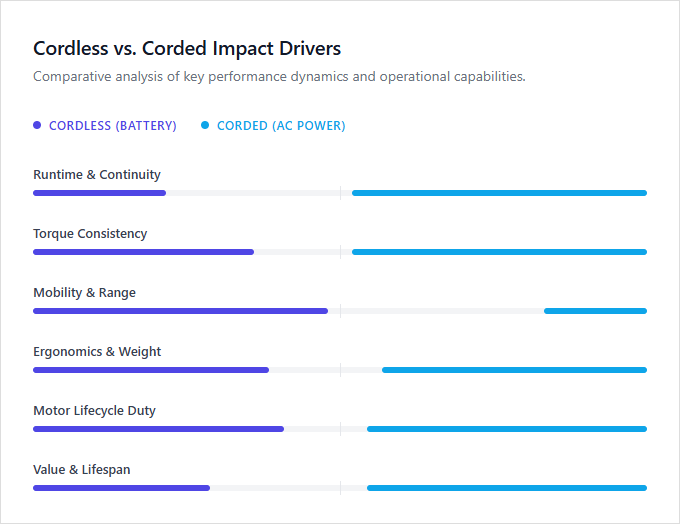
| Power Source & Runtime | Cordless impact drivers rely on rechargeable lithium-ion battery packs measured in Ampere-hours (Ah), whereas corded models draw continuous alternating current (AC) power directly from an electrical outlet, offering unlimited runtime. |
| Torque & Power Output | Corded impact drivers deliver highly consistent torque and rotational force due to a stable voltage supply, while cordless models may experience a drop in fastening torque as the battery voltage depreciates during use. |
| Mobility & Portability | Cordless impact drivers offer superior maneuverability and access to tight spaces free from cord restrictions, whereas corded models are limited by the physical length of the power cord and proximity to an electrical mains outlet. |
| Weight & Ergonomics | Corded tools are generally lighter and reduce user fatigue because they lack a heavy onboard battery, though cordless tools often feature better center-of-gravity ergonomics. |
| Motor Technology & Durability | Cordless units frequently utilize advanced brushless motors to optimize battery efficiency, while corded impact drivers often employ robust brushed motors designed for continuous, high-duty-cycle operation. |
| Cost & Longevity | Corded impact drivers typically have a lower initial purchase price and longer operational lifespan because they do not require expensive replacement lithium-ion batteries that degrade over time. |
Continuous amperage versus battery voltage drop-off under sustained heavy loads
Corded impact drivers draw continuous amperage directly from the electrical grid, ensuring consistent torque and speed throughout prolonged applications. This constant power supply eliminates the risk of performance degradation during demanding tasks. In contrast, cordless alternatives rely on battery chemistry, which is susceptible to voltage drop-off under sustained heavy loads. As battery capacity depletes, internal resistance rises, resulting in a gradual decline in maximum driving power.
While advanced lithium-ion technology mitigates this drop-off with sophisticated thermal management, corded units remain superior for relentless, uninterrupted fastening. Mobile contractors and service technicians benefit most from the agility and portability of cordless models, whereas stationary shop fabricators and heavy-timber builders require the endless, unyielding endurance of corded tools.
Brushless motor technology in cordless tools for optimized power-to-weight ratio
When selecting an impact driver, the choice between corded and cordless models depends on your specific operational requirements. Corded impact drivers provide uninterrupted power and consistent torque, eliminating concerns over battery runtime during prolonged, stationary tasks.
Cordless impact drivers offer unmatched portability, driven by advancements in brushless motor technology. By eliminating physical carbon brushes, these modern motors drastically reduce internal friction and heat buildup. This engineering efficiency results in an optimized power-to-weight ratio, delivering maximum torque and extended battery runtime within a highly compact, lightweight frame.
Corded models are ideal for workshop-based professionals requiring continuous, heavy-duty output, while cordless brushless drivers are best suited for mobile contractors and DIY enthusiasts prioritizing maneuverability across diverse job sites.
Breakaway torque and fastening torque limits measured in Newton-meters
Modern cordless impact drivers deliver exceptional performance, frequently achieving fastening torque limits up to 220 Nm and breakaway torque capabilities exceeding 300 Nm. Powered by advanced brushless motors and high-voltage battery technology, these tools provide temporary bursts of extreme power. In contrast, corded impact drivers offer a highly consistent power supply, typically maintaining a stable fastening torque limit between 150 Nm and 180 Nm. While corded units may lack the peak breakaway thresholds of top-tier cordless alternatives, they deliver sustained, reliable output without the risk of voltage drop.
Selecting the appropriate platform depends on specific operational environments and user needs. Cordless models are highly suited for mobile contractors requiring maximum portability and high peak torque on dynamic job sites, while corded units are ideal for dedicated workshop technicians who require continuous, uninterrupted runtime.
Impact Rate and Rotational No-Load Speed
When selecting an impact driver, evaluating the relationship between rotational no-load speed (RPM) and impact rate, measured in blows per minute (BPM), is essential. Corded impact drivers deliver consistent, high-velocity performance, maintaining peak RPM and BPM without degradation due to their direct connection to a continuous power source. Cordless models utilize advanced brushless motors and high-voltage lithium-ion batteries to match these performance metrics, offering impressive fastening speeds alongside the benefit of variable speed control.
The synergy between high RPM and rapid BPM ensures efficient driving of large fasteners into dense substrates. Corded units excel in sustained, high-torque applications where power drops are unacceptable, while modern cordless options provide the high-performance specs needed without the restriction of a tether. Corded models are ideal for stationary workshop fabricators requiring uninterrupted endurance, whereas cordless versions suit mobile contractors and residential renovators who prioritize portability and overhead maneuverability.
Corded Duty Cycle vs. Cordless Thermal Throttling
When selecting between corded and cordless impact drivers, power delivery under prolonged use is a critical differentiator. Corded impact drivers offer an unlimited duty cycle, drawing continuous electricity directly from the grid to sustain high-torque performance without interruption. Conversely, cordless models rely on lithium-ion batteries that are susceptible to thermal throttling; heavy, continuous fastening tasks generate significant heat, forcing internal battery management systems to reduce power output or temporarily shut down to prevent cell damage.
This operational contrast dictates which tool is best suited for specific work environments. High-volume industrial fabricators and workshop assembly specialists benefit most from the unfailing endurance of a corded system, whereas mobile contractors and DIY enthusiasts requiring maximum portability are ideal candidates for cordless versatility.
High-Torque Socket Anvil Retention Mechanisms
Cordless and corded impact drivers differ in mobility and sustained power, which directly influences how they utilize anvil retention mechanisms. High-torque socket applications require secure anvil connections, typically achieved via friction rings or detent pins. Friction rings allow for rapid, tool-free socket changes, making them highly efficient for dynamic, multi-size fastening tasks. Detent pins provide a semi-permanent, locked connection that prevents sockets from detaching under extreme vibration, though they require a pin tool for release.
Cordless models offer the portability needed for agile, on-the-go socket swaps, while corded units deliver relentless power suited for stationary, heavy-duty applications. Mobile automotive technicians benefit most from versatile cordless drivers with friction rings, whereas industrial fabrication workers require the unwavering power of corded drivers equipped with secure detent pins.
How Battery Capacity Dictates Peak Discharge Rates
When comparing cordless and corded impact drivers, power delivery mechanisms represent the primary differentiator. In cordless models, the battery's Amp-hour (Ah) capacity directly dictates the maximum current discharge rate, which is critical for achieving peak torque. High-Ah batteries feature more parallel cell configurations that lower internal resistance, allowing the motor to draw the massive current required for heavy-duty driving tasks. Corded impact drivers, by contrast, rely on a constant AC power supply to deliver sustained, high-torque performance without the power degradation associated with draining batteries.
While cordless units provide superior mobility, their peak output is inherently bound to the battery's state of charge and capacity. High-volume, stationary fabricators requiring relentless, uninterrupted power are best suited for corded impact drivers, whereas service technicians and residential contractors prioritizing portability and multi-angle accessibility will find high-Ah cordless systems more appropriate for their daily workflows.
Leave a comment