
For industrial operators and shop managers, matching the right fastening tool to high-demand applications is a persistent challenge; relying on inadequate rotational torque inevitably leads to stripped fasteners, stalled workflows, and costly project delays. Typically, addressing these operational bottlenecks involves analyzing standard equipment funding sources to secure high-capacity machinery.
However, selecting the correct power tool platform grants assembly teams the precise torque density needed to optimize output without overextending capital. The essential stipulation to manage expectations is that raw rotational power must always be balanced against facility infrastructure and utility costs. For example, in structural steel fabrication and heavy-duty fleet maintenance, the utility of the tool dictates daily production rates.
This article provides an executive comparison of pneumatic and cordless impact drivers. We will evaluate their rotational torque capabilities, duty cycles, and total cost of ownership to help you select the optimal system for your high-torque applications.
| Factor | Summary |
|---|---|
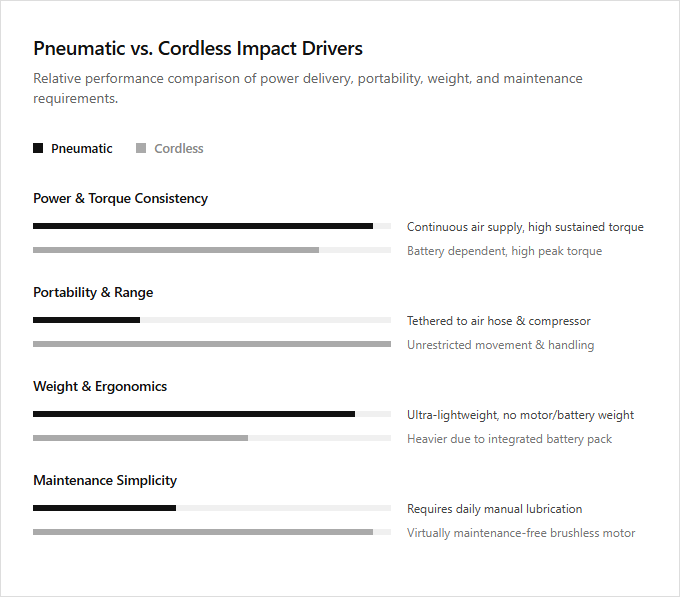
| Power Source | Pneumatic impact drivers rely on a continuous supply of compressed air from an external compressor, whereas cordless models utilize rechargeable lithium-ion battery packs. |
| Torque Output | Pneumatic drivers generally deliver higher, sustained torque-to-weight ratios, while cordless drivers rely on brushless DC motors to achieve high peak torque. |
| Portability | Cordless impact drivers offer superior maneuverability and unrestricted range of motion, whereas pneumatic tools are limited by the physical reach of air hoses. |
| Weight & Ergonomics | Pneumatic tools are significantly lighter because they lack an internal motor and heavy battery, which reduces operator muscle fatigue. |
| Maintenance | Pneumatic drivers require daily lubrication with specialized pneumatic oil, while cordless models are virtually maintenance-free due to sealed brushless motor enclosures. |
Sustained torque-to-weight ratio of pneumatic rotary vane motors
When comparing pneumatic and cordless impact drivers, the motor design dictates long-term performance. Pneumatic impact drivers utilize air-powered rotary vane motors, which deliver an exceptional, sustained torque-to-weight ratio. Because these tools lack heavy internal batteries and complex electrical windings, they maintain peak torque output indefinitely without thermal degradation or power fade during continuous, high-duty cycle fastening operations.
In contrast, cordless impact drivers offer unmatched portability. While modern brushless motors provide impressive peak torque, they are subject to thermal limits and gradual power decline as the battery drains. Industrial assembly line workers and automotive mechanics requiring relentless, lightweight power benefit most from pneumatic systems, whereas mobile contractors and utility technicians are better suited for the cord-free mobility of cordless models.
Voltage sag prevention in high-capacity lithium-ion batteries
Pneumatic impact drivers offer consistent torque derived from a continuous compressed air supply, bypassing the power degradation issues inherent to battery-operated systems. In contrast, cordless impact drivers rely on advanced lithium-ion battery packs. To combat voltage sag during high-load applications, modern cordless units utilize high-capacity cells with low internal resistance and sophisticated electronic monitoring to maintain stable, efficient power delivery.
This technological integration allows cordless models to deliver near-constant performance that closely rivals pneumatic efficiency under heavy duty cycles. Stationary industrial assemblers requiring limitless, uniform power benefit most from pneumatic systems, whereas mobile contractors needing high-torque versatility without hose restrictions are ideal candidates for high-capacity cordless tools.
Continuous SCFM and PSI requirements for stable pneumatic output
Pneumatic impact drivers offer an exceptional power-to-weight ratio but require a dedicated air infrastructure to function efficiently. To ensure a stable torque output and prevent tool degradation, these air-powered tools typically demand a continuous supply of 4 to 5 SCFM (Standard Cubic Feet per Minute) at a consistent pressure of 90 PSI. In contrast, cordless impact drivers leverage high-capacity lithium-ion batteries to deliver comparable torque, bypassing the need for hoses and loud compressors entirely.
Selecting the appropriate tool depends heavily on your workspace environment and operational demands. Pneumatic impact drivers are best suited for industrial assembly lines and automotive mechanics working in fully equipped bays, whereas cordless impact drivers are the ideal choice for mobile contractors and residential DIYers who prioritize portability and rapid deployment.
Electronic clutch calibration in brushless DC motor cordless drivers
Pneumatic impact drivers rely on constant compressed air for torque delivery, offering high power-to-weight ratios but limited on-tool adjustment. In contrast, modern cordless impact drivers utilize brushless DC (BLDC) motors paired with advanced electronic clutch calibration. This digital regulation allows users to program precise torque limits and rotational speeds via microprocessors, preventing fastener stripping and material damage through real-time motor current monitoring.
This electronic feedback represents a significant evolution from the mechanical bypass valves of traditional pneumatic systems. While air-powered tools excel in continuous-duty industrial environments, cordless models provide unmatched portability and adaptive performance. High-volume automotive assembly technicians favor the relentless, consistent power of pneumatic drivers, whereas mobile contractors and precision installers benefit most from the highly customizable control of brushless cordless systems.
Thermal overload vulnerability during extended duty cycles
Pneumatic impact drivers rely on compressed air, meaning they generate virtually no heat within the tool itself during prolonged use. The continuous air expansion actually cools the tool, making pneumatic systems highly resistant to thermal overload during extended duty cycles. In contrast, cordless electric impact drivers house internal motors and lithium-ion battery packs that generate substantial heat under sustained loads. Without adequate cooling periods, cordless models risk thermal shutdown or permanent component degradation from heat buildup.
While cordless options offer unmatched portability, their duty cycles must be monitored to prevent overheating during heavy-duty applications. High-volume industrial assembly mechanics require the heat-resistant endurance of pneumatic drivers, whereas mobile contractors and service technicians benefit most from the cordless variety's untethered convenience.
Planetary gear reduction efficiency versus direct air-drive mechanisms
Cordless impact drivers rely on electric brushless motors paired with complex planetary gear reduction systems to multiply torque. This mechanical gear configuration allows for precise speed modulation, though it introduces minor frictional energy losses and heat buildup during extended use. Conversely, pneumatic impact drivers utilize a direct air-drive mechanism, where high-pressure compressed air acts directly upon the rotor vanes. This streamlined design eliminates the need for heavy gear trains, resulting in a superior power-to-weight ratio and virtually continuous operation without thermal degradation.
The choice between these drive mechanisms depends on the specific demands of the workspace. Highly mobile cordless models are best suited for field contractors and tradespeople requiring portability, whereas pneumatic tools are the standard choice for automotive technicians and industrial assembly workers who demand relentless, lightweight power within a stationary workshop equipped with a central air compressor.
Anvil rotational inertia and impacts per minute under peak load
Pneumatic impact drivers rely on a continuous compressed air supply, maintaining a highly consistent rate of impacts per minute (IPM) even under peak loads. Their lightweight internal design minimizes anvil rotational inertia, allowing the tool to reach maximum velocity almost instantly. In contrast, cordless impact drivers utilize battery-powered electric motors. While their IPM can decay under sustained peak loads as battery charge depletes, their heavier anvil assemblies generate superior rotational inertia, delivering massive torque per individual blow once momentum is established.
Choosing between these power delivery systems depends on the operational environment. Stationary industrial technicians requiring continuous, rapid fastening favor pneumatic systems, whereas field-based contractors and mobile maintenance professionals benefit most from the portable versatility of cordless models.
Leave a comment