
Every contractor and DIY enthusiast knows the frustration of a sudden metallic snap mid-drive, leaving a sheared screwdriver bit wedged permanently into a ruined workpiece. Traditionally, users rely on standard, off-the-shelf bit sets-the legacy accessories originally designed for low-torque, rotary drills. While these standard options are sufficient for light-duty drilling, they quickly fatigue and fail under the rapid, concussive rotational blows delivered by modern impact drivers.
Upgrading to specialized accessories grants operators unmatched project efficiency and long-term cost savings, particularly during demanding applications like driving heavy-duty structural fasteners into dense ledger boards. However, an important educational stipulation remains: impact-rated durability is not a cure-all and still requires proper user pressure and tool alignment to prevent cam-out.
To help you optimize your toolkit, this guide will examine the key metallurgical differences, torque-absorption engineering, and cost-per-use metrics of both accessory classes, establishing a clear framework for selecting the right bit for your high-torque fastening needs.
| Factor | Summary |
|---|---|
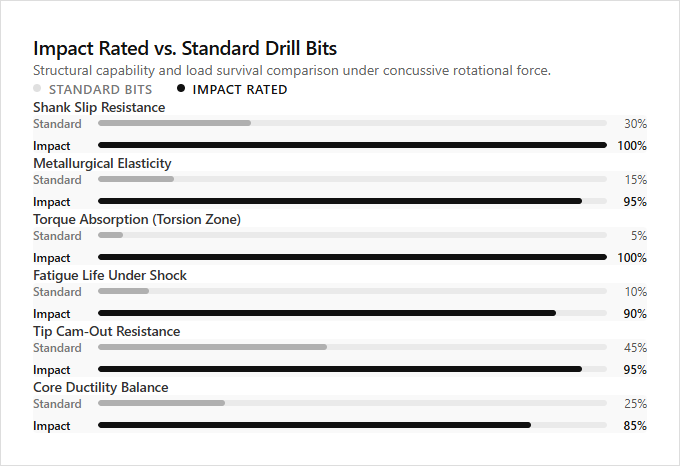
| Shank Design | Impact rated bits feature a standardized 1/4-inch hex shank designed to lock securely into quick-change chucks, preventing the rotational slippage common with round-shank standard bits. |
| Metallurgical Composition | Impact rated bits are forged from proprietary, tempered steel alloys engineered for high elasticity, whereas standard bits are made of rigid high-speed steel that is highly susceptible to brittle fracture. |
| Torsion Zone | A specialized torsion zone in impact rated bits absorbs peak rotational torque by flexing under load, a structural feature absent in standard bits. |
| Failure Mechanism | Under high-torque loads, standard bits typically experience catastrophic shear failure and snap, while impact rated bits are designed to deform elastically before failing. |
| Tip Geometry | Precision-milled tips on impact rated bits minimize cam-out, ensuring a secure fastener fit that standard bits cannot maintain under concussive force. |
| Heat Treatment | Impact rated bits undergo a specialized case-hardening process to optimize the balance between surface hardness and core ductility. |
Torsion zone flexing to prevent shearing under peak torque
When operating high-torque impact drivers, the distinction between impact-rated bits and standard drill bits is critical for performance and safety. Standard bits are highly rigid, making them susceptible to snapping under the sudden, repetitive rotational blows of an impact driver. In contrast, impact-rated bits feature a specialized torsion zone. This engineered, narrowed mid-section actively flexes to absorb peak torque spikes, effectively preventing the bit from shearing or stripping the fastener head.
This elastic deformation zone distributes the stress of high-impact fastening, significantly extending the lifespan of the accessory during demanding tasks. Standard drill bits are best suited for light-duty homeowners performing basic drilling in softwoods with a traditional drill, whereas impact-rated bits are indispensable for contractors and heavy DIYers executing high-torque fastening into dense lumber, masonry, or metal.
Proprietary heat-treated steel alloy for enhanced ductility
When utilizing high-torque impact drivers, the distinction between impact-rated bits and standard drill bits lies primarily in metallurgy. Impact-rated bits are engineered from a proprietary heat-treated steel alloy formulated specifically to enhance ductility. This specialized formulation allows the bit to flex slightly under extreme rotational shock, effectively absorbing high-torque peaks without fracturing. In contrast, standard drill bits are constructed from harder, more brittle steel designed to maintain a sharp cutting edge, but they lack this torsional flexibility and frequently shear under sudden impact forces.
Selecting the correct accessory depends entirely on the application and the user's operational demands. Impact-rated bits are essential for professional contractors and heavy-duty assemblers driving large fasteners into dense materials, while standard drill bits remain highly efficient for general DIY enthusiasts performing precise, low-torque drilling tasks in wood or soft metals.
Precision CNC-machined tips to minimize fastener cam-out
Impact drivers deliver extreme rotational torque, requiring specialized accessories to prevent fastening failures. While standard drill bits are adequate for basic drilling, impact-rated bits are engineered to withstand the concussive forces of impact tools. A key differentiator is the integration of precision CNC-machined tips in impact-rated designs. This precise manufacturing ensures an exact fit into the fastener head, significantly reducing cam-out and preventing damage to the work surface.
Standard bits lack this specialized geometry, often slipping under high load and leading to stripped screws and rapid bit wear. In contrast, the combination of CNC-machined tips and engineered torsion zones in impact-rated bits absorbs peak torque spikes. General DIYers undertaking occasional light drilling projects will find standard bits sufficient, whereas professional contractors and heavy-duty builders require impact-rated bits for high-torque assembly work.
Hexagonal shank design for optimized power transmission in impact chucks
Impact drivers deliver extreme rotational torque, necessitating a specialized connection between the tool and the accessory. Impact-rated bits feature a robust hexagonal shank design that locks securely into the quick-release chuck of an impact driver. This precise geometry ensures optimized power transmission, preventing the bit from slipping under heavy loads while protecting the tool's internal drive mechanism from premature wear.
In contrast, standard drill bits typically utilize cylindrical shanks designed for traditional three-jaw chucks, which can slip when subjected to sudden resistance. Standard bits also lack the engineered torsion zones of impact-rated alternatives, making them highly susceptible to snapping under high-torque demands. Standard round-shank bits are suitable for casual DIYers tackling basic, light-duty drilling in wood or plastic, whereas impact-rated hex bits are essential for trade professionals performing demanding, high-torque fastening into dense materials.
High shear strength to withstand anvil-driven rotational impact forces
Impact drivers operate using a rapid series of anvil-driven rotational impacts that deliver extreme torque. Standard drill bits, constructed from rigid and brittle steel, often shear or shatter under these conditions because they lack the high shear strength required to withstand such violent, sudden forces. In contrast, impact-rated bits are engineered with a specialized torsion zone and flexible steel chemistry designed specifically to absorb and distribute these intense rotational shocks.
Using standard bits in an impact driver leads to premature stripping, breakage, and potential damage to the workpiece. Impact-rated bits endure the rigorous demands of heavy-duty fastening without fracturing, ensuring optimal tool performance and safety on the job. Standard bits are ideal for casual DIYers performing light-duty drilling with traditional drill-drivers, while impact-rated bits are essential for professional contractors and tradespeople executing high-torque fastening applications.
Rockwell C scale hardness optimization balancing wear resistance and toughness
Impact-rated driver bits undergo specialized heat treatment to optimize their Rockwell C scale (HRC) hardness, carefully balancing wear resistance with torsional toughness. By targeting a slightly lower, more ductile HRC rating, these bits can flex under the sudden, violent torque peaks of an impact driver without shearing. Standard drill bits, conversely, are engineered with a higher HRC rating to maximize rigidity and edge retention during continuous rotary drilling, leaving them brittle under concussive forces.
Choosing the correct accessory depends on the application: high-torque construction and fastening tasks require the resilient, shock-absorbing properties of impact-rated bits, while precision metalworking and general woodwork are best suited for specialists utilizing the ultra-hard, wear-resistant profile of standard bits.
Structural fatigue resistance during high-frequency axial vibration
Impact drivers subject accessories to intense rotational impacts and high-frequency axial vibration, demanding specialized metallurgy. Standard drill bits feature a rigid, brittle construction that quickly succumbs to structural fatigue under these cyclic stresses, leading to micro-fractures and catastrophic shearing. Impact-rated bits are engineered with proprietary, tempered steel alloys and a flexible torsion zone designed to actively absorb vibrational shocks, preserving the structural integrity of the shank under continuous stress.
This mechanical distinction dictates the appropriate application for each accessory. Standard bits are ideal for light-duty, precision drilling in soft materials by occasional DIYers, whereas impact-rated bits are indispensable for structural contractors and tradespeople executing high-torque fastening.
Leave a comment