
Many professionals and serious DIYers frequently battle the frustration of stripped fastener heads, snapped screws, or stalled drives, despite using high-end impact drivers.
Traditionally, users rely on standard specifications like battery voltage and maximum torque ratings to guide their tool selection and usage. However, mastering the precise relationship between Revolutions Per Minute (RPM) and Impacts Per Minute (IPM) grants operators unprecedented control, minimizing material damage while maximizing driving speed.
It is important to stipulate that raw power alone does not guarantee success; optimal performance requires aligning these dual metrics with your specific workpiece. For instance, driving structural three-inch lag bolts into dense lumber requires a high-impact, moderate-speed approach, whereas fastening delicate brass hinges demands rapid, low-impact rotation.
In this article, we will demystify how RPM and IPM interact under load, break down their mechanical differences, and provide clear guidelines to help you select the ideal settings for every application.
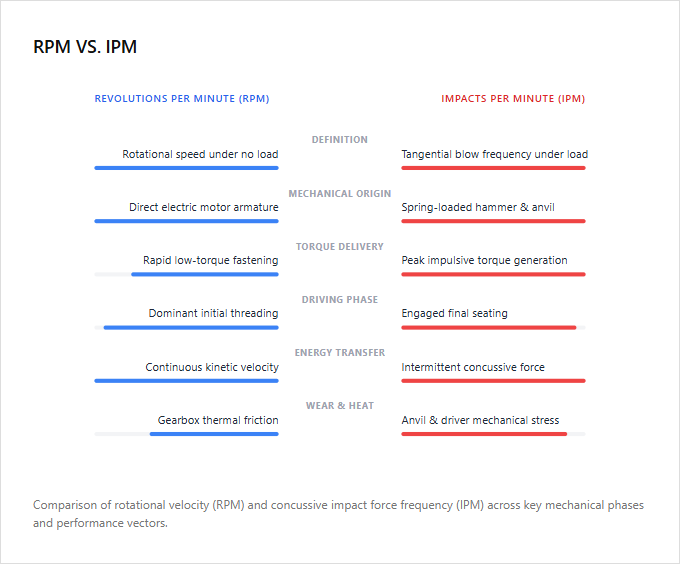
| Factor | Summary |
|---|---|
| Definition | RPM measures the rotational speed of the chuck under no load, whereas IPM quantifies the frequency of tangential blows delivered by the internal hammer-and-anvil mechanism during resistance. |
| Mechanical Origin | RPM is directly driven by the electric motor's armature rotation, while IPM is generated when rotational resistance triggers a spring-loaded impact mechanism. |
| Torque Delivery | High RPM facilitates rapid fastening during low-torque phases, but IPM is essential for generating maximum peak torque to drive fasteners into dense materials. |
| Driving Phase | RPM dominates the initial threading phase of the driving process, whereas IPM engages during the final seating phase when the tool encounters high rotational resistance. |
| Energy Transfer | RPM represents continuous kinetic energy transfer through rotational velocity, while IPM delivers intermittent kinetic energy via concussive force to prevent motor stalling. |
| Tool Wear and Heat | Sustained high RPM generates friction-induced thermal load in the gearbox, while high IPM increases mechanical stress and vibration on the anvil and driver bit. |
RPM dictates the no-load speed of the rotational spindle.
An impact driver operates using two key performance metrics: Revolutions Per Minute (RPM) and Impacts Per Minute (IPM). RPM dictates the no-load speed of the rotational spindle, measuring how rapidly the chuck spins before the tool encounters resistance. This rotational velocity determines the efficiency of initial fastening tasks and is crucial for quickly driving screws through lighter materials.
Once the fastener meets resistance, the internal hammer-and-anvil mechanism engages, transitioning the tool's performance to focus on IPM. IPM represents the frequency of the rapid, concussive rotational blows that deliver the high torque required to seat stubborn fasteners.
Electricians and cabinet makers prioritizing rapid, precision fastening thrive with high-RPM tools, whereas structural carpenters driving heavy lag bolts require high-IPM machinery.
IPM: Measuring Hammer and Anvil Striking Frequency
An impact driver relies on two key metrics to define its performance: Revolutions Per Minute (RPM) and Impacts Per Minute (IPM). While RPM measures the rotational speed of the chuck under no load, IPM indicates the tool's performance under resistance. Specifically, IPM measures the striking frequency of the internal hammer and anvil as they engage to deliver concussive rotational force.
When the tool encounters resistance, the internal mechanism engages, translating motor power into rapid blows. High-RPM models suit finish carpenters and woodworkers prioritizing fast, clean fastening in softer materials, while high-IPM units are ideal for structural builders and automotive technicians demanding maximum torque to drive heavy lag screws into dense mediums.
Concussive IPM: High Torque, Zero Kickback
An impact driver utilizes both Revolutions Per Minute (RPM) and Impacts Per Minute (IPM) to drive fasteners efficiently. While RPM dictates the rotational speed of the tool under light loads, IPM measures the frequency of the internal hammer striking the anvil as resistance increases. This concussive IPM mechanism delivers high peak torque through rapid, localized blows. Crucially, because these impacts occur in split-second bursts, the system prevents the transfer of reactionary torque to the user's wrist.
This unique delivery of force ensures maximum fastening power without the physical strain associated with traditional drills. High-IPM performance is suited for heavy-duty contractors driving large fasteners into dense timber, whereas high-RPM capabilities are ideal for precision assembly workers requiring rapid, light-duty screw driving.
How High IPM Prevents Driver Cam-Out
An impact driver relies on two key metrics to drive fasteners efficiently: Revolutions Per Minute (RPM), which measures rotational speed under no load, and Impacts Per Minute (IPM), which measures the frequency of the tool's internal concussive blows. While high RPM quickly spins a screw into place initially, high IPM becomes critical when the fastener encounters resistance. The rapid, downward force of a high IPM mechanism continuously drives the bit into the screw head, preventing the bit from slipping out. This consistent engagement prevents cam-out, protecting both the fastener and the work surface from damage.
Selecting the right balance between these specifications depends on the specific demands of the project. High-RPM tools are best suited for high-volume cabinet makers who require rapid assembly, while high-IPM tools are ideal for structural framers and steel fabricators who need to drive heavy-duty lag bolts under intense resistance.
How Impact Drivers Convert Rotational Force
An impact driver relies on two key metrics to deliver its performance: Revolutions Per Minute (RPM) and Impacts Per Minute (IPM). While RPM measures the rotational speed of the chuck under no load, IPM defines the frequency of the internal hammer striking the anvil. The driver's internal mechanism converts rotational energy into high-torque, tangential force pulses when the tool encounters resistance, preventing fastener cam-out and reducing user fatigue.
During heavy applications, the spring-loaded hammer spins rapidly until resistance triggers the anvil, releasing stored energy in rapid, concussive rotational blows. High-RPM configurations suit cabinetry installers and woodworkers who require rapid fastening speeds in softer materials, whereas high-IPM models are ideal for automotive technicians and steel fabricators who need maximum concussive force to secure or break loose stubborn fasteners.
High RPM Accelerates Initial Fastening Speed
An impact driver relies on both Revolutions Per Minute (RPM) and Impacts Per Minute (IPM) to secure fasteners efficiently. RPM measures the rotational speed of the chuck under no load, representing the tool's raw velocity. High RPM accelerates initial fastener driving speed before resistance is met, allowing screws to penetrate materials rapidly during the first phase of insertion.
Once the material resists, the internal anvil mechanism engages, shifting the primary force to IPM, which delivers concussive rotational blows to prevent stalling. High-RPM configurations suit cabinet makers and drywall installers who require rapid, repetitive fastening, whereas high-IPM models are ideal for heavy-duty construction workers driving large lag bolts into dense timber.
Brushless RPM/IPM Control for Material-Specific Fastening
An impact driver relies on both Revolutions Per Minute (RPM) and Impacts Per Minute (IPM) to drive fasteners efficiently. RPM dictates the rotational speed of the tool under light loads, while IPM measures the frequency of the physical hammer-and-anvil strikes engaged during high resistance. Modern brushless motor controllers electronically regulate the ratio between these two metrics, dynamically adjusting speed and impact frequency to optimize torque for specific materials.
By manipulating this digital synchronization, the tool prevents over-driving delicate fasteners while delivering maximum force for heavy structural bolts. High-RPM, low-IPM settings serve production woodworkers needing rapid assembly, whereas low-RPM, high-IPM configurations benefit heavy-duty construction carpenters demanding precise control in dense substrates.
Leave a comment