
Selecting the wrong drive interface for high-torque applications often leads to stripped fasteners, sheared adapters, and costly downtime. Industry professionals frequently struggle to maintain efficient energy transfer from the tool motor to the workpiece. While organizations typically address this by allocating standard equipment procurement funding to higher-voltage tools, raw power alone cannot resolve connection-point inefficiency.
Optimizing this connection grants operators direct, lossless torque transfer, unlocking the tool's true mechanical potential. It is important to stipulate, however, that even the most advanced impact wrench underperforms if the drive system is mismatched to the load requirements. For instance, heavy-duty fleet maintenance and structural steel assembly demand a rigid, robust connection that lightweight adapters simply cannot support.
The following analysis provides an executive overview of anvil square drives versus quick-change chuck systems, comparing their torque transfer efficiency, overall durability, and ideal operational applications.
| Factor | Summary |
|---|---|
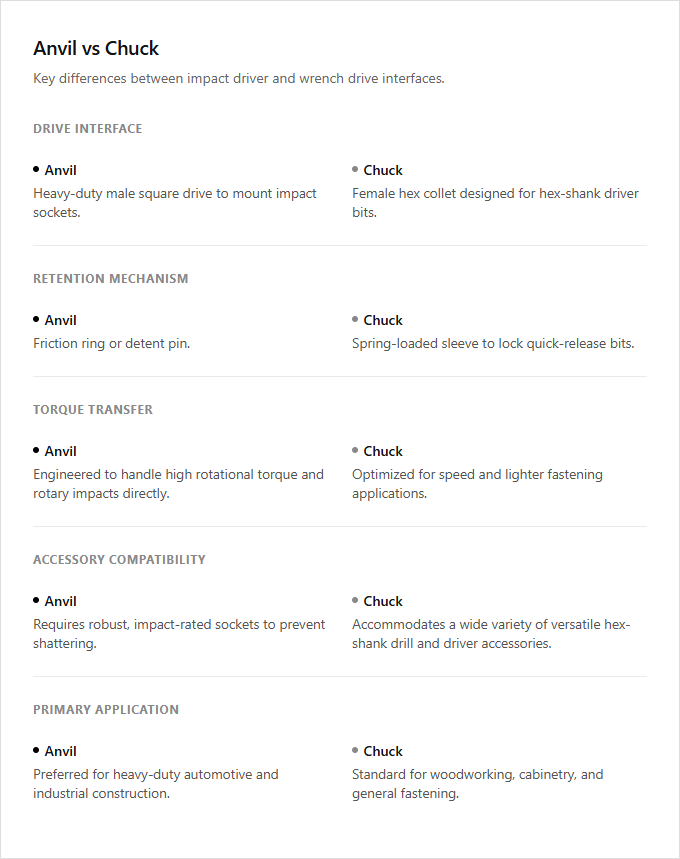
| Drive Interface | Anvils utilize a heavy-duty male square drive to mount impact sockets, whereas chucks typically feature a female hex collet designed for hex-shank driver bits. |
| Retention Mechanism | Anvils secure accessories using a friction ring or detent pin, while chucks employ a spring-loaded sleeve to lock quick-release bits. |
| Torque Transfer | Anvils are engineered to handle high rotational torque and rotary impacts directly, whereas chucks are optimized for speed and lighter fastening applications. |
| Accessory Compatibility | Anvils require robust, impact-rated sockets to prevent shattering, while chucks accommodate a wide variety of versatile hex-shank drill and driver accessories. |
| Primary Application | Anvils are preferred for heavy-duty automotive and industrial construction, whereas chucks are standard for woodworking, cabinetry, and general fastening. |
Square drive anvil torque capacity versus hex collet chuck limitations
Impact wrenches utilize a square drive anvil to deliver maximum torque transfer. The solid, one-piece metal construction of the square anvil directly locks into heavy-duty impact sockets, allowing the tool to withstand intense rotational forces without slipping. This robust design minimizes energy loss, making it the industry standard for high-torque fastening tasks.
In contrast, hex collet chucks rely on a spring-loaded sleeve mechanism to secure quarter-inch hex-shank bits. While this interface offers rapid, tool-free changes, the smaller contact surface area inherently limits torque capacity, creating a risk of bit shearing under extreme loads. Heavy-duty diesel mechanics and structural steel erectors require the uncompromising strength of a square drive anvil, whereas residential remodelers and electricians favor the versatility of a hex collet chuck.
Rotational backlash and impact energy dissipation efficiency
In impact tools, the drive interface directly dictates energy transfer. An anvil features a solid square drive that establishes a direct connection with sockets, minimizing rotational backlash. This rigid coupling ensures superior impact energy dissipation efficiency, transferring the hammer's kinetic force directly to the fastener with minimal mechanical loss.
A chuck utilizes adjustable jaws or quick-change sleeves that introduce minor mechanical play. This design increases rotational backlash under high torque, dissipating a portion of the impact energy through vibration and friction. Professionals in heavy-duty automotive and structural construction require the raw power of anvil-equipped wrenches, while general contractors and DIY enthusiasts benefit more from the rapid bit-changing versatility of chuck-based systems.
Friction ring versus detent pin retention mechanism stability
An impact wrench anvil utilizes either a friction ring or a detent pin for socket retention, with each design offering distinct stability and retention profiles. The friction ring, or hog ring, allows rapid, tool-free socket changes by compressing during installation. While highly efficient for quick transitions, it provides lower holding security under prolonged vibration, making it susceptible to socket slippage during heavy-duty use.
In contrast, the detent pin mechanism maximizes retention stability. It features a spring-loaded pin that locks securely into the socket hole, requiring a manual release pin to detach. Friction rings are ideal for automotive technicians prioritizing rapid socket changes, whereas detent pins are best suited for industrial ironworkers and utility linemen who require absolute socket security when working at heights.
Torsional shear stress and material fatigue under high-frequency impact loading
The anvil of an impact wrench, typically featuring a solid square drive, is engineered to withstand extreme torsional shear stress. During high-frequency impact loading, this monolithic steel structure minimizes energy loss and distributes rotational force uniformly. This robust design resists material fatigue over prolonged heavy-duty cycles, maintaining structural integrity under repetitive, high-torque demands.
A chuck mechanism, such as a quick-change hex receiver, introduces multiple moving parts that experience localized stress concentration. Under continuous high-frequency impacts, these contact points undergo more rapid material fatigue, which increases the risk of mechanical deformation over time. Anvils are ideal for heavy-duty industrial mechanics requiring maximum durability for high-torque fastening, whereas chucks suit service technicians and assembly workers who prioritize rapid bit changes for lighter-duty applications.
Direct drive engagement versus quick-release coupling play
Impact wrenches equipped with a traditional square anvil utilize direct drive engagement, transferring rotational force directly from the internal hammer to the socket. This solid, rigid connection minimizes energy loss and eliminates rotational play, ensuring maximum torque delivery during demanding fastening applications.
Models featuring a quick-release hex chuck introduce a minor amount of coupling play due to the clearance required by the spring-loaded sleeve. While this design facilitates rapid, tool-free accessory changes, the mechanical tolerance within the coupling can slightly dampen the transfer of impact energy compared to a solid anvil.
Anvils are ideal for industrial maintenance professionals requiring uncompromised torque for heavy machinery, whereas quick-release chucks are best suited for general contractors who value rapid bit transitions across light-to-medium fastening tasks.
Rotational inertia of solid anvil vs hollow chuck geometry
The solid steel anvil of a traditional impact wrench features a compact, dense geometry that minimizes rotational inertia. This low inertia allows the tool to accelerate rapidly, maximizing the kinetic energy transferred during each impact for high-torque applications. Because the mass is concentrated close to the rotational axis, energy loss is minimized during fast fastening cycles.
In contrast, a hollow chuck geometry distributes mass further from the center of rotation, which increases rotational inertia. This design yields a smoother torque delivery and accommodates quick-change hex bits, though it reduces the raw impact efficiency. Solid anvils are ideal for automotive mechanics requiring maximum breakaway torque on stubborn fasteners, while hollow chucks suit construction contractors who prioritize tool versatility and rapid bit changes.
Mating tolerance and drive interface deformation resistance
Anvils, typically featuring square drives, offer high-precision mating tolerances designed to transfer massive torque directly to impact sockets. This solid metal-on-metal interface provides exceptional resistance to deformation under extreme, repetitive rotational stress, preventing slip and wear. Hex chucks, on the other hand, rely on a looser sleeve system to accommodate various bits. While convenient, this design has lower deformation resistance under sustained load, making the internal receptacle more susceptible to rounding over time.
Square drive anvils are engineered for heavy-duty automotive and structural technicians requiring maximum durability, whereas hex chucks are best suited for light assembly workers who prioritize rapid bit changes.
Leave a comment