
Selecting the right fastening equipment often presents a frustrating challenge for fleet managers and industrial technicians, who frequently battle tool overheating and sudden torque drop-offs during critical operations. While procurement departments typically address these equipment needs through standard capital expenditure budgets or traditional tool financing programs, the true key to performance lies in understanding the underlying motor engineering.
Making the correct choice between brushless and brushed designs grants your team unprecedented mechanical efficiency, minimizing downtime while maximizing torque output. However, we must stipulate that raw torque specifications on paper are highly dependent on battery chemistry and continuous duty-cycle demands. For example, high-throughput automotive assembly lines and heavy-duty structural steel fabricators consistently demonstrate that motor efficiency dictates long-term tool survival in high-stress environments.
In this guide, we will analyze the mechanical differences between brushless and brushed systems, evaluate their respective torque-to-weight ratios, and outline a strategic selection framework to help you secure the ideal impact wrench for your shop.
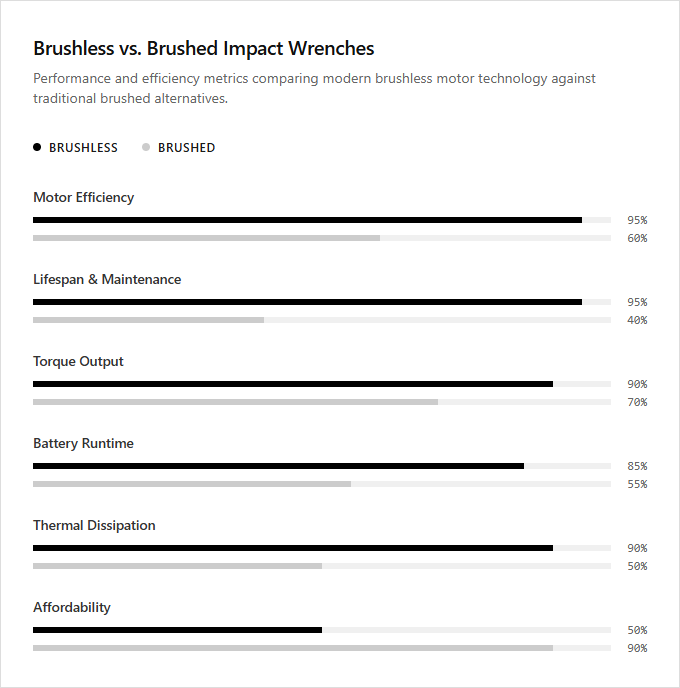
| Factor | Summary |
|---|---|
| Motor Efficiency | Brushless motors utilize an electronic controller rather than physical commutators, eliminating energy loss caused by friction. |
| Lifespan and Maintenance | Brushed motors require regular replacement of carbon brushes, whereas brushless designs lack these wearing components to extend overall duty cycle. |
| Torque Output | Brushless impact wrenches deliver a superior torque-to-weight ratio because the magnetic field is digitally managed for optimal power transfer. |
| Battery Runtime | The absence of frictional drag in brushless models reduces amp-hour draw, significantly extending the battery run time per charge cycle. |
| Thermal Dissipation | Because the heat-generating coils are anchored to the motor housing in brushless tools, thermal dissipation is much more efficient than in rotating brushed armatures. |
| Manufacturing Cost | Brushed impact wrenches remain more budget-friendly due to basic analog circuitry, while brushless tools require expensive integrated microprocessors. |
Electronic Speed Controller (ESC) optimization to eliminate mechanical friction losses
In the evolution of impact wrenches, the transition from brushed to brushless motor technology represents a significant engineering advancement. Traditional brushed motors rely on physical carbon brushes to transfer electrical current, which inevitably generates mechanical friction, heat, and energy loss. Conversely, brushless impact wrenches utilize an intelligent Electronic Speed Controller (ESC) to precisely manage alternating magnetic fields. By replacing physical contact with digital commutation, the ESC eliminates mechanical friction losses, drastically improving energy efficiency, heat dissipation, and overall tool longevity.
This electronic optimization delivers more consistent torque and significantly extends battery runtime under heavy loads. While cost-effective brushed models are well-suited for occasional DIY enthusiasts seeking a budget-friendly tool for light garage work, high-efficiency brushless impact wrenches are the superior choice for automotive professionals and industrial contractors who require maximum power, reliability, and daily high-duty cycle performance.
Neodymium permanent magnets on the rotor to maximize torque density
In impact wrenches, the transition from brushed to brushless motors represents a significant technological leap. Brushless designs utilize high-energy Neodymium permanent magnets on the rotor, which greatly maximizes torque density and motor efficiency. Because these rare-earth magnets deliver exceptionally strong magnetic fields within a compact space, brushless impact wrenches produce higher rotational force and sustain greater power under load while generating far less heat and friction.
Traditional brushed motors rely on physical carbon brushes and a commutator to deliver current, which limits their power-to-weight ratio and increases wear over time. Professional automotive technicians requiring maximum power for demanding daily use benefit most from high-torque brushless models, whereas occasional DIY hobbyists find affordable brushed models ideal for light-duty household tasks.
Stator-mounted copper windings for superior heat dissipation during high-load fastening
Brushless impact wrenches offer significant thermal advantages over traditional brushed models during demanding applications. In a brushless configuration, the copper windings are mounted directly on the stationary outer stator rather than the spinning inner armature. This design places the primary heat-generating components in direct contact with the tool's housing, facilitating superior heat dissipation during high-load fastening tasks and preventing thermal overload.
In contrast, brushed motors trap heat within the internal rotor, which can lead to performance degradation under sustained resistance. By eliminating friction-inducing brushes and optimizing heat transfer, brushless tools deliver consistent torque and extended service life. Brushed models are highly suitable for budget-conscious DIY enthusiasts undertaking occasional home repairs, whereas brushless impact wrenches are engineered for professional mechanics and industrial operators who demand continuous, heavy-duty performance.
Closed-loop feedback sensors adjusting power output dynamically based on resistance
Brushless impact wrenches utilize electronic circuitry and closed-loop feedback sensors to monitor rotational resistance in real-time. These sensors constantly communicate with the microprocessor, dynamically adjusting voltage and power output to match the immediate torque requirements of the fastener. In contrast, traditional brushed motors rely on continuous mechanical contact, delivering a fixed rate of energy regardless of the load variation, which often results in energy waste and friction-induced heat.
By modulating power output based on resistance, brushless systems optimize battery efficiency and prevent tool overload during heavy-duty applications. High-volume industrial professionals requiring precise, self-regulating power for demanding daily tasks will benefit most from brushless models, whereas budget-conscious homeowners performing occasional, light automotive repairs are well-suited for traditional brushed tools.
Elimination of commutator-brush voltage drop to increase energy conversion efficiency
The primary differentiator between brushless and brushed impact wrenches lies in their motor design and energy efficiency. Traditional brushed motors rely on physical carbon brushes and a commutator to deliver electrical current, which creates friction and a significant voltage drop across the contact point. Brushless motors eliminate this physical interface entirely, replacing it with electronic circuitry to manage power distribution.
Removing the commutator-brush voltage drop directly improves energy conversion efficiency. Without the resistance and heat generated by mechanical friction, brushless impact wrenches convert a higher percentage of battery power into rotational torque. This engineering advancement extends tool runtime per battery charge and prevents thermal degradation during demanding fastening applications.
Cost-conscious DIY hobbyists requiring occasional tool use benefit from affordable brushed models, whereas high-volume industrial professionals demanding maximum runtime and low maintenance require brushless technology.
High-Torque Performance in a Compact Design
When selecting an impact wrench, the choice between brushless and brushed motor technology fundamentally dictates tool performance. Brushless motors eliminate physical brushes, drastically reducing internal friction and energy loss. This engineering efficiency translates directly into a higher power-to-weight ratio, enabling manufacturers to deliver exceptional torque output within a much lighter and more compact housing.
Traditional brushed impact wrenches rely on mechanical contact to transfer energy, which generates heat and requires a larger tool footprint to achieve high torque levels. Heavy-duty mechanics and industrial professionals requiring maximum torque in tight spaces benefit most from brushless models, while DIY hobbyists and budget-conscious users will find dependable brushed options highly sufficient for intermittent, general-purpose tasks.
Extending Continuous Duty Without Armature Burnout
Brushless impact wrenches offer a distinct advantage in demanding applications by eliminating the physical brushes and commutator found in traditional motors. This design dramatically reduces friction and heat buildup, allowing the tool to maintain extended continuous duty cycles without the risk of armature burnout under heavy, prolonged loads.
Brushed motors rely on carbon brushes that generate significant thermal energy during operation. Continuous use without cooling intervals can melt the protective insulation on the armature, leading to premature tool failure. Industrial professionals requiring relentless, high-volume performance on job sites benefit most from brushless models, whereas budget-conscious homeowners performing occasional repairs find brushed tools perfectly adequate.
Leave a comment