
Selecting the wrong induction motor for a heavy-duty drill press often leads to stalled spindles, burned-out workpieces, and costly workshop downtime. When seeking to upgrade machinery, operators typically rely on standard equipment funding sources or basic utility hookups to resolve these torque bottlenecks, assuming all power configurations yield similar results.
However, understanding the distinction between motor phase dynamics is what truly grants operators unprecedented control over speed variability and energy efficiency. Of course, maximizing these benefits comes with the stipulation that your facility's electrical panel can safely accommodate the corresponding voltage load and phase requirements.
For example, integrating a three-phase motor with a Variable Frequency Drive (VFD) has allowed high-output machine shops to transition seamlessly from drilling soft aluminum to boring hardened tool steel without losing torque. Below, we analyze the operational differences, installation requirements, and cost-benefit ratios of both induction motor types to guide your next workshop procurement decision.
| Factor | Summary |
|---|---|
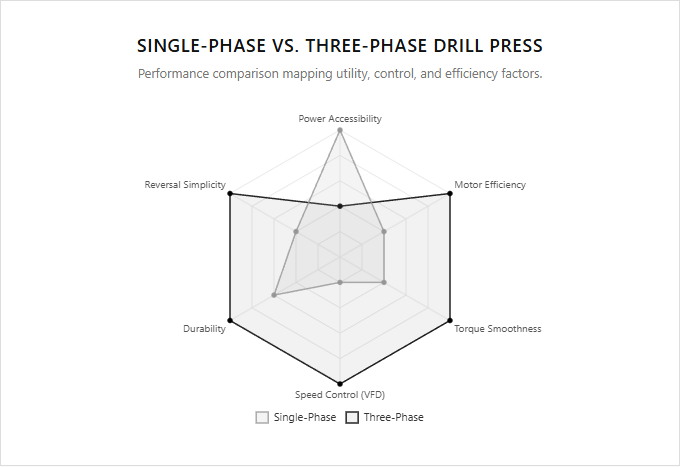
| Power Supply Requirements | Single-phase drill presses run on standard household alternating current, whereas three-phase models require industrial-grade power configurations utilizing three distinct sinusoidal voltages. |
| Motor Efficiency | Three-phase motors operate with higher electrical efficiency because they establish a rotating magnetic field without needing auxiliary starting windings or capacitors. |
| Torque Delivery | Three-phase drill presses provide constant torque with minimal torque ripple, resulting in smoother drilling operations compared to the pulsating torque of single-phase motors. |
| Speed Regulation | Three-phase systems easily integrate with a Variable Frequency Drive to allow precise, electronic speed control, a feature highly complex to implement in single-phase induction motors. |
| Maintenance and Durability | Single-phase motors rely on mechanical centrifugal switches and start capacitors that are prone to wear, while three-phase motors have fewer wearing parts, enhancing operational longevity. |
| Directional Reversibility | Reversing the rotation of a three-phase motor simply requires swapping any two stator leads to alter the phase sequence, whereas single-phase motors require complex internal wiring changes. |
Variable Frequency Drive (VFD) compatibility for precise spindle speed control
Standard single-phase drill presses operate on residential power and offer reliable torque, but adjusting spindle speeds usually requires manual belt-and-pulley changes. In contrast, three-phase motors excel in industrial environments and pair seamlessly with a Variable Frequency Drive (VFD). A VFD converts single-phase input into three-phase output, allowing for infinitely variable speed control and constant torque even at low RPMs. This electronic speed adjustment eliminates mechanical belt adjustments, extending tool life and improving drilling precision across various materials.
Single-phase models are ideal for hobbyists and home workshops seeking straightforward, plug-and-play operation, while three-phase VFD setups are best suited for professional machinists and high-production facilities requiring precise speed modulation for diverse metalworking projects.
Torque Ripple Minimization for Superior Machining Finish
When selecting a drill press, the choice between single-phase and three-phase motors significantly impacts machining quality. Single-phase motors, common in standard workshops, experience inherent pulsating power delivery that creates noticeable torque ripple. Conversely, three-phase motors utilize three overlapping alternating currents to deliver continuous, constant power. This steady energy flow minimizes torque ripple, drastically reducing spindle vibration during heavy operations.
This reduction in vibration directly translates to a superior machining surface finish, as the cutting tool maintains a highly consistent chip load without micro-chatter. By eliminating rotational fluctuations, three-phase systems prevent the surface blemishes often caused by single-phase power delivery. Single-phase models are ideal for home hobbyists requiring standard utility, whereas three-phase units are best suited for industrial machinists demanding flawless, high-precision finishes.
High Locked-Rotor Torque Without Centrifugal Switches
Single-phase drill presses typically rely on auxiliary start windings and mechanical centrifugal starting switches to initiate rotation. These moving components introduce potential points of mechanical wear and electrical failure, particularly in workshop environments prone to accumulated dust and debris.
In contrast, three-phase motors inherently generate a rotating magnetic field, delivering exceptional locked-rotor torque without requiring any mechanical starting switches or capacitors. This simplified design significantly increases long-term reliability and ensures smooth, continuous power delivery under heavy drilling loads.
Single-phase units are ideal for DIY hobbyists requiring standard residential power compatibility, whereas three-phase systems are suited for industrial operators demanding maximum equipment uptime and heavy-duty performance.
Instantaneous rotational reversal capabilities for tapping and threading operations
Three-phase drill press motors are inherently superior for instantaneous rotational reversal due to their continuous, balanced magnetic fields. Reversing the rotation merely requires swapping two input lines, which can be done instantly mid-cycle via a drum switch or contactor. This capability is crucial for efficient tapping and threading operations, where the tap must be backed out of a cut thread immediately without waiting for the spindle to coast to a stop.
Single-phase motors rely on starting capacitors and centrifugal switches, preventing immediate reversal while the spindle is rotating. They require a complete stop before switching directions, which significantly slows down high-volume production. Industrial manufacturers requiring rapid, repetitive tapping operations are best suited for three-phase systems, whereas home hobbyists and small repair shops with standard electrical service will find single-phase machines sufficient for occasional threading tasks.
Power Factor and Efficiency Under Heavy Drilling Loads
When operating a drill press under heavy mechanical loads, the choice between single-phase and three-phase power significantly impacts electrical efficiency. Single-phase motors often experience drops in power factor and increased current draw during deep drilling, leading to higher thermal losses. In contrast, three-phase motors maintain a consistently high power factor and superior electrical efficiency, as the continuous rotating magnetic field delivers smooth, constant torque without the voltage drops typical of single-phase systems.
This inherent efficiency of three-phase systems minimizes energy waste and prevents motor overheating during prolonged, high-capacity drilling operations. Single-phase drill presses are ideal for DIY hobbyists and light commercial workshops requiring standard utility outlets, whereas three-phase models are best suited for industrial manufacturers and high-volume fabricators demanding continuous, heavy-duty performance.
Single-Phase Grid Access vs. Phase Converter Requirements
When selecting a drill press, power compatibility is a critical infrastructure consideration. Single-phase utility grids are standard in residential garages and light commercial workshops, allowing single-phase drill presses to operate immediately without electrical modifications. Conversely, three-phase power is typically restricted to industrial zones. To run a three-phase drill press on a standard residential grid, users must install a phase converter, such as a variable frequency drive, to convert the incoming single-phase power.
This conversion process introduces additional upfront cost and setup complexity, though it grants access to the smoother operation and higher efficiency of industrial-grade motors. Single-phase models are suited for hobbyists and light-duty contractors requiring straightforward utility access, while three-phase setups are designed for high-volume manufacturers and professional machinists who prioritize maximum torque control and equipment longevity.
Superior Cooling for Continuous, Prolonged Machining
When selecting a drill press for high-output environments, the choice between single-phase and three-phase motors heavily influences operational efficiency. Three-phase motors excel in demanding applications due to their continuous duty cycle rating and superior thermal dissipation. Unlike single-phase units, which experience significant internal temperature spikes during prolonged machining, three-phase systems maintain a balanced electrical load. This balanced distribution minimizes resistive heat generation and prevents thermal degradation under constant load.
Single-phase motors rely on auxiliary start/run windings that generate localized heat, often requiring cool-down periods to avoid tripping thermal overloads. In contrast, the constant power delivery of a three-phase system allows the machinery to run indefinitely without performance degradation. Single-phase models are ideal for home hobbyists and light-duty workshops needing standard utility outlets, whereas three-phase drill presses are best suited for industrial machinists and commercial fabricators requiring non-stop, heavy-duty production capacity.
Leave a comment