
Woodworkers and shop managers frequently struggle with weak suction and frequent circuit overloads, often watching their dust collectors choke on heavy planing waste due to inadequate CFM airflow. Before investing in costly aftermarket ductwork or looking into external shop safety grants, operators typically look to maximize their existing power infrastructure.
Transitioning to a dedicated 220V circuit grants your dust collection system a highly efficient electrical draw, unlocking consistent, peak static pressure without the constant risk of tripping breakers. However, we must stipulate that doubling the voltage does not inherently double the motor's horsepower; rather, it optimizes overall operational efficiency and minimizes voltage drop under load. For instance, a standard 2 HP cyclone collector runs significantly cooler and reaches peak RPM faster on a 220V line compared to a strained 110V connection.
Below, we will analyze the technical differences between 110V and 220V configurations, evaluate their direct impact on CFM performance, and outline how to safely optimize your workshop's power grid.
| Factor | Summary |
|---|---|
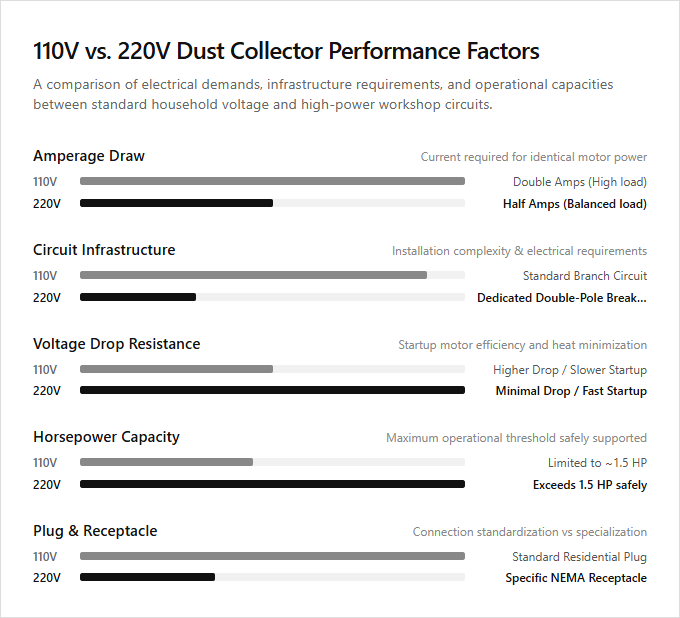
| Amperage Draw | Running a dust collector on 110V requires double the amperage compared to a 220V system to deliver the same power, increasing the load on the electrical panel. |
| Circuit Infrastructure | A 220V dust collector requires a dedicated double-pole circuit breaker and specialized wiring, whereas a 110V unit can often run on standard residential branch circuits. |
| Voltage Drop | Operating on a 220V circuit minimizes voltage drop during startup, which helps the induction motor reach full operational speed faster with less heat buildup. |
| Horsepower Limits | Dust collectors exceeding 1.5 horsepower typically require a 220V configuration because their energy demands exceed the safe capacity of standard household 110V outlets. |
| Plug Configuration | While 110V dust collectors use standard residential plugs, 220V units require specific NEMA receptacles corresponding to their higher voltage and amperage rating. |
Voltage drop mitigation for maintaining consistent impeller RPM
When selecting a workshop dust collector, the choice between 110V and 220V configurations directly impacts motor efficiency and suction stability. High-power induction motors require a stable power supply to maintain the impeller's rated RPM, which is critical for sustaining static pressure. Operating a heavy-duty collector on a standard 110V circuit often introduces significant voltage drop over long wire runs, causing the motor to run hotter and experience RPM degradation under heavy loads. Upgrading to a 220V system halves the amperage draw for the same wattage, effectively mitigating line resistance and ensuring the impeller maintains consistent velocity during intensive wood extraction.
Standard 110V units are ideal for hobbyists with single-tool garage workshops requiring occasional mobility, while 220V models are best suited for professional cabinetmakers operating stationary, multi-branch duct networks with continuous high-volume demands.
Amperage draw reduction to prevent thermal overload of the circuit
When selecting a workshop dust collector, the choice between 110V and 220V configurations significantly impacts electrical efficiency. Operating a high-powered unit on a standard 110V circuit draws substantial amperage, which increases the risk of tripping breakers and causing thermal overload. Rewiring the motor to run on 220V cuts the current draw in half while maintaining identical performance. This reduction in amperage minimizes heat buildup within the branch circuit wiring, protecting the electrical system during extended woodworking sessions.
A cooler-running 220V system provides greater stability and prevents voltage drops that can damage the motor over time. Standard 110V models are ideal for casual hobbyists utilizing standard garage outlets for light cleanup, while 220V systems are best suited for professional woodworkers running heavy machinery continuously in dedicated shop spaces.
Startup torque optimization for rapid acceleration of heavy impellers
Heavy impellers in dust collection systems demand substantial startup torque to overcome static inertia. Operating a dust collector on a 220-volt circuit rather than a 110-volt line optimizes this initial phase by halving the current draw for the equivalent power output. This reduction in amperage minimizes voltage drop along the circuit, ensuring the motor receives maximum voltage to generate immediate rotational force.
With stable voltage delivery, the motor achieves rapid acceleration, bringing the heavy impeller to full speed almost instantly. This rapid transition minimizes the duration of high inrush current, reducing thermal stress on the motor windings. Standard 110V collectors are ideal for light-duty hobbyists using dedicated single-phase garage outlets, while robust 220V systems are best suited for professional woodworkers running large-scale, continuous machinery.
Winding resistance heat reduction to sustain peak motor efficiency
When comparing dust collectors, operating voltage directly impacts thermal performance. A 220V configuration draws half the current of a 110V system to deliver the same power. Because heat generation in motor windings is proportional to the square of the amperage, the lower current of a 220V circuit significantly reduces winding resistance heat. This minimized thermal stress prevents performance degradation, allowing the motor to sustain peak operating efficiency during extended collection cycles.
While 110V models offer plug-and-play convenience, 220V units provide superior thermal management for intensive demands. Standard 110V dust collectors suit DIY hobbyists and small home workshops with standard power outlets, whereas robust 220V systems are ideal for professional woodworkers and commercial shops requiring continuous, heavy-duty debris extraction.
Horsepower threshold capacity limits for high-CFM induction motors
In dust collection, the capacity threshold for induction motors lies at the 1.5 to 2 horsepower (HP) mark. Standard 110V circuits safely support motors up to 1.5 HP, providing adequate CFM for localized, single-tool extraction. Upgrading to a 2 HP or larger motor to achieve the high CFM needed for ducted systems requires a 220V circuit to prevent overloaded breakers from high startup current.
Operating at 220V reduces current draw and heat buildup in the motor during extended use. 110V models suit hobbyists needing portable, single-port extraction, whereas 220V systems are best for professional woodworkers requiring continuous, multi-branch shop filtration.
Static pressure compensation through stable operating voltage
In dust collection, maintaining static pressure is critical for overcoming ductwork resistance. While both 110V and 220V motors can deliver comparable airflow, 220V systems offer superior voltage stability under heavy load. By drawing half the amperage of their 110V counterparts, 220V units minimize voltage drop along the circuit, allowing the motor to maintain consistent RPM and compensate effectively for static pressure changes as filters fill with debris.
Standard 110V models experience greater voltage fluctuation during peak resistance, which can temporarily reduce collection efficiency. Portable 110V units are best suited for hobbyists requiring plug-and-play versatility in standard garages, while robust 220V collectors are ideal for professional woodworkers running complex duct networks that demand continuous, high-pressure extraction.
Conductor gauge efficiency and branch circuit power delivery
Choosing between a 110V and 220V dust collector depends heavily on electrical efficiency and infrastructure. At 220V, the motor draws half the amperage of a 110V system of equivalent wattage. This reduction in current allows the branch circuit to utilize smaller conductor gauges, minimizing line resistance and thermal energy waste over long wire runs.
Furthermore, 220V branch circuits provide superior power delivery by reducing voltage drop during startup, ensuring the dust collector maintains optimal CFM performance. While 110V units are suitable for hobbyists utilizing standard residential outlets for occasional workshop cleanup, 220V systems are best for professional woodworkers requiring continuous, high-capacity extraction for heavy machinery.
Leave a comment