
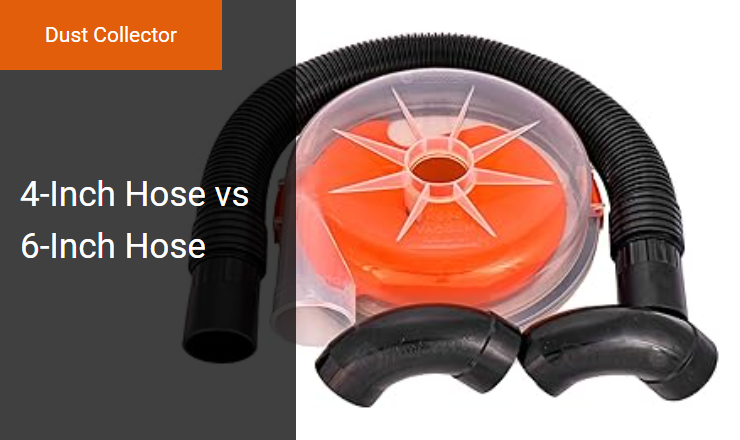
Many woodshop operators struggle with disappointing dust extraction, frequently finding fine, hazardous particulate settling on workshop surfaces despite having invested in high-horsepower collection units. While facility managers often attempt to bridge this performance gap by allocating standard equipment-upgrade funds toward purchasing larger, more expensive impellers, the true bottleneck usually resides within the ductwork configuration itself.
Correctly optimizing your system's pipe diameter is a far more efficient leverage point; it grants immediate, maximum airflow velocity and superior static pressure management without requiring a complete system overhaul. However, under the critical stipulation that branch-line velocity must stay above 4,000 FPM to prevent material settling and fire hazards, choosing between a 4-inch and 6-inch hose remains a high-stakes decision. High-demand machinery, such as 3HP cabinet saws and 15-inch thickness planers, requires precise static pressure balancing to capture dust at the source.
This article evaluates the fluid dynamics of both hose sizes, analyzes friction loss variables, and provides a clear engineering framework to help you select the optimal configuration for your shop layout.
| Factor | Summary |
|---|---|
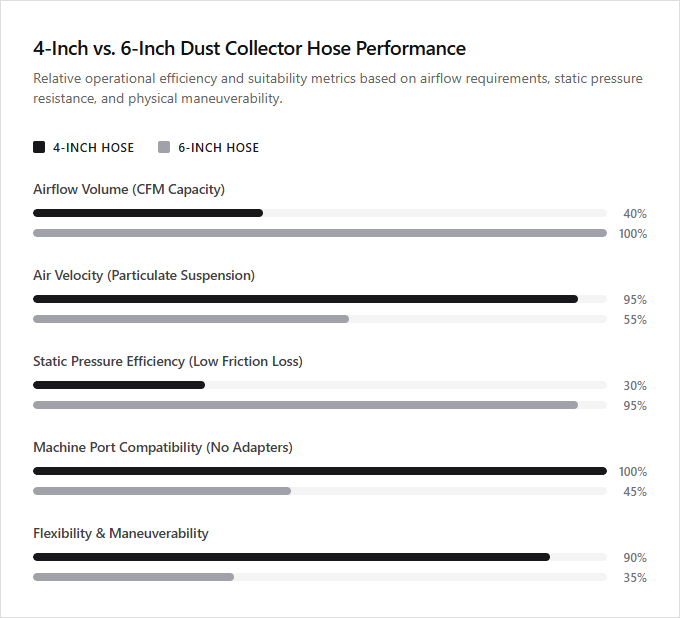
| Airflow Volume | A 6-inch hose accommodates significantly higher CFM (Cubic Feet per Minute) capacity than a 4-inch hose, maximizing the dust collector's volumetric flow rate. |
| Air Velocity | A 4-inch hose maintains a higher FPM (Feet per Minute) velocity in lower-CFM systems, preventing fine particulates from settling in the ductwork. |
| Static Pressure Loss | Friction resistance is exponentially lower in a 6-inch hose, reducing static pressure head loss and allowing the blower's impeller to operate at peak efficiency. |
| Machine Port Compatibility | While most workshop machinery features standard 4-inch ports, adapting them to a 6-inch hose requires step-up reducers which can introduce local turbulence. |
| Flexibility and Maneuverability | A 4-inch hose provides a much tighter bend radius and lighter weight, making it ideal for mobile tool connections compared to the rigid structure of a 6-inch hose. |
Why 6-Inch Hoses Double 4-Inch Capacity
Selecting the correct hose diameter is a critical decision when designing an efficient workshop dust collection system. The primary differentiator between these two sizes is their cross-sectional area, which directly dictates airflow capacity. While a standard four-inch hose offers an area of approximately 12.6 square inches, a six-inch hose provides about 28.3 square inches of space. This geometric difference means a six-inch hose delivers more than double the volumetric capacity, significantly reducing static pressure resistance and maintaining higher velocity.
This increased capacity allows larger dust collection units to transport high volumes of debris and fine dust without clogging. Four-inch hoses are ideal for hobbyists operating small, single-stage collectors with portable machinery, while six-inch hoses are best suited for professional woodworkers utilizing high-horsepower, central extraction systems.
Cubic Feet per Minute volumetric flow rate optimization
Optimizing volumetric flow rate, measured in Cubic Feet per Minute (CFM), is critical for effective dust collection. A 4-inch hose typically supports a maximum airflow of approximately 350 to 450 CFM, which is sufficient for smaller, localized woodworking machinery. Upgrading to a 6-inch hose more than doubles the cross-sectional area, allowing the system to achieve flow rates exceeding 800 CFM. This significant increase reduces static pressure loss and maximizes the air velocity required to capture fine, airborne particles before they escape into the workspace.
Selecting the correct diameter depends on the shop's scale and the machinery in use. A 4-inch system is ideal for hobbyists operating single benchtop tools in confined spaces, while a 6-inch configuration serves professional woodworkers or high-production shops utilizing heavy-duty machinery that demands maximum dust extraction efficiency.
Friction loss reduction to minimize total static pressure
In dust collection systems, optimizing airflow requires minimizing static pressure resistance, which is heavily influenced by duct diameter. A 4-inch hose introduces high friction loss due to the restricted boundary layer and increased air velocity, forcing the impeller to work harder. Upgrading to a 6-inch hose exponentially reduces this frictional drag, allowing the dust collector to maintain higher Cubic Feet per Minute (CFM) with significantly less total static pressure.
Larger ductwork maximizes the efficiency of the main extraction unit, ensuring optimal velocity to keep debris suspended throughout the run. Smaller hoses restrict flow but maintain the high velocity necessary for short, localized connections. While hobbyists with compact workshops and portable benchtop machinery benefit from the flexibility of a 4-inch system, professional woodworkers operating high-capacity stationary machinery require the low-resistance 6-inch setup to sustain peak extraction performance.
Minimum transport velocity maintenance to prevent particulate settling
Maintaining a minimum transport velocity-typically 3,500 to 4,000 feet per minute-is critical in dust collection to prevent particulates from settling and clogging the ductwork. A 4-inch hose restricts airflow but maintains this necessary velocity when paired with lower-CFM (cubic feet per minute) collectors. In contrast, a 6-inch hose allows for a much higher volume of air but requires a significantly more powerful blower to keep the velocity high enough to transport heavy debris.
An underpowered system connected to a larger hose will suffer from velocity drops, causing dust to accumulate in the lines. Hobbyists operating small, single-stage collectors in home workshops benefit most from the velocity-preserving 4-inch hose, whereas commercial operators utilizing high-capacity, multi-horsepower cyclone systems require the high-volume capabilities of a 6-inch layout.
System curve alteration to match the dust collector fan curve
In dust collection, matching the system curve to the fan curve is critical for maximizing airflow. A 4-inch hose introduces high static pressure resistance, steepening the system curve and forcing the fan to operate at a lower volume (CFM) point. Conversely, upgrading to a 6-inch hose flattens the system curve by drastically reducing friction loss, allowing the fan curve to intersect at a significantly higher CFM operating point.
This modification ensures the impeller operates within its optimal efficiency range, preventing air starvation and maintaining critical chip transport velocity. Small-scale hobbyists running single, compact machines benefit most from the simplicity of a 4-inch setup, while professional workshop operators requiring high-volume extraction across complex, multi-tool networks need the high-flow capacity of a 6-inch configuration.
Boundary layer drag and turbulence variations in flexible ducting
In flexible dust collection ducting, hose diameter significantly dictates airflow efficiency due to fluid dynamics. A 4-inch hose exhibits a high surface-area-to-volume ratio, which amplifies boundary layer drag against the corrugated interior walls. This friction forces high-velocity airflow into a turbulent state, rapidly increasing static pressure loss and reducing overall collection efficiency.
Upgrading to a 6-inch hose more than doubles the cross-sectional area, which drastically minimizes the relative impact of the boundary layer. The expanded volume lowers velocity and curtails turbulence, preserving the high cubic feet per minute (CFM) required for effective dust containment. The highly restrictive 4-inch hose serves hobbyists managing compact, single-tool garages, whereas the high-volume 6-inch ducting benefits professional shop owners operating centralized, multi-port extraction systems.
Impact of Airflow Resistance on Blower Motor Horsepower
In dust collection systems, duct diameter directly dictates static pressure resistance and the resulting brake horsepower (BHP) demand on the blower motor. A 4-inch hose introduces high friction loss, restricting airflow and causing the blower to operate at a higher static pressure. Because centrifugal fans draw less power when airflow is restricted, a 4-inch hose decreases the BHP demand on the motor, though at the cost of overall volume performance.
A 6-inch hose significantly reduces static pressure, allowing the fan to move a much larger volume of air. This increased air volume raises the BHP demand, requiring a more robust motor to prevent overloading from the high flow rate. Small-shop hobbyists utilizing portable, low-horsepower collectors benefit from the lower load of a 4-inch system, whereas professional woodworkers operating high-capacity central systems require 6-inch ducting to maximize particle extraction.
Leave a comment