
For fleet operators and field technicians, few setbacks are as frustrating as mid-job thermal shutdowns caused by an overtaxed cordless inflator. When high-volume commercial tires demand sustained pressure, standard tool motors rapidly overheat, stalling critical roadside operations.
To mitigate this, organizations typically rely on standard equipment procurement budgets to purchase redundant battery packs or bulky, truck-mounted pneumatic compressors. However, integrating brushless motor technology into your fleet grants technicians a highly efficient, lightweight alternative that drastically minimizes thermal downtime. Under the stipulation that operators understand the tool's continuous-run limits, this transition delivers superior energy conversion. For example, leading mobile service fleets utilizing brushless inflators have successfully optimized their duty cycles, maintaining rapid, consecutive tire inflations without motor degradation.
This article compares the internal mechanics of brushed and brushless motors, examines their impact on pneumatic efficiency, and outlines key criteria for selecting the optimal cordless inflator for your operational needs.
| Factor | Summary |
|---|---|
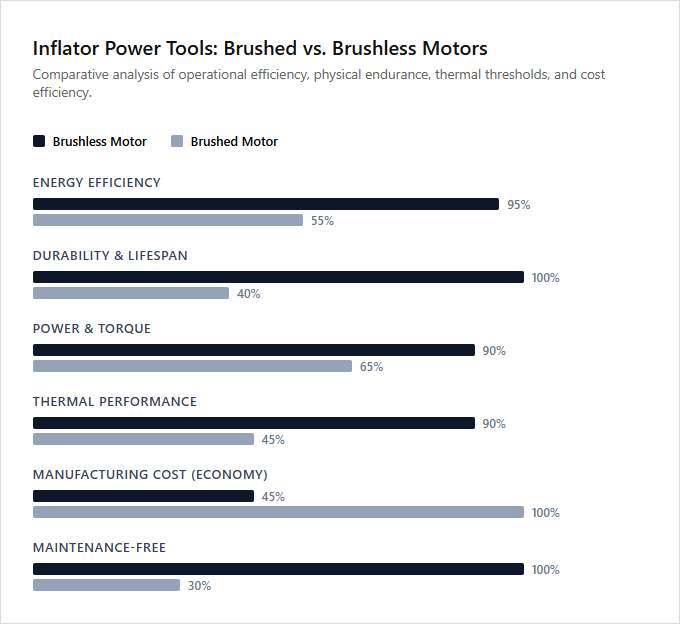
| Energy Efficiency | Brushless inflators achieve superior energy efficiency by eliminating brush friction, utilizing an electronic controller to optimize power consumption and extend battery runtime. |
| Durability and Lifespan | Without physical carbon brushes prone to mechanical wear and friction-induced degradation, brushless motors offer a significantly longer operational lifespan. |
| Power and Torque | Brushless motors deliver higher torque density and rotational speed, allowing the inflator to sustain higher pounds per square inch (PSI) outputs under heavy loads. |
| Thermal Performance | Brushless designs generate far less heat dissipation and avoid the sparking associated with commutators, drastically reducing the risk of tool overheating during continuous inflation. |
| Manufacturing Cost | Brushed motor inflators are more budget-friendly due to simpler internal circuitry and the absence of expensive electronic speed controllers (ESCs). |
| Maintenance Requirements | Brushed inflators require periodic maintenance to replace worn-down carbon brushes, whereas brushless systems are completely maintenance-free. |
Brushless Motors Extend Inflator Duty Cycle
In portable inflator design, the choice between brushed and brushless motors dictates performance limits. Traditional brushed motors rely on physical carbon brushes and a commutator to transfer current, a process that inherently generates friction and thermal buildup. Brushless motors eliminate this mechanical contact through electronic commutation. This lack of friction significantly reduces heat generation, directly extending the inflator's continuous duty cycle for demanding tasks.
While brushed inflators offer a cost-effective solution for short, intermittent tasks, they require cool-down periods to prevent thermal damage. Brushless models sustain high pressure for longer periods without overheating, maintaining consistent output during heavy-duty applications. Casual homeowners needing occasional tire top-offs will find brushed inflators highly economical, whereas high-volume professionals and off-road enthusiasts requiring rapid, continuous multi-tire inflation should invest in brushless technology.
ESC Optimizes Brushless Motor Torque Under Pneumatic Loads
When selecting an inflator power tool, the choice between brushed and brushless motors directly impacts performance efficiency. Brushless systems utilize an Electronic Speed Control (ESC) to dynamically adjust power delivery. Under varying pneumatic loads-such as transitioning from high-volume pumping to high-pressure tire inflation-the ESC continuously optimizes the torque-to-weight ratio. This electronic regulation maintains high torque output without the physical weight of larger motor components, offering superior efficiency over traditional brushed designs.
Brushed motors rely on physical carbon brushes to deliver current, creating friction and limiting real-time adaptation to changing resistance. While brushed models offer a highly cost-effective and straightforward design, they lack these intelligent, load-sensing speed controllers. Budget-conscious homeowners performing occasional inflation tasks will find brushed motors highly practical, whereas professional contractors and automotive technicians requiring sustained power under heavy loads are best suited for brushless inflators.
Minimizing Copper Losses Preserves Piston Seal Efficiency
When selecting an inflator power tool, the motor architecture directly impacts performance sustainability under load. Brushless motors offer distinct thermodynamic advantages over traditional brushed designs by eliminating physical brushes and optimizing stator windings. This configuration minimizes I²R copper losses, which significantly reduces heat generation within the tool housing. Preventing excess thermal buildup protects the critical piston seals from degradation, thereby preserving the pump's volumetric efficiency under high backpressure.
Brushed motors generate more internal friction and heat, which can lead to premature seal wear during extended operation. Casual DIY users seeking an affordable tool for occasional tire top-offs will benefit from a brushed inflator, while commercial operators and automotive professionals require the thermal endurance of a brushless model for continuous, high-pressure applications.
Hall-Sensor Feedback Maintains Constant Flow Under Backpressure
When selecting an inflator power tool, the choice between brushed and brushless motors dictates performance consistency under load. Traditional brushed motors experience a drop in rotational speed as resistance increases, leading to slower inflation times as pressure builds. Conversely, brushless motors can utilize advanced electronic control systems. By employing closed-loop feedback driven by integrated Hall effect sensors, a brushless inflator continuously monitors rotor position and adjusts power delivery in real time, maintaining a constant volumetric flow rate despite rising backpressure.
This technological distinction directly influences tool utility and efficiency. Casual DIYers seeking an affordable, straightforward tool for occasional sports equipment inflation will benefit from brushed models, whereas automotive professionals and high-volume operators requiring rapid, consistent performance under pressure should select brushless technology.
Brushless Design Enhances Pneumatic Drive Linkage Reliability
In pneumatic inflator design, the choice between brushed and brushless motors directly impacts tool longevity and operational safety. Traditional brushed motors rely on physical carbon brushes that create friction, wear, and brush arcing during high-pressure inflation cycles. In contrast, brushless motors eliminate these contacts entirely, preventing electromagnetic interference (EMI) and spark generation. This omission stabilizes the electronic control systems and significantly enhances the long-term reliability of the pneumatic drive linkage under heavy loads.
Removing physical wear points also translates to superior thermal management and minimized maintenance. Budget-conscious homeowners requiring occasional tire top-offs benefit from the cost-effective simplicity of brushed inflators, whereas roadside assistance professionals and high-volume workshop operators require the spark-free safety and continuous duty cycle of brushless models.
Brushless Motors Enable Compact, High-Compression Pumps
When selecting an inflator power tool, the choice between brushed and brushless motors directly impacts performance and tool longevity. Brushless motors represent a significant technological advancement in this category. Their high power density enables compact pump designs that sustain a higher compression ratio without overheating, allowing for sustained, high-pressure output during demanding tasks.
In contrast, traditional brushed motors rely on carbon brushes that generate friction and heat, which limits their continuous runtime. Casual DIYers needing an affordable tool for occasional tire top-offs will find brushed inflators highly suitable, whereas service professionals requiring rapid, heavy-duty commercial inflation are best served by the endurance and efficiency of brushless models.
Dynamic Motor Thermal Protection via Current Modulation
When selecting an inflator power tool, the choice between brushed and brushless motors directly impacts operating duty cycle and thermal limits. Brushed motors rely on mechanical commutators that generate friction and heat under continuous load. In contrast, premium brushless designs integrate sophisticated digital control. Microcontroller-driven thermal overload protection dynamically modulates stator current to prevent winding insulation breakdown during prolonged high-pressure operation, ensuring the tool maintains peak performance without degradation.
This advanced electronic monitoring allows brushless inflators to sustain high-duty cycles, whereas brushed alternatives require intermittent cooling periods to prevent premature wear. Budget-conscious homeowners performing occasional bicycle or passenger tire top-offs will find the simplicity and lower cost of brushed motors sufficient, while commercial fleet operators and off-road enthusiasts requiring rapid, multi-vehicle tire inflation should invest in the continuous-duty reliability of brushless models.
Leave a comment