
Few automotive inconveniences are as frustrating as encountering a low-tire warning light during a hectic commute, only to find the nearest station's air pump is out of service. Historically, drivers have relied on standard contingency resources-such as roadside assistance subscriptions or bulky, stationary garage compressors-to address these routine pressure drops.
However, securing a dedicated portable inflator grants vehicle owners complete maintenance autonomy, ensuring safety and optimal fuel economy. To manage expectations, we must stipulate that portable inflators are designed for pressure maintenance rather than seating beads on commercial-grade tires. For instance, inflating a high-volume SUV tire from flat demands different duty cycles than topping off a standard sedan tire, directly impacting your choice between a 12V corded plug-in and an 18V cordless lithium-ion unit.
Below, we examine the critical differences between corded and cordless portable air compressors, comparing power delivery, runtime, and overall utility to help you select the ideal tool for your vehicle.
| Factor | Summary |
|---|---|
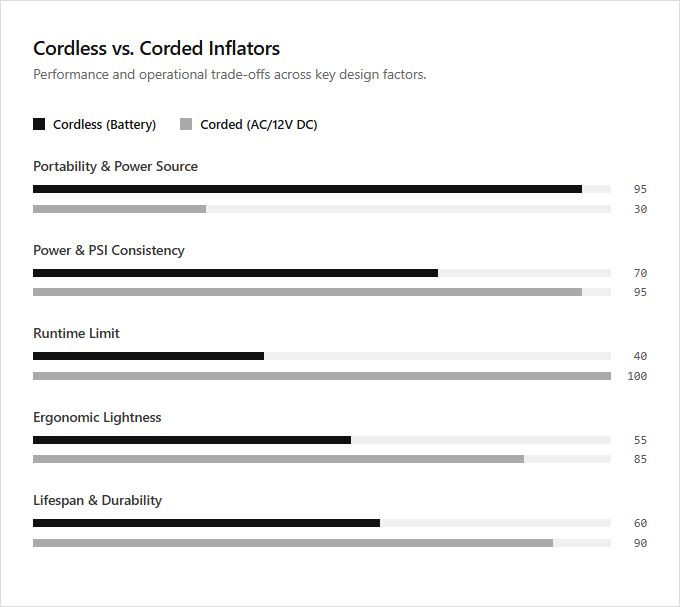
| Power Source | Cordless inflators utilize rechargeable lithium-ion battery packs for unmatched portability, whereas corded models rely on a continuous AC or 12V DC electrical connection. |
| Performance and PSI | Corded inflators generally deliver higher duty cycles and consistent maximum PSI output without the risk of voltage drop. |
| Runtime Limit | Cordless models are limited by the milliampere-hour capacity of their battery pack, while corded units offer unlimited runtime for heavy-duty tasks. |
| Weight and Ergonomics | Cordless tools are typically heavier and bulkier due to the integrated battery cells, whereas corded units remain lightweight but are restricted by cord geometry. |
| Lifespan | Cordless units face eventual performance decline due to lithium-ion battery degradation, whereas corded inflators experience longer operational lifespans with fewer electronic wear points. |
Li-ion Battery Capacity vs. 12V Aux Power
Cordless power inflators rely on lithium-ion batteries, where the Ampere-hour (Ah) capacity directly determines the tool's runtime and overall performance. Higher Ah ratings provide the mobility to inflate multiple vehicle tires or sports equipment anywhere, free from the limitations of power cords.
Corded inflators utilize a continuous 12V DC auxiliary power supply, drawing energy directly from a vehicle's electrical system. This configuration eliminates battery degradation and recharging downtime, ensuring steady, uninterrupted pressure delivery for heavy-duty or high-volume applications.
Mobile technicians and daily commuters benefit most from the rapid, on-the-go convenience of a high-Ah cordless model, whereas recreational vehicle owners and long-distance travelers are better suited for the endless runtime of a corded 12V DC unit.
Thermal overload protection and duty cycle limitations during continuous operation
Cordless inflators offer exceptional portability but typically feature shorter duty cycles, often requiring a cool-down period after ten minutes of continuous use. To safeguard the lithium-ion battery and compact motor from excessive heat, manufacturers integrate sensitive thermal overload protection systems that automatically shut down the tool when temperature thresholds are exceeded.
In contrast, corded inflators generally support longer duty cycles due to a stable power source and more robust internal cooling mechanisms. While they still employ thermal overload safety switches to prevent motor burnout during intensive tasks, they can sustain continuous operation for extended periods before requiring rest.
Cordless models are ideal for motorists needing quick roadside top-ups, while corded units are best suited for workshop professionals requiring high-volume, uninterrupted inflation.
Max CFM Output at Specific PSI
When selecting an inflator power tool, understanding the relationship between Cubic Feet per Minute (CFM) and Pounds per Square Inch (PSI) is essential. Corded inflators consistently deliver higher CFM ratings at elevated PSI levels because they draw continuous power from an electrical outlet. This stable energy source allows these units to maintain high-volume output under pressure without performance drops, making them highly efficient for rapid, heavy-duty inflation tasks.
Cordless inflators offer unmatched portability but typically feature lower CFM delivery at higher PSI ratings due to battery power limitations. While modern battery technology has closed this gap, voltage drop during extended use can lead to a gradual reduction in airflow efficiency. Corded models are ideal for stationary workshop environments and high-volume commercial operations, whereas cordless units are best suited for roadside emergencies and mobile trade professionals requiring on-the-go convenience.
Battery Drain and Self-Discharge in Trunk Storage
Cordless inflators offer portability but face distinct challenges during long-term trunk storage. Lithium-ion batteries experience natural self-discharge, a process accelerated by extreme trunk temperatures. Internal circuitry can also exert a parasitic draw, gradually depleting the battery over months of inactivity and leaving the device dead during an emergency.
Corded inflators bypass these storage issues entirely. Operating from a vehicle's 12V auxiliary outlet, they require no battery maintenance and remain ready for immediate use. Emergency-preparedness motorists who prioritize low-maintenance reliability will benefit most from corded models, whereas active users needing rapid, frequent mobility are better served by cordless options.
Digital pressure transducer accuracy and auto-shutoff calibration
Cordless inflators rely on rechargeable battery power to drive their internal digital pressure transducers. High-quality cordless models utilize sophisticated electronic calibration to compensate for minor voltage drops as the battery drains, ensuring the auto-shutoff mechanism triggers precisely at the target PSI. This digital precision prevents over-inflation and maintains consistent performance during mobile roadside tasks.
Corded inflators draw continuous power from AC outlets or 12V DC vehicle ports, delivering a steady electrical current to the transducer. This constant energy supply maintains highly stable sensor calibration over prolonged operation, allowing the auto-shutoff feature to remain exceptionally accurate during heavy-duty, high-volume tasks. Cordless models are ideal for active motorists requiring on-the-go portability, while corded units suit workshop technicians who prioritize uninterrupted runtime.
12V Cigarette Lighter Fuse Voltage and Current Limits
Corded 12V inflators rely on a vehicle's accessory outlet, exposing them to specific electrical limitations. These circuits are typically protected by 10-amp or 15-amp fuses, restricting the maximum current draw of the tool and increasing the risk of blown fuses during heavy-duty tasks. Longer power cables also introduce a noticeable voltage drop, reducing motor efficiency and slowing inflation times during prolonged use.
Cordless inflators bypass these constraints by utilizing onboard lithium-ion batteries to deliver high, consistent voltage directly to the motor. This independent power source eliminates the risk of vehicle electrical damage and ensures maximum performance. Cordless models suit active commuters and outdoor enthusiasts requiring rapid, portable inflation, while corded options remain ideal for drivers seeking budget-friendly, emergency-only backup stored permanently in the trunk.
Brushless Efficiency vs. Brushed Heat in Compact Housings
In compact inflator designs, motor efficiency is critical for managing thermal output. Cordless inflators increasingly utilize brushless motors, which eliminate physical brushes to reduce friction and optimize energy transfer. This design significantly lowers heat generation within tight housings, allowing for prolonged runtimes and superior battery conservation.
Corded inflators often rely on traditional brushed motors, which generate more internal heat due to mechanical friction. While this heat requires careful thermal management in small enclosures, corded units offer unlimited run time without battery degradation. Cordless brushless inflators are ideal for mobile professionals needing rapid, on-the-go roadside assistance, while corded brushed models best suit homeowners seeking reliable, budget-friendly garage utility without battery maintenance.
Leave a comment