
Achieving perfectly square, repeatable cuts remains a persistent challenge for workshop operators battling subtle blade deflection and vibration. While standard equipment budgets are typically directed toward external upgrades like premium fences or aftermarket blades, these investments cannot compensate for a weak internal foundation. It is the structural integrity of the internal trunnion system that ultimately grants a table saw its fundamental stability and long-term calibration retention under heavy load.
To frame this comparison accurately, we must stipulate that motor horsepower is largely irrelevant if the underlying mounting geometry flexes during a cut. For instance, heavy, cabinet-mounted cast-iron trunnions offer massive vibration-dampening advantages over lighter, table-mounted contractor bracket designs. Below, we conduct a detailed comparative analysis of cabinet and contractor table saws, evaluating how trunnion architecture, weight distribution, and calibration mechanisms dictate the best choice for your workshop's precision demands.
| Factor | Summary |
|---|---|
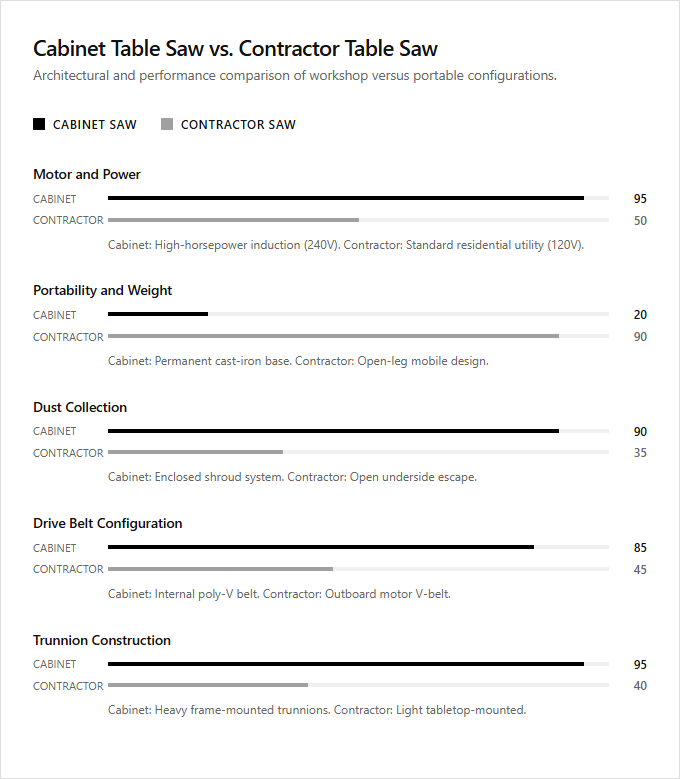
| Motor and Power | Cabinet saws utilize high-horsepower induction motors requiring 240-volt circuits, whereas contractor saws run on lower-power motors compatible with standard 120-volt residential outlets. |
| Portability and Weight | Contractor saws feature an open-leg stand design making them relatively mobile for job sites, while cabinet saws have a heavy, enclosed cast-iron base designed for permanent workshop installation. |
| Dust Collection | Cabinet saws feature an enclosed shroud and dedicated dust ports for superior dust extraction efficiency, whereas contractor saws have open undersides that allow sawdust to escape easily. |
| Drive Belt Configuration | Cabinet saws use internally mounted serpentine or poly-V belt systems to minimize vibration, while contractor saws typically feature an outboard motor mount with a standard V-belt drive. |
| Trunnion Construction | Cabinet saws have heavy-duty trunnions mounted directly to the cabinet frame for superior blade alignment stability, whereas contractor saws have lighter trunnions attached directly to the underside of the table top. |
Cabinet-mounted trunnions versus table-mounted trunnions structural rigidity
The structural distinction between cabinet and contractor table saws lies primarily in their trunnion design, which dictates overall rigidity and alignment stability. Cabinet table saws feature heavy-duty, cabinet-mounted trunnions secured directly to the heavy steel frame. This internal mounting system isolates vibration and ensures the blade remains perfectly parallel to the miter slot under heavy loads. The robust cast-iron construction of these trunnions provides superior structural integrity, allowing for precise adjustments and consistent performance during demanding operations.
Contractor table saws utilize table-mounted trunnions, which connect directly to the underside of the tabletop. While this configuration reduces overall machine weight, it compromises structural rigidity and makes blade alignment more tedious, as adjusting the trunnions requires manipulating the entire tabletop. Heavy-duty cabinet saws are ideal for professional woodworkers requiring daily precision and maximum durability, whereas portable contractor models best serve hobbyists and jobsite professionals who prioritize mobility and space-saving designs.
Vibration damping capacity of heavy cast iron trunnion brackets
Cabinet table saws feature heavy cast iron trunnions mounted directly to the cabinet base. This massive construction provides superior vibration damping capacity, ensuring exceptionally smooth operation and precise cuts. In contrast, contractor table saws utilize lighter trunnions mounted to the underside of the table top, which offers significantly less mass to absorb motor and blade vibrations during heavy use.
The robust damping of a cabinet saw minimizes blade runout and extends bearing life under continuous workloads. While contractor saws trade some of this stability for portability and lower cost, they still manage light-to-medium duty tasks effectively. Professional woodworkers requiring maximum accuracy and daily production benefit most from a cabinet saw, whereas hobbyists and mobile carpenters value the transportable nature of a contractor saw.
Blade-to-miter-slot parallelism alignment mechanisms
Cabinet table saws feature a trunnion assembly mounted directly to the heavy cast-iron cabinet base. This design isolates the alignment mechanism from the tabletop, allowing users to adjust blade-to-miter-slot parallelism by loosening the cabinet-to-table bolts. This enables precise, micro-adjustments of the tabletop relative to the fixed blade assembly, ensuring the alignment remains stable under heavy, continuous use.
Contractor table saws typically utilize trunnions mounted directly to the underside of the cast-iron table. Adjusting parallelism on these models requires loosening the trunnion bolts beneath the saw and shifting the arbor and motor assembly, a process that is often more tedious and susceptible to shifting during retightening. Cabinet saws are ideal for dedicated professionals requiring high-precision, heavy-duty production, while contractor saws suit mobile tradespeople or hobbyists prioritizing portability and standard workshop tasks.
Direct load-bearing transfer to the heavy-gauge steel cabinet base
The fundamental distinction between cabinet and contractor table saws lies in their structural design and vibration management. Cabinet table saws utilize a superior engineering approach where the heavy cast-iron trunnions mount directly to the heavy-gauge steel cabinet base. This direct load-bearing transfer to the solid, fully-enclosed frame ensures maximum stability, dampens operational vibration, and maintains precise blade alignment under heavy loads.
Contractor table saws, conversely, feature trunnions attached directly to the underside of the cast-iron table top, offering less structural rigidity but allowing for a lighter, more open design. Professional woodworkers and industrial shops requiring absolute precision and daily heavy-duty cutting are best suited for cabinet saws, while mobile carpenters and DIY hobbyists prioritize contractor saws for their portability and lower power requirements.
Arbor assembly and motor carriage stability under high-torque loads
Cabinet table saws feature heavy-duty cast iron trunnions mounted directly to the cabinet frame. This robust construction securely supports a massive arbor assembly and a powerful induction motor. Under high-torque loads, the cabinet-mounted design minimizes vibration, maintaining precise blade alignment even when cutting thick, dense hardwoods.
Contractor table saws employ lighter, table-mounted trunnions to suspend the motor carriage. This configuration offers less structural mass, making the arbor assembly more susceptible to deflection and vibration under heavy resistance. Cabinet saws are ideal for professional furniture makers requiring absolute precision and daily high-volume output, whereas contractor saws best suit mobile tradespeople and hobbyists who prioritize portability and moderate workshop utility.
Cast-iron table top deflection and stress relief comparison
Cabinet table saws feature heavy-duty, solid cast-iron tops that undergo rigorous stress-relieving processes during manufacturing. This thermal aging prevents warping over time, ensuring the surface remains flat. The sheer mass of these tables minimizes deflection under heavy workpieces, providing a highly stable, vibration-free reference surface essential for high-precision woodwork.
Contractor table saws, designed for portability, often utilize thinner cast-iron tops with open-web designs. These tops undergo less intensive stress-relief cycles, making them more susceptible to minor deflection under downward pressure. While they offer adequate flatness for standard tasks, they lack the absolute structural rigidity found in stationary cabinet-grade machinery.
Cabinet saws are best suited for dedicated professionals requiring maximum precision in a permanent workshop, while contractor saws are ideal for mobile craftspeople who need a balance of portability and reliable jobsite performance.
Worm-gear tilt and elevation mechanism durability and backlash prevention
Cabinet table saws feature heavy-duty, cast-iron trunnions with massive worm-gear tilt and elevation mechanisms. This robust construction provides exceptional durability and utilizes tight gear tolerances to prevent backlash during blade adjustments. The weight and stability of these enclosed systems ensure the gears remain perfectly aligned under heavy loads, maintaining precise cutting angles over years of continuous operation.
In contrast, contractor table saws employ lighter, open trunnion systems with smaller worm gears. While functional, these exposed mechanisms are more susceptible to debris accumulation and wear, which can introduce backlash and compromise alignment accuracy over time. Cabinet saws are ideal for professional woodworkers requiring uncompromising, heavy-duty precision, whereas contractor saws are best suited for mobile tradespeople and hobbyists who prioritize portability and occasional jobsite use.
Leave a comment