
Contractors and DIYers alike struggle with the hazardous, pervasive nature of crystalline silica dust when cutting stone, tile, and concrete. This airborne hazard compromises respiratory health, ruins jobsite visibility, and demands hours of tedious cleanup. While traditional tool investments and standard equipment budgets often prioritize basic shroud attachments, these rudimentary setups frequently fall short of true dust-free performance.
Selecting the optimal specialized saw grants operators total compliance with OSHA dust regulations while guaranteeing pristine, chip-free edges. However, achieving this dust-free state requires a strict stipulation: the saw must be paired with either a continuous water-delivery system or a certified HEPA-extraction vacuum, as demonstrated in professional porcelain tile and brick-paving installations.
Below, we compare wet tile saws and dry-cut masonry saws, evaluating their dust suppression mechanisms, material compatibility, and portability to help you choose the ultimate tool for your cutting needs.
| Factor | Summary |
|---|---|
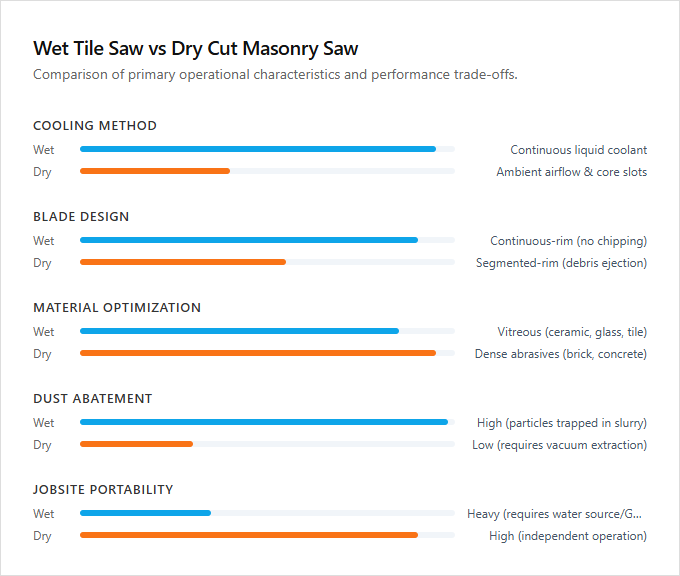
| Cooling Method | Wet tile saws utilize a continuous flow of liquid coolant from a water pump to prevent thermal stress, whereas dry cut masonry saws rely on ambient airflow and specialized heat-dissipating core slots. |
| Blade Design | Wet saws require continuous-rim diamond blades to prevent chipping on delicate surfaces, while dry masonry saws utilize segmented diamond blades designed to eject particulate debris and withstand extreme friction. |
| Material Compatibility | Wet tile saws are optimized for vitreous materials like ceramic, porcelain, and glass, whereas dry cut masonry saws are engineered for dense, heavy-duty abrasives such as brick, concrete, and pavers. |
| Dust Abatement | Wet cutting naturally suppresses hazardous crystalline silica dust by suspending particles in a slurry, while dry cutting requires integrated vacuum dust-extraction ports to maintain safety compliance. |
| Jobsite Portability | Dry cut masonry saws offer superior mobility due to the absence of water reservoirs and plumbing, whereas wet tile saws require a stable, GFCI-protected power source near a dedicated water supply. |
Continuous Wet vs. Segmented Dry Diamond Blades
Wet tile saws utilize continuous rim diamond blades, which require constant water lubrication to cool the steel core and flush away debris. This fluid-cooled process prevents thermal damage and friction, resulting in exceptionally smooth, chip-free cuts on delicate materials like ceramic, porcelain, and glass.
In contrast, dry-cut masonry saws employ segmented diamond blades. The deep gullets between the blade segments allow air to circulate and dissipate heat without water, facilitating fast, aggressive cutting through dense, heavy materials like concrete, brick, and stone.
Wet tile saws are ideal for precision-focused interior tilers requiring flawless finishes, whereas dry masonry saws best suit heavy-duty construction contractors and hardscapers who value cutting speed and portability on outdoor jobsites.
Integrated submersible water pump vs HEPA-vacuum dust extraction port
A wet tile saw utilizes an integrated submersible water pump to continuously feed water to the blade. This system cools the cutting surface and suppresses silica dust at the source, ensuring clean, chip-free cuts in delicate materials like glass, porcelain, and ceramic.
In contrast, a dry cut masonry saw relies on a HEPA-vacuum dust extraction port to manage airborne particulates. This dry system avoids the mess of slurry and is highly effective for heavy-duty materials like brick, concrete, and stone where water-free operation is preferred or required by indoor safety regulations.
Wet tile saws are ideal for indoor tile installers prioritizing precision and flawless finishes, while dry cut masonry saws are suited for construction contractors requiring mobility and rapid dust containment on diverse job sites.
Preventing Thermal Degradation: Water vs. Air Gullet Cooling
Wet tile saws utilize continuous water cooling to prevent thermal degradation of both the blade and the workpiece. This constant liquid flow absorbs intense frictional heat, protecting the diamond matrix from premature wear and ensuring clean, chip-free cuts in delicate ceramics and glass.
Dry cut masonry saws rely on air-cooling gullets engineered into the blade perimeter. These specialized segments generate airflow during high-speed rotation to disperse heat, allowing the tool to operate without water, though the blade remains susceptible to faster thermal fatigue under prolonged heavy use.
Wet tile saws are ideal for indoor tile installers requiring high-precision, dustless cuts, while dry cut masonry saws are best suited for outdoor bricklayers prioritizing speed and tool portability on rugged jobsites.
OSHA Table 1 compliance for respirable crystalline silica exposure control
Wet tile saws inherently comply with OSHA Table 1 regulations through integrated water delivery systems. This continuous flow suppresses respirable crystalline silica dust at the point of cutting, effectively eliminating the need for additional respiratory protection under standard operating conditions.
In contrast, dry cut masonry saws require rigorous alternative control measures to meet Table 1 standards. Operators must utilize a dust collection system equipped with a commercial shroud and a HEPA-filtered vacuum. Depending on task duration, workers may also need approved respiratory protection.
Wet tile saws are ideal for indoor tile installers requiring high-precision, dust-free finishes, while dry cut masonry saws are best suited for outdoor utility contractors prioritizing mobility and rapid setup.
High-RPM Dry Drivetrain vs. Water-Cooled Motor Torque
Dry cut masonry saws utilize high-RPM, brushed motor drivetrains to rapidly sever dense materials like concrete and brick. This high-velocity configuration prioritizes blade speed and portability, relying on ambient airflow for cooling, which allows for fast, water-free operation at the expense of dust control and motor longevity under continuous load.
Conversely, wet tile saws employ lower-speed, high-torque induction motors engineered for quiet, continuous duty. This design relies on a constant water feed to cool the blade and manage thermal stress, ensuring vibration-free, highly precise cuts through delicate glass, porcelain, and natural stone without chipping.
Dry masonry saws are ideal for outdoor hardscape contractors requiring rapid, mobile cuts on heavy site materials, while wet tile saws are best suited for finish tilers and renovators who demand dust-free, surgical precision indoors.
Abrasive Slurry Management vs. Airborne Dust Containment
Wet tile saws utilize a continuous water flow to suppress silica dust, transforming potential respiratory hazards into an abrasive slurry. Managing this liquid byproduct requires containment trays and diligent cleanup to prevent the mixture from hardening on surfaces or clogging local drainage systems.
Dry cut masonry saws rely on vacuum extraction and dust shrouds to capture airborne particulate matter at the point of cut. This dry method eliminates liquid waste but demands high-efficiency filtration to mitigate inhalation risks. Wet tile saws are ideal for indoor installers requiring dust-free precision, while dry cut masonry saws best suit outdoor contractors prioritizing rapid setup and mobility.
Ceramic Tile Chipping vs. Masonry Aggregate Penetration
Wet tile saws utilize a continuous water flow to cool the diamond blade and lubricate the cut. This constant lubrication minimizes thermal shock and friction, which is essential for preventing delicate chipping along the edges of vitreous ceramic tile, ensuring a clean, factory-grade finish on fragile glazed surfaces.
Dry cut masonry saws are engineered for high-speed, high-torque performance. They excel at rapid aggregate penetration, quickly slicing through dense concrete blocks, pavers, and brick. This dry cutting process prioritizes speed and raw cutting power over edge aesthetics in demanding outdoor construction environments.
Wet tile saws are ideal for detail-oriented interior tile installers who require flawless, chip-free edges, while dry cut masonry saws are best suited for heavy-duty hardscape contractors who prioritize speed and high-volume material reduction.
Leave a comment