
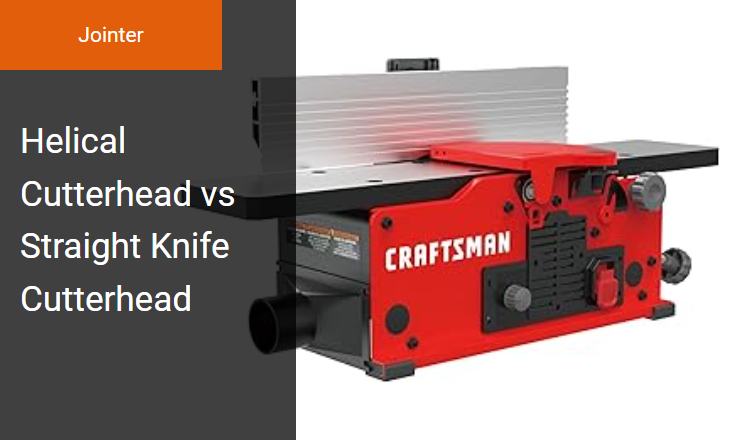
Achieving a perfectly flat, tear-out-free surface on figured hardwoods is a persistent frustration for woodworkers. Standard straight-knife jointers often leave chatter marks and tear delicate grain, leading to hours of tedious corrective sanding. Historically, operators have relied on traditional OEM straight-knife configurations and frequent blade-sharpening schedules, accepting these surface defects as standard operational overhead.
However, upgrading to a helical cutterhead grants shops unprecedented surface smoothness and a dramatic reduction in ambient noise. While helical heads deliver superior results, a necessary stipulation is their higher initial capital cost and the need for precise insert torqueing. Woodworking professionals utilizing carbide inserts, such as the Byrd Shelix system, routinely report flawless finishes on highly figured curly maple without the typical tear-out.
Below, we will compare straight knives and helical cutterheads across critical performance metrics, including cut quality, maintenance, noise levels, and long-term ROI, to help you optimize your jointer for peak performance.
| Factor | Summary |
|---|---|
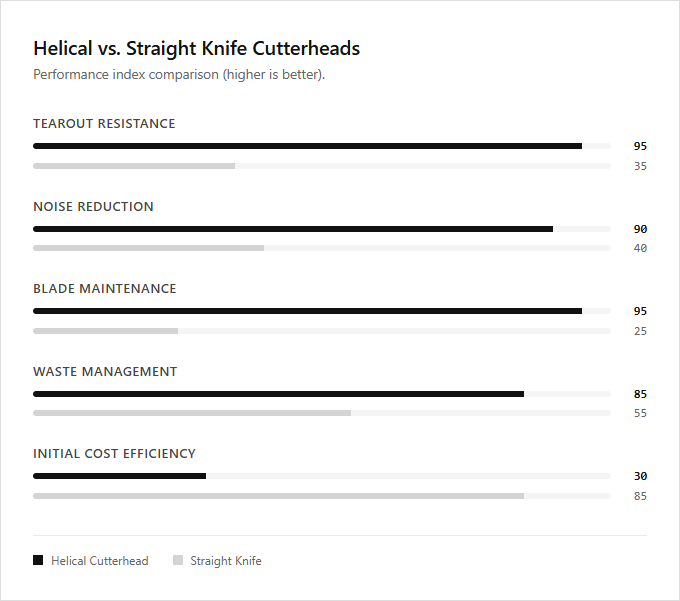
| Tearout Resistance | Helical cutterheads utilize indexed carbide inserts positioned at an angle to produce a shearing cut that drastically reduces tearout on figured grain compared to the straight impact of high-speed steel knives. |
| Noise Emission | The segmented design of helical cutterheads breaks up air pressure waves, resulting in a significantly lower decibel output during operation than the continuous wind-tunnel effect of straight knives. |
| Blade Maintenance | Individual carbide inserts in a helical head can be rotated to a fresh edge if nicked, whereas straight knives require complete removal and tedious height realignment. |
| Waste Management | Helical cutterheads produce smaller, uniform wood chips that improve dust collection efficiency and prevent chute clogging compared to the long, ribbon-like shavings generated by straight knives. |
| Initial Cost | While helical cutterheads demand a much higher upfront capital investment, their long-term cost-efficiency is superior due to the extreme durability of tungsten carbide over traditional tool steel. |
Shear angle geometry reducing grain tearout on figured hardwoods
When preparing figured hardwoods, the choice between a helical cutterhead and a traditional straight knife cutterhead significantly impacts surface quality. Traditional straight knives strike the wood parallel to the grain, which often leads to severe tearout on challenging grain patterns. In contrast, helical cutterheads position individual carbide inserts at an angled, shearing orientation. This shear angle geometry slices the wood fibers gradually rather than chopping them, which virtually eliminates grain tearout on highly figured species and produces an exceptionally smooth finish.
Beyond surface quality, helical cutterheads offer quieter operation and simpler maintenance, as individual damaged teeth can be rotated rather than replacing an entire knives set. Straight knife jointers are well-suited for budget-conscious hobbyists working primarily with straight-grained utility woods, whereas helical cutterhead machines are the ideal match for professional woodworkers and serious artisans who demand flawless results on premium, highly figured hardwoods.
Indexable carbide inserts minimizing maintenance downtime
Choosing between a helical and a straight knife cutterhead significantly impacts workshop efficiency. Traditional straight knives require tedious, precise alignment during replacement, leading to substantial downtime when blades dull. In contrast, helical cutterheads utilize indexable carbide inserts. If an insert chips, you simply rotate it to a fresh edge rather than replacing the entire system, greatly minimizing maintenance downtime.
Additionally, helical heads produce cleaner shear cuts and operate at a much lower noise level. While straight knives offer a lower initial investment, the long-term durability of carbide inserts reduces operating costs. Straight knife jointers are suitable for budget-conscious hobbyists working with standard lumber, whereas helical cutterheads are ideal for professionals requiring minimal upkeep and maximum precision on figured woods.
Ambient decibel reduction during high-speed cutterhead rotation
Standard straight knife cutterheads feature long, continuous blades that spin at high revolutions per minute, creating a significant fan-like siren effect as they chop the air and impact the workpiece. This traditional design generates substantial ambient noise, frequently exceeding 100 decibels, which necessitates constant, heavy-duty hearing protection in the workshop environment.
Helical cutterheads utilize small, individual carbide inserts arranged in a staggered spiral pattern. This configuration shears the wood progressively rather than striking it all at once, which dramatically minimizes aerodynamic drag and impact vibration. The design reduces ambient noise by up to 15 decibels during high-speed rotation, creating a significantly safer and more comfortable acoustic environment.
Straight knife jointers are ideal for budget-conscious hobbyists working in isolated workspaces, while helical cutterhead models are best suited for high-volume professionals and community shops prioritizing noise reduction and low maintenance.
Micro-chip formation optimizing dust extraction system CFM performance
The primary engineering distinction between helical and straight knife cutterheads lies in chip geometry and its subsequent impact on waste management. Helical cutterheads utilize small, angled carbide inserts to shear wood into uniform micro-chips. In contrast, traditional straight knife cutterheads produce long, curled shavings that occupy significant volume and easily entangle within extraction ductwork.
This difference in chip formation directly optimizes dust extraction system performance. The compact, dense micro-chips produced by helical heads flow aerodynamically, minimizing static pressure losses and preventing clogs. This allows dust collectors to operate at peak CFM (cubic feet per minute) efficiency, maintaining cleaner workshop environments with lower extraction demands.
Straight knife units remain suitable for budget-conscious hobbyists with basic extraction setups, whereas helical cutterheads are ideal for production-oriented woodworkers prioritizing maximum dust mitigation and low-maintenance operation.
Reduced motor horsepower draw from sequential cutter engagement
When comparing jointer cutterheads, the mechanical efficiency of sequential engagement is a primary differentiator. Traditional straight knife cutterheads impact the workpiece across its entire width simultaneously, creating significant, periodic resistance that spikes motor demand. In contrast, helical cutterheads feature small, staggered carbide inserts that shear the wood in a continuous, progressive sequence. This staggered entry minimizes the peak force required for each cut, significantly reducing the instantaneous horsepower draw on the motor.
By distributing the cutting workload, helical systems allow the machine to maintain consistent RPMs through dense hardwoods without straining the electrical drive. Straight knife jointers suit budget-conscious hobbyists who work primarily with softwoods, while helical cutterheads are ideal for high-volume professionals requiring maximum power efficiency and superior performance on figured lumber.
Precision-machined insert pockets eliminating dial indicator calibration
When evaluating jointer cutterheads, the primary distinction lies in maintenance efficiency and alignment precision. Helical cutterheads utilize individual carbide inserts seated in precision-machined pockets, a design that completely eliminates the need for tedious dial indicator calibration during blade replacements. Conversely, traditional straight knife cutterheads require meticulous manual alignment using specialized gauges whenever the knives are serviced, adding significant downtime to workshop workflows.
While straight knives offer a lower upfront cost, helical heads deliver quieter operation, smoother cuts on figured wood, and vastly simplified maintenance. High-production professionals seeking efficiency and flawless finishes find helical cutterheads indispensable, whereas hobbyists on a limited budget who tolerate manual setup tasks remain well-suited for traditional straight knives.
Higher initial capital expenditure offset by carbide edge wear life
When selecting a jointer, the choice between helical and straight knife cutterheads represents a balance of long-term value against upfront cost. Helical cutterheads require a higher initial capital expenditure, yet this investment is quickly offset by the superior wear life of their indexable carbide inserts. These carbide edges last up to ten times longer than traditional high-speed steel straight knives and can be individually rotated if damaged, significantly reducing maintenance downtime and sharpening costs.
While straight knife systems offer a lower entry price, they demand frequent calibration and complete blade replacements. High-volume professional woodworkers requiring precision on figured hardwoods will benefit most from the investment in a helical cutterhead, whereas occasional hobbyists working on standard softwoods are well-suited for the simplicity of a straight knife system.
Leave a comment