
Achieving and maintaining perfectly coplanar jointer beds is a persistent frustration for woodworkers seeking flawless, gap-free glue joints. When upgrading shop machinery, buyers typically look to standard capital equipment budgets or traditional workshop financing to fund these high-ticket acquisitions. However, selecting the optimal table design is what truly grants operators the lifetime precision and minimal maintenance downtime required for high-throughput production.
Under the stipulation that no cast-iron machine remains perfectly aligned indefinitely under heavy use, understanding the mechanical differences between adjustment systems is critical. Professional cabinetmakers and high-end millwork shops rely on this technical knowledge to maintain strict tolerances over years of operation.
This comparative analysis examines the structural differences, ease of calibration, and long-term alignment durability of parallelogram versus dovetailed way jointers, providing the essential insights needed to make an informed investment for your shop.
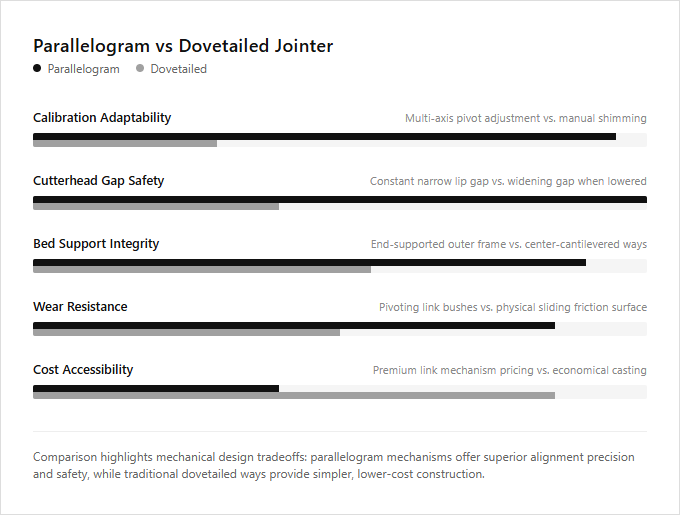
| Factor | Summary |
|---|---|
| Table Adjustment Mechanism | Parallelogram jointers utilize eccentric bushings and parallel linkages to raise and lower the beds, whereas dovetailed jointers rely on sloped cast-iron ways and adjustable gibs for height translation. |
| Cutterhead Gap Maintenance | The parallelogram design maintains a constant, tight clearance between the table lip and the cutterhead during depth adjustments, while the dovetailed design causes this gap to widen significantly as the table is lowered. |
| Co-planarity Calibration | Adjusting the infeed and outfeed tables to be perfectly co-planar is highly adjustable on a parallelogram jointer via multi-axis pivot points, whereas a dovetailed jointer requires tedious manual shimming of the sliding ways. |
| Structural Bed Support | Parallelogram jointers support the long cast-iron tables closer to their outer edges to prevent sagging, while dovetailed jointers rely on a central cantilevered design that can experience deflection over time. |
| Cost and Wear Longevity | Dovetailed jointers offer a simpler, more economical traditional design but are susceptible to physical wear along the sliding mating surfaces, whereas parallelogram units feature complex pivoting link-arms that command a premium price. |
Parallelogram vs. Dovetailed Jointer Table Travel
Dovetailed jointers utilize linear inclined travel along machined ways, moving the table diagonally down and away from the cutterhead. In contrast, parallelogram jointers feature an arcuate travel path, where the table pivots along a curved arc. This arcuate movement maintains a constant, tight clearance between the table lip and the cutterhead at all depth settings, which minimizes tear-out and enhances operator safety.
While linear inclined ways are mechanically simple, they can develop sag over time and require tedious manual shimming. Parallelogram mechanisms allow for independent, multi-axis adjustments to maintain coplanar tables with high precision. Traditional dovetailed models suit hobbyists looking for simple, cost-effective machinery, while highly adjustable parallelogram jointers are ideal for professional woodworkers requiring absolute precision and frequent calibration.
Parallelogram vs. Dovetailed: Cutterhead Gap Comparison
In professional woodworking, the mechanism governing table movement dictates jointer performance and safety. Parallelogram jointers utilize a four-point pivoting link system to adjust table height. This sophisticated design maintains a constant, minimal throat clearance between the table edge and the cutterhead throughout the entire range of cut depths, which optimizes workpiece support and significantly reduces tear-out near the knives.
Dovetailed jointers employ angled ways that slide the tables diagonally. As the table lowers for deeper cuts, the physical gap between the table and the cutterhead widens, creating a variable throat clearance that can compromise dust collection and edge support. Professional woodworkers requiring maximum precision and safety benefit most from parallelogram systems, while budget-conscious hobbyists and occasional users find dovetailed designs highly sufficient for standard projects.
Eccentric Bushings vs. Gib Shimming for Coplanar Calibration
Parallelogram jointers utilize parallel linkages and eccentric bushings to adjust the infeed and outfeed tables. This engineering allows for precise, multi-axis coplanar calibration across four separate pivot points. Technicians can easily align the tables parallel to the cutterhead and to each other, maintaining a tight, safe gap near the cutterhead throughout the entire depth-of-cut range.
In contrast, traditional dovetailed jointers move along sloped ways, relying on manual gib screw adjustments and physical shimming for alignment. This method can be tedious and time-consuming, as it offers limited lateral adjustment control compared to the fluid movement of eccentric bushings. Parallelogram models suit high-volume commercial woodworkers requiring frequent, micro-fine calibration, while dovetailed units are ideal for hobbyists seeking a budget-friendly, set-and-forget machine.
Parallel Link Pivot Wear vs. Linear Slideway Friction
Parallelogram jointers utilize a four-point parallel link system to adjust table height, maintaining a tight, constant arc around the cutterhead. Because this motion relies on rotating pins, the pivot joints experience minimal, localized wear. This design allows the tables to remain highly co-planar over extended periods without requiring frequent user calibration.
Dovetailed jointers employ linear slideways where the table slides along angled ways. This configuration is subject to continuous sliding friction and relies on adjustable metal gibs to maintain tightness. Over time, uneven gib compression and wear can introduce table sag, necessitating manual adjustments to restore coplanar alignment.
The parallelogram design offers superior alignment retention, whereas the traditional dovetailed jointer provides a simpler, more compact mechanism. Production-scale woodworkers requiring constant precision and minimal downtime prefer the parallelogram jointer, while budget-conscious hobbyists or traditional machinists favor the straightforward maintenance of the dovetailed design.
Dovetailed Slideways vs. Parallelogram Linkage Supports
Dovetailed jointers utilize angled slideways to guide the tables during depth adjustments. This traditional design relies on cantilevered table support, which concentrates the physical load on the inner end of the bed. Over time, the leverage exerted by heavy lumber can cause these tables to sag, requiring meticulous manual adjustment of the gibs to restore coplanar alignment.
Conversely, parallelogram jointers feature a four-point, distributed linkage system that supports the bed along its entire length. This configuration maintains a constant, tight clearance between the table lip and the cutterhead at all cutting depths, preventing sag and ensuring permanent precision under heavy loads. Dovetailed machines suit budget-conscious hobbyists working with shorter stock, whereas parallelogram models are ideal for production-grade woodworkers requiring uncompromising accuracy with massive timbers.
Parallelogram vs. Dovetailed Bed Height Adjustments
Parallelogram jointers utilize a four-point pivoting system to adjust table height. This design keeps the table edge close to the cutterhead throughout its arc of travel, maintaining a consistent, narrow gap that improves safety and reduces tear-out. Height changes are made via quick-action levers, allowing operators to make rapid depth adjustments with minimal physical effort.
Dovetailed jointers feature angled slide ways where the tables move along a straight diagonal path. This movement is driven by traditional handwheels and leadscrews, offering highly precise, micro-adjustable depth control. Although the gap between the table and cutterhead widens at deeper settings, this design is renowned for its robust mechanical simplicity and rock-solid stability.
The lever-operated parallelogram jointer is best for high-volume shops needing quick setup changes, whereas the handwheel-driven dovetailed jointer is suited for detail-oriented woodworkers who value incremental precision and long-term durability.
Torsional Rigidity vs. Linkage Pivot Tolerance
Dovetailed jointers rely on solid cast-iron ways machined directly into the machine base. This configuration offers exceptional torsional rigidity, preventing table deflection under heavy workpiece downforce. The linear, angled travel of these ways ensures robust stability, though adjusting the depth of cut alters the critical gap between the table edge and the cutterhead.
Conversely, parallelogram jointers adjust via a four-point linkage system, moving the tables in a tight arc to maintain a constant distance from the cutterhead. While this design enhances safety and chip collection, its long-term alignment depends entirely on the tight rotational pivot tolerance of the linkages. Traditional dovetailed models suit high-volume production shops seeking rugged, low-maintenance longevity, while parallelogram designs are ideal for precision woodworkers who prioritize micro-adjustments and close-to-cutterhead safety.
Leave a comment