
Equipping a professional or serious home workshop with a heavy-duty jointer often leads to a frustrating bottleneck: choosing the right induction motor phase. Many woodworkers struggle to balance their need for raw, consistent milling power with the existing electrical limitations of their facility.
While standard equipment funding sources and capital budgets can easily secure a high-end machine, the physical utility connection often dictates reality. However, making the right electrical choice grants workshops unmatched torque, lower operating temperatures, and extended tool longevity.
To manage expectations, our technical stipulation section outlines the critical requirements-and hidden costs-of utilizing phase converters in residential spaces. For instance, heavy-duty setups like the Powermatic 1285 jointer showcase how industrial-grade three-phase power optimizes performance under load.
In this article, we will compare single-phase and three-phase jointer motors, analyze conversion costs, and help you identify the optimal electrical configuration for your woodworking demands.
| Factor | Summary |
|---|---|
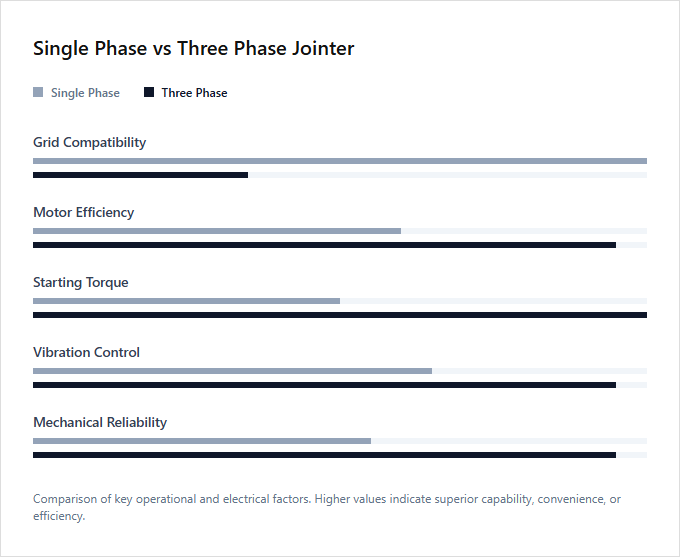
| Power Source | Single-phase jointers run on standard residential utility grids, whereas three-phase jointers require industrial power distribution systems or a phase converter. |
| Motor Efficiency | Three-phase induction motors operate with higher electrical efficiency and less heat generation compared to their single-phase counterparts. |
| Starting Torque | Three-phase jointers deliver constant, high starting torque without needing capacitors, while single-phase motors rely on start capacitors to initiate rotation. |
| Vibration and Cut Quality | The continuous power delivery of three-phase current minimizes rotational speed fluctuation, resulting in reduced vibration and a smoother finish on the workpiece. |
| Internal Components & Reliability | Single-phase motors utilize mechanical centrifugal switches that are prone to wear, whereas three-phase motors feature a simpler design with fewer failure points. |
Single-Phase vs. Three-Phase Motor Starting
When selecting a wood jointer, the choice between single-phase and three-phase motors directly impacts the machine's internal complexity and operational efficiency. Single-phase motors rely on auxiliary start capacitors and centrifugal switches to initiate rotor movement from a standard electrical supply. In contrast, three-phase motors inherently produce a self-starting rotating magnetic field through three distinct alternating currents, which eliminates the need for these additional mechanical wear components and ensures smoother power delivery.
The optimal choice depends on your workshop's existing electrical infrastructure and production volume. Single-phase jointers are ideal for home hobbyists and small-scale woodworkers operating on standard residential grids, whereas three-phase models are best suited for industrial manufacturers and high-output professionals requiring maximum continuous torque and energy efficiency.
Smoother Jointer Finishes with Three-Phase Motors
When selecting a jointer, the choice between single-phase and three-phase motors significantly impacts machining performance. Single-phase jointers are standard in residential workshops, but they experience inherent power fluctuations. In contrast, three-phase motors deliver continuous, overlapping power phases. This constant power delivery exhibits significantly lower torque ripple, which minimizes motor vibration during operation.
This reduction in vibration directly translates to a smoother cutterhead rotation and a superior wood surface finish. With fewer harmonic disturbances, the knives make more consistent contact with the timber, reducing tear-out and machining marks. Single-phase units are best suited for hobbyists and home DIYers operating on standard household power, while three-phase jointers are ideal for industrial professionals requiring flawless precision and continuous, high-volume production.
Single-Phase VFD Control for Three-Phase Motors
When selecting a jointer, the electrical configuration determines the machine's power delivery and operational flexibility. Single-phase models are the standard for residential workshops due to their direct compatibility with standard household grids. In contrast, three-phase jointers offer superior efficiency and torque consistency, which are traditionally restricted to industrial facilities. By integrating a Variable Frequency Drive (VFD), woodworkers can successfully operate an industrial three-phase jointer on standard single-phase residential power.
This VFD configuration provides a significant advantage beyond basic phase conversion, introducing precise electronic speed control to match the cutterhead rotation to specific wood species and grain profiles. Adjusting the RPM helps minimize tear-out on highly figured hardwoods while maintaining optimal torque at lower speeds. Single-phase jointers are ideal for hobbyists seeking plug-and-play simplicity, whereas three-phase units paired with a VFD suit demanding professionals and advanced woodworkers who require industrial-grade durability and precise speed customization.
Three-Phase Motors: Superior Efficiency and Power Factor
When selecting a jointer for professional woodworking, the choice between single-phase and three-phase power significantly impacts operational performance. Three-phase induction motors operate with a higher power factor and superior energy efficiency compared to their single-phase counterparts. This efficiency stems from a continuous, balanced power delivery that reduces heat generation, minimizes mechanical vibration, and maintains consistent cutterhead speed during heavy stock removal.
Single-phase jointers offer excellent utility in standard workshop environments, avoiding the need for specialized electrical infrastructure or phase converters. Professional woodworkers operating in dedicated industrial facilities benefit most from the high-throughput capability of three-phase jointers, whereas hobbyists and small-scale artisans will find the straightforward installation of single-phase models ideal for their workshop needs.
Wiring Advantages of Three-Phase Jointers
When selecting a jointer for a woodworking facility, the choice between single-phase and three-phase power significantly impacts your electrical infrastructure. Operating a jointer on three-phase power reduces the full-load amperage, allowing for smaller wire gauges and lighter breaker requirements. This electrical efficiency simplifies installation and lowers overall wiring costs, especially when setting up multiple high-horsepower machines in a production environment.
While three-phase motors offer superior efficiency and balanced power delivery, single-phase models remain the standard for locations without industrial power access. Single-phase jointers are ideal for hobbyists, independent artisans, and small-scale workshops requiring straightforward utility compatibility, whereas three-phase jointers are suited for industrial manufacturing managers and high-volume commercial shops seeking optimized energy performance during continuous operations.
Cool-Running Three-Phase Motors for Heavy Jointing
When selecting a jointer for a professional woodworking facility, the distinction between single-phase and three-phase power configurations is critical for operational efficiency. Three-phase motors feature superior thermal dissipation and a continuous duty cycle rating, preventing overheating during heavy jointing operations. This robust electrical design ensures consistent torque and a prolonged machinery lifespan under constant, high-volume workloads.
While single-phase jointers operate on standard utility grids, they lack the same thermal capacity under prolonged, heavy use. Single-phase models are best suited for home hobbyists and small custom woodworkers with intermittent production schedules, whereas three-phase machines are ideal for industrial manufacturers requiring continuous, heavy-duty processing.
Easy Three-Phase Motor Reversal
When selecting a jointer for a woodworking facility, the choice between single-phase and three-phase motors significantly impacts installation and machinery calibration. A key operational distinction lies in how these systems handle directional rotation. In a three-phase jointer motor, reversing the cutterhead rotation is easily achieved by swapping any two of the three stator power leads. In contrast, single-phase motors require a complex reconfiguration of internal terminal connections and winding leads to alter the motor's operating direction.
Beyond rotation control, three-phase systems deliver superior efficiency and constant torque under heavy stock removal, whereas single-phase units offer compatibility with standard electrical grids. Single-phase jointers are ideal for hobbyists and small workshop owners seeking straightforward utility, while three-phase models are best suited for industrial professionals who require continuous, high-capacity performance and have access to industrial power infrastructure.
Leave a comment