
Choosing between a magnetic drill press and a traditional benchtop model often leaves fabricators and machinists caught in a frustrating compromise between on-site versatility and workshop precision. Selecting the wrong configuration risks project delays, wasted material, and compromised operator safety. While workshop managers typically look to standard equipment acquisition budgets or traditional tool-procurement channels to resolve these capacity bottlenecks, the solution requires a deeper technical analysis of the application at hand.
Understanding the core mechanics of each system grants operators unprecedented efficiency and long-term cost savings. However, a key stipulation remains: magnetic drills strictly require a flat, ferrous surface to secure their electromagnetic base, whereas benchtop models depend on stationary, mechanical clamping. For example, drilling structural steel H-beams on-site relies heavily on portable annular cutting, whereas repetitive, high-tolerance machining of non-ferrous aluminum brackets requires a stationary spindle.
This article evaluates both configurations, comparing their cutting mechanisms, portability, and material compatibility to guide your optimal purchasing decision.
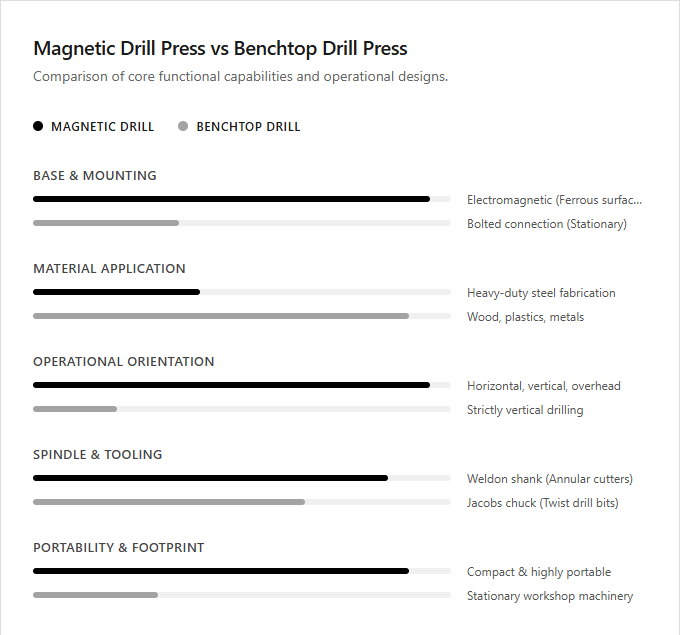
| Factor | Summary |
|---|---|
| Base and Mounting | Magnetic drill presses utilize an electromagnetic base to secure themselves directly to ferrous metal workpieces, whereas benchtop drill presses require a bolted connection to a stationary workbench. |
| Material Application | Magnetic drills are engineered specifically for heavy-duty steel fabrication and structural steelwork, while benchtop models offer versatile machining capabilities for wood, plastics, and non-ferrous metals. |
| Operational Orientation | The magnetic base allows for horizontal, vertical, or overhead drilling operations on-site, whereas benchtop models are strictly restricted to stationary vertical drilling. |
| Spindle and Tooling | Magnetic drill presses often feature a Weldon shank spindle optimized for annular cutters, while benchtop drill presses typically utilize a standard keyed or keyless Jacobs chuck for twist drill bits. |
| Form Factor and Portability | Benchtop drill presses are designed as stationary workshop machinery with a large physical footprint, whereas magnetic drills are compact, highly portable units engineered for field construction. |
Electromagnetic base adhesion force versus stationary cast-iron worktable mounting
Magnetic drill presses rely on a powerful electromagnetic base that adheres directly to thick ferrous metals. This magnetic force enables the tool to operate in vertical, horizontal, or overhead positions, providing exceptional mobility for drilling large, immovable steel structures directly on-site.
Benchtop drill presses utilize a heavy, stationary cast-iron worktable mounted to a workbench. This design offers a rigid and stable platform that effectively dampens vibration, ensuring precise, repetitive drilling through various materials using traditional mechanical clamps.
Field-based fabricators and structural steel workers requiring portability choose the magnetic drill press, whereas workshop-based woodworkers and metal fabricators prioritizing static precision prefer the benchtop model.
Weldon shank annular cutters versus Jacobs chuck twist drill bits
Magnetic drill presses utilize Weldon shank annular cutters to core out large-diameter holes in heavy steel. This system relies on a dual-flat locking mechanism that prevents slippage under high torque. Because these cutters remove only the periphery of the hole, they require significantly less power and time than solid bits.
Benchtop drill presses feature a Jacobs chuck to secure standard round-shank twist drill bits. This setup offers immense versatility for drilling smaller, various-sized holes in wood, plastics, and lighter metals. The three-jaw chuck system allows for quick adjustments across a wide range of shank diameters.
Structural steel fabricators requiring on-site portability and heavy metal boring excel with the magnetic drill press, whereas workshop hobbyists and general woodworkers are best served by the stationary versatility of the benchtop model.
Pilot Pin Slug Ejection vs. Manual Quill Clearance
Magnetic drill presses utilize specialized annular cutters paired with a spring-loaded pilot pin. This design automates the ejection of the core steel slug immediately upon hole completion, maximizing efficiency and safety during repetitive metal fabrication by eliminating manual debris clearance.
In contrast, benchtop drill presses rely on twist drill bits operated via a manual quill stroke. Operators must actively control the plunge depth and manually retract the spindle to clear packed wood chips or metal shavings from the workpiece, offering greater tactile feedback at the expense of automated speed.
Structural steel fabricators requiring rapid, repeatable drilling on-site benefit most from the efficiency of magnetic models, while workshop hobbyists and light manufacturers needing versatile depth control across diverse materials prefer benchtop units.
On-site structural steel positioning versus fixed workshop perpendicular spindle alignment
Magnetic drill presses are engineered for exceptional on-site versatility, utilizing a powerful electromagnetic base to adhere directly to ferrous metal surfaces. This specialized design enables operators to perform precise drilling on structural steel beams in vertical, horizontal, or overhead orientations, eliminating the need to transport massive structural components to a workshop.
In contrast, benchtop drill presses are stationary workshop fixtures designed to prioritize rigid, perpendicular spindle alignment. These machines feature stable, cast-iron tables and adjustable columns that guarantee highly accurate, repeatable vertical holes through diverse workpieces under controlled environmental conditions.
Mobile ironworkers and structural steel fabricators require the portable, surface-clinging power of the magnetic drill, whereas precision machinists and furniture makers depend on the fixed, perpendicular consistency of the benchtop model.
Integrated gravity-fed coolant arbor versus external manual cutting fluid application
Magnetic drill presses feature an integrated gravity-fed coolant arbor that automatically delivers cutting fluid directly to the cutter during operation. This continuous, hands-free lubrication system maintains optimal operating temperatures, significantly extending tool life and ensuring clean, precise holes through thick steel plates.
Benchtop drill presses rely on external, manual cutting fluid application, requiring operators to pause or manually apply oil with a squeeze bottle or brush. This method demands more active attention and can disrupt the drilling workflow, but it offers excellent flexibility for general workshop tasks where different materials are processed.
Magnetic units are best suited for industrial ironworkers and field fabricators tackling thick structural steel, while benchtop models are ideal for woodworkers and light-duty hobbyists seeking a versatile, stationary machine for varied workshop projects.
Slide-way travel mechanism versus rack-and-pinion table elevation
Magnetic drill presses utilize a precision slide-way travel mechanism, where the entire motor and spindle assembly moves along machined gibs integrated into the frame. This design ensures exceptional rigidity and minimal deflection, which is critical when drilling through heavy steel plates where the tool is magnetically secured directly to the workpiece.
Conversely, benchtop drill presses employ a rack-and-pinion mechanism to elevate and lower the worktable along a vertical column. While this system allows for quick, versatile height adjustments to accommodate various material thicknesses, the multiple moving components can introduce slight deflection compared to the fixed-slide design.
Heavy-duty steel fabricators and field structural engineers benefit most from the rigid, high-precision slide-way of magnetic drills, whereas hobbyists and general woodworkers require the adaptable rack-and-pinion table of a benchtop model for diverse workshop tasks.
Morse taper spindle compatibility versus direct-drive motor configurations
Magnetic drill presses often feature Morse taper spindles, allowing operators to quickly swap between heavy-duty twist drills, annular cutters, and specialized tooling. This spindle compatibility provides the mechanical rigidity required for high-torque, on-site steel fabrication where the tool secures directly to the workpiece.
Benchtop drill presses, by comparison, frequently employ direct-drive motor configurations or belted pulley systems. This stationary setup prioritizes consistent vertical alignment and precise speed control for repetitive workshop tasks on a stable table.
Magnetic models suit structural steel fabricators and field technicians needing portable, heavy-duty drilling on existing steel structures, while benchtop units are ideal for woodworkers and precision machinists requiring a stationary workshop fixture.
Leave a comment