
Selecting the right power drill often begins with a common, costly frustration: a tool stalling mid-task when driving heavy fasteners into dense materials. Traditionally, operators attempt to resolve this by simply increasing their tool acquisition budgets or relying on battery voltage as a primary indicator of performance. However, securing the right tool requires looking beyond these standard metrics.
Prioritizing the underlying motor engineering grants users a distinct competitive advantage, unlocking maximum torque efficiency and vastly extended tool lifespans. Crucially, this selection operates under the stipulation that peak torque must be balanced with thermal management; raw power is useless if a tool overheats during demanding applications, such as driving heavy-duty lag bolts into structural timber.
This article provides an objective comparison of brushless versus brushed motors. We will analyze how these competing designs impact continuous torque output, maintenance requirements, and overall return on investment, guiding you to the optimal power drill for your operational needs.
| Factor | Summary |
|---|---|
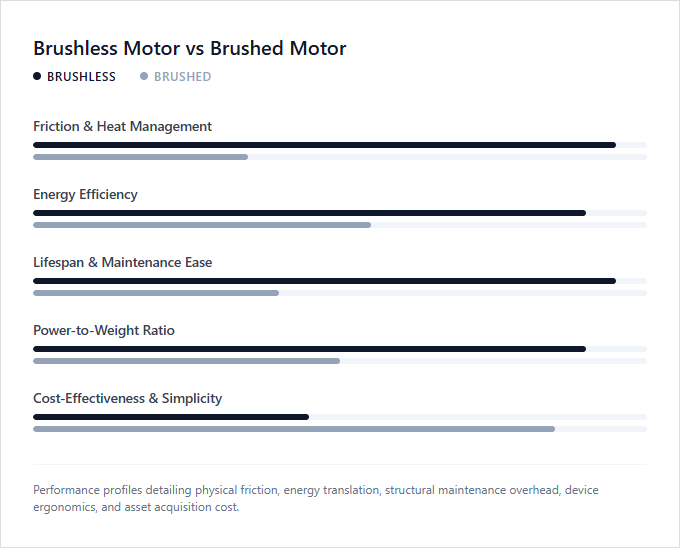
| Friction and Heat Generation | Brushless motors eliminate physical carbon brushes, significantly reducing mechanical friction and thermal loss during operation. |
| Energy Efficiency | By utilizing an electronic controller rather than a mechanical commutator, brushless drills optimize current flow to extend battery runtime. |
| Maintenance and Lifespan | Brushed motors require regular replacement of wearing components, whereas brushless systems sustain less mechanical wear for a longer service life. |
| Power-to-Weight Ratio | Brushless technology delivers superior torque density, allowing the power tool to be more compact while maintaining high rotational force. |
| Cost and Complexity | The integration of sophisticated microcontrollers and sensors increases the initial manufacturing cost of brushless drills compared to simpler brushed models. |
How Brushless Drills Optimize Torque
When selecting a drill power tool, the choice between brushed and brushless motors significantly impacts performance. Brushless drills utilize an electronic speed controller to continuously adjust current for optimized torque output. This smart system senses resistance and delivers only the required power, reducing friction, heat buildup, and energy waste. In contrast, brushed motors rely on physical carbon brushes that deliver constant power regardless of the load, leading to higher wear and lower efficiency over time.
These technological differences dictate the ideal application for each tool type. Brushless models offer superior longevity and runtime, while brushed alternatives remain cost-effective and simpler to maintain. Professional contractors requiring maximum efficiency and daily durability benefit most from brushless drills, whereas occasional DIY hobbyists seeking budget-friendly tools find brushed models perfectly adequate for light household tasks.
Eliminating Friction Maximizes Brushless Motor Torque
When selecting a drill power tool, the mechanical distinction between brushless and brushed motors directly impacts performance. In brushless motors, the lack of commutator friction eliminates mechanical energy loss, maximizing torque efficiency and preserving battery life. Because the internal components do not physically rub together, these tools generate less heat and deliver more consistent power under heavy loads.
Standard brushed motors rely on carbon brushes that rub against the commutator, leading to unavoidable energy loss, friction, and eventual component wear. Professional contractors requiring high torque and daily reliability will benefit most from brushless drills, while occasional DIYers seeking an affordable tool for simple household tasks are well-suited for traditional brushed models.
How Rotor Magnets Maximize Brushless Motor Power
When selecting a drill power tool, understanding the underlying motor technology is essential for matching the tool to your operational needs. Brushless motors mount permanent magnets on the rotor to allow for a larger stator winding that generates stronger magnetic fields. This innovative configuration eliminates physical carbon brushes, resulting in reduced friction, minimal heat buildup, and a highly efficient transfer of electrical energy into mechanical power.
Conversely, traditional brushed motors rely on mechanical contacts that wear down over time, limiting their overall lifespan and power density. While brushed drills offer a cost-effective solution for straightforward applications, brushless models provide superior torque and extended battery runtime under heavy loads. Budget-conscious DIYers undertaking occasional household projects are well-suited for brushed drills, whereas trade professionals demanding maximum durability and continuous performance will benefit most from brushless power tools.
Dynamic Torque Control in Brushless Drills
When selecting a drill, the choice between brushed and brushless motors depends heavily on efficiency and power delivery. Brushed motors rely on physical carbon brushes to transfer current, resulting in friction and energy loss. In contrast, brushless motors utilize an electronic controller to manage power. This digital integration enables a closed-loop feedback system that continuously monitors electromagnetic resistance. When the drill encounters a heavy load, this system senses the resistance and dynamically increases torque to maintain performance.
This smart adjustment ensures optimal battery usage and prevents overheating under demanding conditions. Budget-conscious DIY enthusiasts typically prefer reliable brushed drills for occasional household tasks, whereas professional contractors and high-frequency users require the smart efficiency and superior torque control of brushless models.
Advanced Brushless Cooling Sustains Peak Torque
When selecting a drill power tool, the mechanical distinction between brushless and brushed motors directly impacts performance longevity. Brushless motors eliminate physical carbon brushes, drastically reducing internal friction and energy loss. This advanced design facilitates exceptional thermal dissipation, which prevents overheating and maintains high torque during extended duty cycles under heavy loads.
In contrast, brushed motors rely on physical contact to deliver current, generating friction and heat that can degrade performance over time. While brushed drills remain a highly cost-effective option, brushless models deliver the sustained power necessary for demanding, continuous operations. Professional contractors requiring maximum efficiency and durability will benefit most from brushless tools, whereas weekend DIY hobbyists will find the simpler, traditional brushed design perfectly suited for periodic household tasks.
Brushless Technology: Maximum Torque, Lightweight Design
When selecting a drill power tool, the choice between brushless and brushed motors represents a critical decision in tool efficiency and lifespan. Brushless technology provides a superior power-to-weight ratio, yielding maximum torque from a lightweight drill casing. By eliminating the physical brushes, these motors experience less friction and heat buildup, which translates directly into extended battery runtime and enhanced motor longevity under demanding workloads.
Traditional brushed motors rely on mechanical contact to deliver power, offering a simpler, highly cost-effective alternative that remains popular for standard applications. Professional contractors and heavy-duty users requiring maximum performance will benefit most from brushless models, whereas casual DIYers and homeowners seeking budget-friendly tools for light maintenance will find brushed drills perfectly suitable.
Why Brushed Motors Permanently Lose Torque
When selecting drill power tools, understanding the mechanical differences between brushed and brushless motors is essential for long-term performance. Brushed motors rely on physical carbon brushes to deliver current, a design that inherently leads to voltage arcing and progressive brush degradation. This ongoing friction and electrical wear permanently reduces the tool's maximum torque capacity over time, diminishing overall efficiency and power output.
Brushless motors eliminate physical contact by utilizing electronic controllers to manage energy delivery. This friction-free operation prevents power degradation, offering consistent torque and superior energy efficiency throughout the tool's lifespan. Brushed drills remain ideal for budget-conscious DIYers undertaking occasional home repairs, while brushless models are best suited for professionals requiring sustained high performance and durability on demanding jobsites.
Leave a comment