
Selecting the incorrect speed on an oscillating multi-tool often leads to scorched workpieces, melted plastics, or prematurely worn accessories-a frustrating setback for any craftsman. While many professionals rely on standard tool power baselines and default manufacturer guidelines as their primary operational resources, these generic starting points rarely yield perfect results.
Mastering variable Oscillating Runs Per Minute (OPM) grants operators the precise control needed to transition from aggressive demolition to delicate finishing seamlessly. However, this level of execution carries the stipulation that higher speed does not inherently guarantee faster or better results; material density and accessory design dictate the thermal threshold. For instance, when plunge-cutting hardwood oak trim or detail-sanding soft pine veneers, the correct OPM configuration acts as the deciding factor between a flawless finish and a ruined workpiece.
In this guide, we will analyze the technical differences between high and low OPM settings, outline optimal speeds for key materials, and provide a systematic framework for selecting the perfect speed for your next project.
| Factor | Summary |
|---|---|
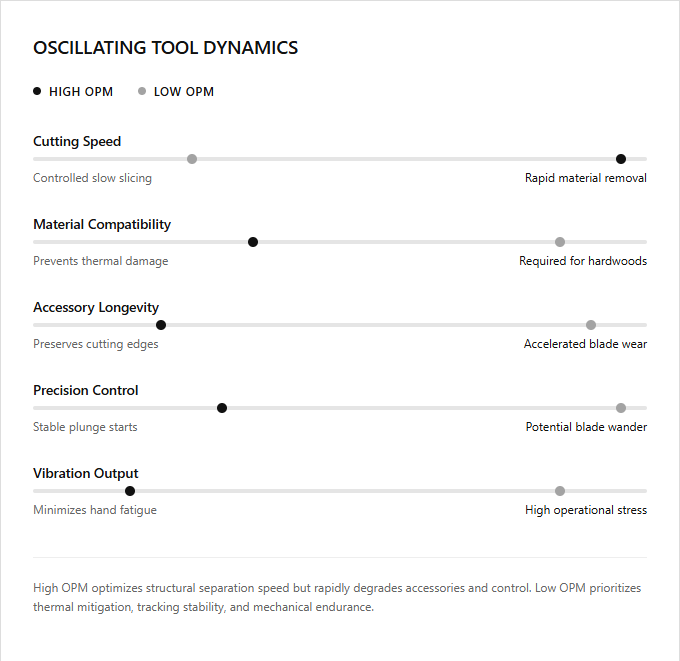
| Cutting Speed | High OPM maximizes the material removal rate for rapid slicing, whereas low OPM is utilized for slower, highly controlled cuts. |
| Material Compatibility | Low OPM prevents the thermal degradation of sensitive materials like plastics, while high OPM is required to efficiently cut dense hardwoods. |
| Accessory Longevity | High OPM subjects the blade to intense friction-induced heat, whereas low OPM preserves the cutting edge of bi-metal accessories. |
| Precision Control | Low OPM significantly reduces blade wander during the initial plunge cut, whereas high OPM offers less starting stability. |
| Vibration Output | High OPM increases the resonance amplitude transferred to the operator, whereas low OPM minimizes fatigue during extended use. |
Maximizing Hardwood Plunge Cutting MRR with High OPM
When executing plunge cuts in dense hardwoods, maximizing the material removal rate requires operating the oscillating multi-tool at high oscillations per minute (OPM). High OPM, typically ranging from 18,000 to 22,000, allows the accessory blade to shear wood fibers rapidly, preventing the tool from binding under load. This rapid action facilitates efficient sawdust clearance from the kerf, maintaining continuous cutting momentum without scorching the hardwood.
Lower OPM settings reduce frictional heat and provide greater control over delicate tasks. High OPM is favored by professional contractors and carpenters demanding maximum speed and productivity for heavy-duty installations, while low OPM is suited for detailed restorers and craftspeople handling fragile, heat-sensitive materials.
Preventing Thermoplastic Thermal Degradation via Low OPM
Oscillating multi-tools rely on Oscillations Per Minute (OPM) to execute precise cuts across various substrates. While high OPM settings maximize material removal rates in wood or metal, they generate significant friction-induced heat. When working with thermoplastic workpieces, this excessive thermal energy quickly leads to melting, warping, and structural degradation of the polymer.
Regulating the tool to a lower OPM mitigates this thermal risk by limiting friction at the contact point. This speed reduction allows the blade to shear through thermoplastics cleanly without reaching the material's melting point, preserving workpiece integrity and preventing blade gumming.
High-speed OPM configurations are ideal for heavy-duty construction contractors requiring rapid demolition, whereas low-speed OPM adjustments are essential for precision fabricators and model makers working extensively with heat-sensitive polymers.
Reducing Grit Loading in Low-OPM Detail Sanding
High oscillation-per-minute (OPM) settings excel at rapid material removal but generate significant friction heat. This thermal buildup softens wood resins, paints, and finishes, causing debris to quickly clog the abrasive paper and melt the hook-and-loop backing pad.
Operating at a lower OPM mitigates this issue by reducing friction and maintaining cooler temperatures. This prevention of thermal melting ensures that sanding dust remains loose and easily evacuates, minimizing grit loading and protecting the delicate hook-and-loop attachment system from heat degradation.
High-OPM operation is best suited for heavy demolition and rapid material removal by construction professionals, whereas low-OPM functionality is ideal for detail woodworkers and refinishers seeking precise control and extended abrasive life.
Preventing Bi-Metal Blade Tooth Stripping at Low OPM
Oscillating multi-tools operate across a wide range of speed settings, typically measured from 10,000 to over 20,000 oscillations per minute (OPM). While high OPM values excel at rapid wood cutting and efficient sanding, selecting the correct speed is critical when tackling harder materials to prevent premature accessory failure.
When cutting ferrous metals with bi-metal blades, utilizing a lower OPM significantly mitigates the risk of tooth stripping. High-speed oscillations generate excessive friction and heat, which rapidly softens the high-speed steel teeth and leads to immediate blade destruction. Reducing the speed maintains a manageable thermal threshold, allowing the bi-metal teeth to effectively shear the metal without fracturing.
High-OPM operation is best suited for high-production contractors requiring rapid demolition and wood slicing, whereas low-OPM functionality is indispensable for precision metalworkers and HVAC technicians who require maximum blade longevity and controlled, burr-free cuts.
Low-OPM Oscillation Control for Precision Joint Cleaning
High oscillations per minute (OPM) suit rapid material removal, whereas low OPM settings offer superior control. When performing high-precision joint cleaning, operating at a lower OPM minimizes oscillation angle deflection. This reduction in lateral deviation prevents damage to surrounding surfaces and ensures clean, sharp grout or adhesive removal.
By stabilizing the blade's swing path, the reduced speed allows for micro-adjustments along delicate seams. High OPM provides the necessary speed for demolition, while low OPM delivers the mechanical stability required for detailed restoration. High-OPM settings are ideal for construction workers focused on rapid bulk removal, while low-OPM control is suited for restoration specialists requiring meticulous detail.
Constant Speed Under Load at High OPM
Oscillating multi-tools rely on oscillations per minute (OPM) to perform diverse cutting, sanding, and scraping tasks. Operating at a high OPM maximizes material removal rate and efficiency. To sustain this performance during demanding applications, advanced models incorporate electronic feedback circuitry. This technology monitors the load on the motor and dynamically adjusts power to maintain a constant speed, preventing stalling and ensuring consistent cutting action even under heavy resistance.
Conversely, low OPM settings offer enhanced control and precision, reducing the risk of scorching delicate workpieces or melting plastics. High-OPM settings with electronic speed maintenance are ideal for heavy-duty contractors tackling rapid demolition and remodeling, whereas low-OPM capabilities suit detail woodworkers and restoration specialists requiring meticulous accuracy.
Counter-Balancing to Reduce Low-OPM Hand-Arm Vibration
Oscillating multi-tools operate across a wide spectrum of oscillations per minute (OPM) to balance speed and precision. High OPM settings maximize material removal rates during aggressive cutting and grinding, but they generate substantial kinetic energy. Operating at lower speeds reduces this cutting force, yet it can traditionally introduce resonant hand-arm vibrations that accelerate user fatigue.
To minimize vibration emissions at low OPM, advanced tools integrate dynamic counter-balance mechanisms. These engineered internal weights move in direct opposition to the drive shaft, effectively neutralizing inertial forces before they transfer to the tool housing. This mechanical dampening protects the operator's vascular and nervous systems, ensuring steady control during delicate applications.
High OPM settings are ideal for construction contractors requiring rapid demolition and plunge cutting, while low OPM tools equipped with dynamic dampening are best suited for restoration specialists and detail woodworkers performing prolonged, precise sanding.
Leave a comment