
Workshop operators often face the frustrating bottleneck of pneumatic tools sputtering mid-project because their air compressor cannot sustain the necessary airflow. Typically, users rely on standard 120V household electrical outlets, utilizing these baseline power sources as a convenient starting point. However, upgrading to a dedicated 240V supply grants your workshop the raw electrical leverage required to run industrial-grade motors, unlocking the high-volume CFM output needed for demanding applications.
As an educational stipulation, it is important to understand that higher voltage does not directly generate air pressure; rather, it provides the phase efficiency needed to run larger displacement pumps. For example, operating a professional 60-gallon, 12-CFM compressor for continuous sandblasting is mathematically unfeasible on a standard 120V residential circuit.
Ahead, this article will compare 120V and 240V configurations, analyze their impact on sustained CFM delivery, and provide a clear roadmap for selecting the optimal power supply for your workshop's pneumatic demands.
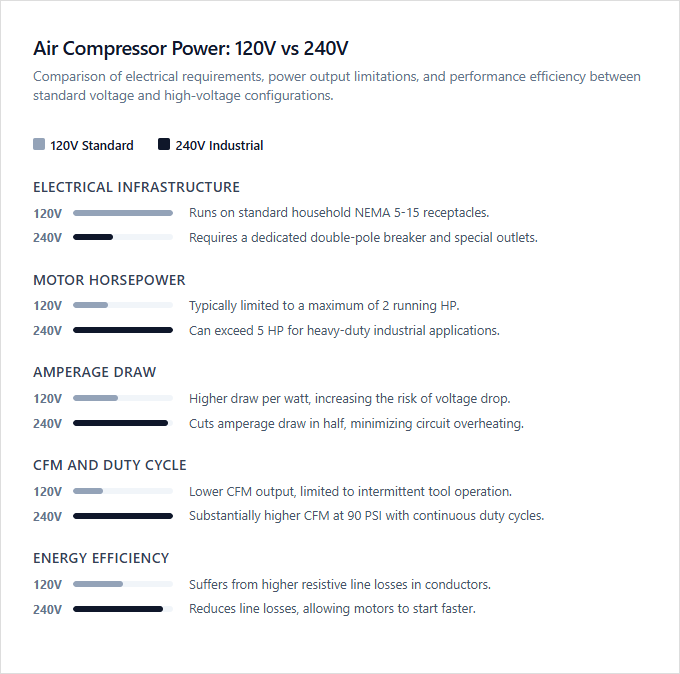
| Factor | Summary |
|---|---|
| Electrical Infrastructure | While 120V air compressors run on standard household NEMA 5-15 receptacles, 240V units require a dedicated double-pole circuit breaker and specialized high-voltage outlets. |
| Motor Horsepower | Standard 120V compressors are typically limited to a maximum of 2 running horsepower to prevent tripping residential breakers, whereas 240V induction motors can exceed 5 horsepower for industrial applications. |
| Amperage Draw | Operating at 240V cuts the amperage draw in half compared to 120V for the same wattage, which significantly reduces voltage drop and minimizes the risk of overheating the electrical circuit. |
| CFM and Duty Cycle | Stationary 240V compressors deliver substantially higher Cubic Feet per Minute (CFM) at 90 PSI and offer continuous duty cycles, whereas 120V units are limited to intermittent pneumatic tool operation. |
| Energy Efficiency | The 240V configuration reduces resistive line losses in the supply conductors, allowing the electric motor to start faster and consume fewer cumulative kilowatt-hours under heavy workloads. |
120V Amperage Limits on Motor HP and CFM
Standard household 120V circuits, typically rated at 15 to 20 amps, impose a strict physical limit on air compressor performance. This electrical threshold caps the maximum motor output at approximately 1.5 to 2 running horsepower. Because motor power directly dictates the compressor pump's ability to displace air, 120V models face a strict ceiling on their CFM (Cubic Feet per Minute) output, often restricting their ability to run continuous-duty pneumatic tools.
Upgrading to a 240V system halves the amperage draw for the same power consumption, allowing for motors that exceed 5 horsepower and deliver significantly higher CFM ratings. Mobile DIYers and finishing carpenters requiring maximum portability benefit most from the plug-and-play convenience of 120V compressors, whereas automotive technicians and industrial workshop operators requiring uninterrupted high-volume airflow need the heavy-duty performance of 240V units.
Preventing 240V Voltage Drop for Peak CFM and Torque
When selecting an air compressor, the choice between 120V and 240V configurations significantly impacts tool performance. Operating at 240V halves the current draw compared to 120V setups, which directly minimizes voltage drop over supply circuits and extension cords. This electrical efficiency prevents motor torque loss during heavy start-up cycles, allowing the compressor to maintain its peak Cubic Feet per Minute (CFM) output under continuous workloads.
While 120V units offer portability and plug-and-play convenience, they remain susceptible to performance degradation during high-demand tasks due to line resistance. Standard 120V models are ideal for DIY hobbyists and residential users needing mobility for light-duty nailing, while high-capacity 240V systems are best suited for commercial shop technicians and industrial contractors requiring sustained pneumatic power.
Boosting Induction Motor Thermal Efficiency to Reduce Wear
When selecting an industrial or workshop air compressor, the choice between 120V and 240V power configurations directly impacts motor longevity and thermal performance. Operating an induction motor at 240V halves the amperage draw compared to a 120V system producing the equivalent mechanical power. This reduction in current minimizes resistive heating within the stator windings, facilitating superior thermal efficiency and keeping the motor significantly cooler during extended operation.
Lower operating temperatures under continuous load prevent premature insulation breakdown and reduce mechanical wear on bearings and internal components. Standard 120V units are ideal for DIY hobbyists and light-duty contractors prioritizing portability and convenience, whereas high-efficiency 240V systems are suited for commercial operators and automotive technicians requiring reliable, continuous air delivery in demanding environments.
Dedicated Breakers Prevent Startup Voltage Sag
Selecting between a 120-volt and a 240-volt air compressor requires careful consideration of electric motor startup demands. During activation, compressor motors draw an inrush current, or locked-rotor amperage, that is significantly higher than their continuous running current. On standard 120-volt lines, this sudden surge can cause a severe voltage sag, resulting in flickering lights or tripped circuit breakers. Dedicated circuits are typically required for 120-volt models to isolate this initial draw and maintain electrical stability.
Operating at 240 volts halves the amperage required to deliver equivalent power, which greatly reduces voltage drop and facilitates smoother motor starting. This higher voltage configuration minimizes strain on the electrical panel and supports larger, more efficient motors. Portable 120-volt compressors are suited for residential DIYers and light trim work, whereas stationary 240-volt units are designed for professional automotive technicians and high-demand industrial workshops.
Optimizing AWG Sizing for Long-Run Resistance
Operating a high-draw air compressor over extended distances requires careful consideration of voltage drop and conductor sizing. At 120 volts, a compressor draws double the current of a 240-volt unit of equivalent horsepower. This higher current increases line resistance, necessitating thicker copper conductors to prevent performance-robbing voltage drops over long wire runs.
Optimizing the American Wire Gauge (AWG) selection mitigates these thermal losses. While a 120-volt setup over 100 feet might demand a heavy 10 AWG cord to maintain motor torque, a 240-volt configuration can utilize a lighter, more cost-effective 12 AWG conductor for the same distance due to the reduced amperage.
Standard 120-volt models serve DIY enthusiasts requiring portable, light-duty inflation around residential garages, whereas robust 240-volt systems are tailored for professional mechanics and industrial workshops demanding continuous, high-volume air delivery.
Dual-voltage motor configuration flexibility allowing reconfiguration for higher CFM performance
When selecting an industrial air compressor, understanding motor configuration is critical for optimizing tool efficiency. Dual-voltage motors offer excellent electrical flexibility, allowing operators to run the equipment on standard 120V circuits or reconfigure the internal wiring for 240V power. This transition to a higher voltage reduces amperage draw by half, minimizing voltage drop and allowing the motor to run cooler during extended operation.
This electrical reconfiguration directly optimizes cubic feet per minute (CFM) performance by ensuring the motor maintains maximum torque under heavy loads. Reconfiguring to 240V prevents circuit overloads and allows the compressor to sustain its peak CFM output continuously without interruption. Standard 120V models are suited for residential DIYers needing portability for light-duty tasks, while 240V configurations are designed for dedicated professionals running demanding pneumatic machinery.
Maximizing Duty Cycle with 240V Low-Current Power
Choosing between a 120V and 240V air compressor depends largely on operational efficiency and duty cycle requirements. A 240V electrical supply draws half the amperage of a 120V system to deliver equivalent power. This reduced current load minimizes heat generation within the motor windings, protecting the internal components from thermal stress. This superior thermal management directly maximizes the machine's duty cycle, enabling sustained, continuous operation under heavy workloads without risking motor shutdown or premature wear.
Standard 120V units offer convenient portability but experience quicker heat buildup and shorter duty cycles due to high current draws. Portable 120V compressors are ideal for residential DIYers performing intermittent inflation and light nailing, whereas heavy-duty 240V models are suited for professional workshop technicians requiring continuous, high-volume pneumatic power.
Leave a comment