
Machinists and shop managers frequently struggle to balance high-speed surface finishing with high-torque material removal, often ending up with a milling machine that stalls under heavy loads or vibrates at high RPMs. Traditionally, businesses justify these machinery acquisitions through standard capital equipment budgets or industrial modernization grants, often treating the spindle's internal drive as a secondary technical specification.
However, prioritizing the right power transmission type grants your shop floor a critical competitive edge, directly optimizing cutting efficiency and extending tooling lifespan. As a crucial stipulation, operators must recognize that no single spindle configuration is a universal cure-all; heavy steel hogging and intricate aluminum profiling demand entirely different mechanical advantages.
For instance, heavy-duty workshops rely on rigid gear-head systems like those in traditional knee mills for raw low-end torque, while high-precision mold makers favor smooth, high-RPM belt drives. In this article, we will compare the torque curves, maintenance requirements, and ideal applications of both belt drive and gear head spindles to help you select the ultimate power transmission for your operational needs.
| Factor | Summary |
|---|---|
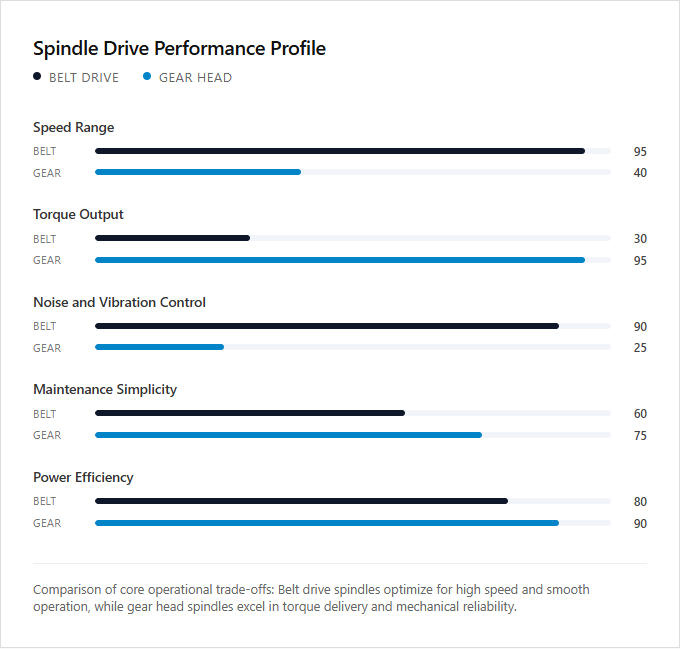
| Speed Range | Belt drive spindles achieve much higher maximum RPMs suitable for high-speed machining, whereas gear head spindles are constrained to lower angular velocities. |
| Torque Output | Gear head spindles utilize direct mechanical engagement to provide superior torque multiplication at low speeds, while belt drives may slip under heavy loads. |
| Noise and Vibration | Belt drives offer smoother operation with minimal harmonic vibration, whereas gear heads produce significant acoustic noise and gear chatter during operation. |
| Maintenance | Gear head spindles require periodic lubrication within a sealed gearcase, whereas belt drives require routine belt tensioning and replacement due to elastomer wear. |
| Power Efficiency | Gear heads provide positive power transmission with zero slip, though they are subject to parasitic energy loss from friction within the gear train. |
Belt Drives vs. Gear Heads: Speed vs. Torque
Belt drive spindles excel in high-speed operations by achieving superior angular velocity. By minimizing vibration transfer from the motor to the spindle, these systems run smoothly at high-RPM limits. This makes them ideal for precise finishing passes and machining softer materials, though they lack the mechanical advantage required for heavy, low-speed cuts.
Gear head spindles utilize direct mechanical engagement to deliver substantial low-speed torque multiplication. This rigid drivetrain ensures maximum power transmission, allowing operators to drive large cutters through tough alloys. While this design limits maximum spindle speeds and increases operational noise, it prevents stalling under heavy loads.
Precision machinists focusing on detailed aluminum or engraving work benefit most from the high-RPM capabilities of belt drives, while heavy-duty industrial fabricators processing structural steel require the robust, low-speed torque of gear heads.
Gear Train Backlash vs. Synchronous Timing Belts
When selecting a milling machine, the spindle drive mechanism significantly impacts machining precision and maintenance. Belt drive spindles utilize high-strength timing belts that offer synchronous engagement. This direct, positive-grip connection eliminates mechanical play, ensuring smooth torque transfer, quieter operation at high RPMs, and superior surface finishes during high-speed operations.
In contrast, gear head spindles rely on interlocking gear trains. While highly robust and capable of delivering immense torque at low speeds, gear systems inherently suffer from mechanical backlash. This microscopic play between mating teeth can introduce slight positioning inaccuracies during direction changes, potentially affecting precision in delicate operations.
Belt drive spindles are ideal for prototype machinists requiring quiet, high-precision finishing, whereas gear head spindles suit heavy-industrial fabricators prioritizing maximum material removal and high-torque hogging.
Dampening Belt Drive Vibration to Optimize Surface Roughness
When selecting a milling machine spindle, the drive mechanism significantly influences the final machining quality. Belt drive spindles excel at absorbing and dampening harmonic vibrations generated by the motor. By isolating these high-frequency oscillations, the flexible belt prevents vibration transfer to the cutting tool, which minimizes surface imperfections and optimizes workpiece surface roughness for high-precision finishes.
In contrast, gear head spindles deliver direct mechanical engagement and maximum torque, though they transmit more gear-meshing vibration to the workpiece. Machinists prioritizing flawless surface aesthetics on delicate materials benefit most from the belt drive, whereas operators focusing on heavy-duty, high-torque metal removal in rugged industrial settings are ideal candidates for the gear head spindle.
Friction-Induced Thermal Expansion and Axial Drift in Gearboxes
Gear head spindles utilize internal gearboxes to transmit torque, a design that inherently generates significant frictional heat during operation. This thermal accumulation leads to measurable thermal expansion within the spindle housing, causing axial drift that compromises machining accuracy over extended runs. Conversely, belt drive spindles isolate the motor's heat from the spindle cartridge. By eliminating direct gear friction, belt-driven systems maintain a much more stable thermal profile, significantly reducing axial drift and ensuring consistent dimensional tolerance.
The choice between these configurations depends on specific operational priorities and tolerance requirements. High-torque gear head machines suit heavy-duty maintenance technicians performing deep, low-speed cuts where thermal drift is manageable, while thermally stable belt drive systems are ideal for precision toolmakers and mold manufacturers requiring high-speed accuracy.
High-Speed Spindle Efficiency and Parasitic Drag
At elevated spindle speeds, the mechanical design of a milling machine's drive system significantly influences power transmission efficiency. Belt drive spindles excel at high RPMs due to their low parasitic drag, as the flexible belt experiences minimal frictional resistance compared to meshing components. This lack of heavy mechanical contact reduces energy loss and heat generation, allowing maximum power to reach the cutting tool during high-speed operations.
In contrast, gear head spindles experience escalating parasitic drag at higher speeds because gear teeth mesh rapidly in an oil bath, generating substantial fluid shear and frictional heat. While gears provide exceptional torque at low speeds, their transmission efficiency drops as RPMs increase. Machinists requiring high-speed precision and smooth finishes benefit from belt drives, while operators performing heavy-duty, low-speed metal removal are best served by gear head systems.
Torsional rigidity and positive displacement under heavy structural cutting loads
Belt drive spindles deliver smooth, high-speed operations but present inherent limitations under heavy structural cutting loads. Because elastomeric belts rely on friction, they exhibit lower torsional rigidity. Under severe resistance, subtle belt deflection or slippage can occur, which compromises positive displacement and can affect machining accuracy during heavy roughing phases.
Gear head spindles utilize direct, mechanical tooth engagement to deliver outstanding torsional rigidity and absolute positive displacement. This rigid configuration prevents rotational play, ensuring constant torque transmission and reliable spindle control when slicing through tough alloys. Belt-driven systems are ideal for high-precision machinists prioritizing fine surface finishes on softer metals, whereas gear-headed machinery is suited for heavy-duty industrial fabricators requiring maximum torque for aggressive material removal.
Acoustic emission and high-frequency decibel output of meshing gear teeth
When evaluating milling machine spindles, acoustic emissions represent a critical differentiator between design configurations. Gear head spindles utilize a series of meshing gear teeth to transmit torque, a mechanism that inherently generates significant high-frequency decibel output. This intense acoustic energy arises from the rapid impact and sliding friction of metal-on-metal teeth under load, producing a characteristic high-pitched whine that can dominate a workshop environment.
In contrast, belt drive spindles offer a much quieter alternative, isolating vibration and dampening noise through elastomeric belts. Eliminating the rigid, meshing components drastically reduces high-frequency decibel output, creating a more sustainable working environment. Low-noise belt drive systems are ideal for prototyping shops and educational labs prioritizing operator comfort, while high-torque gear head spindles remain suited for industrial machinists requiring heavy-duty material removal.
Leave a comment