
Woodworkers and metal fabricators alike know the frustration of a ruined workpiece-unsightly swirl marks, gouges, or scorched grain caused by a sander running too hot or too fast. Traditionally, operators have relied on standard fixed-speed machines, attempting to manage heat and finish quality solely through grit progression.
However, mastering precise Orbits Per Minute (OPM) control grants craftspeople the ability to tailor tool dynamics to the specific material, guaranteeing a flawless finish and significantly reducing wasted stock. The vital stipulation is that variable speed is not a cure-all; it must be carefully calibrated alongside grit density and hand pressure to be effective. For example, sanding delicate walnut veneer requires a dialed-down OPM to prevent burn-through, whereas rapid material removal on hard maple demands maximum speed.
In this article, we will compare the mechanics of fixed and variable speed sanders, explore optimal OPM thresholds for common materials, and outline key techniques to elevate your finishing results.
| Factor | Summary |
|---|---|
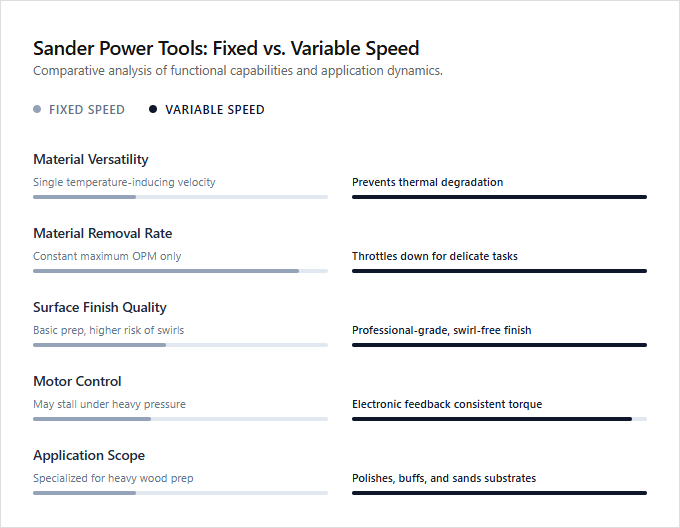
| Material Versatility | Variable speed sanders allow user adjustment to prevent the thermal degradation of heat-sensitive materials, whereas fixed speed sanders operate at a single temperature-inducing velocity. |
| Material Removal Rate | Fixed speed sanders operate at a constant maximum OPM (orbits per minute) for rapid stock removal, while variable speed units can be throttled down for delicate sanding tasks. |
| Surface Finish Quality | Achieving a professional-grade, swirl-free finish on diverse wood species requires modulating the orbital frequency, a capability only found in variable speed sanders. |
| Motor Control | Variable speed models utilize electronic feedback circuitry to maintain consistent torque under load, whereas basic fixed speed sanders may stall under heavy pressure. |
| Application Scope | Fixed speed sanders are specialized for heavy wood prep, while variable speed sanders can adapt to polish, buff, or sand various delicate substrates without damaging the workpiece. |
Variable speed adjustment prevents thermal degradation of heat-sensitive polymer substrates.
Selecting between a fixed speed and a variable speed sander depends heavily on the workpiece material. While fixed speed models operate at a constant, high rate of oscillation, variable speed sanders allow operators to modulate velocity. This capability is crucial when working with heat-sensitive polymer substrates, as lowering the speed prevents friction-induced thermal degradation, melting, or surface warping.
Maintaining control over thermal output ensures the integrity of delicate materials while maximizing material removal rates on sturdier surfaces like hardwoods. Fixed speed sanders are ideal for production-line workers performing repetitive, heavy-duty stock removal on robust materials, whereas variable speed units are best suited for restorers and finishing specialists who regularly transition between diverse, delicate substrates.
High OPM Maximizes Material Removal in Calibration
Selecting between a fixed-speed and a variable-speed sander depends on the precision required for your woodworking applications. A fixed-speed sander operates at a constant, high rate of oscillations per minute (OPM). This high fixed OPM maximizes the material removal rate during initial stock calibration, making it highly efficient for rapidly flattening rough lumber and stripping old finishes.
Variable-speed sanders offer adjustable OPM settings, allowing operators to reduce speed to prevent heat buildup and swirl marks on delicate veneers or during fine finish sanding. Fixed-speed units are ideal for production-focused carpenters performing heavy stock removal, while variable-speed models suit versatile craftspeople requiring precise control over diverse finishing tasks.
Low OPM Settings Optimize Final Polishing Ra
Choosing between a fixed speed and a variable speed sander depends on the precision required for your finishing workflow. Fixed speed sanders operate at a constant, high orbit-per-minute (OPM) rate, making them highly efficient for rapid material removal. In contrast, variable speed sanders provide adjustable OPM ranges that are crucial for delicate tasks. Utilizing low OPM settings on a variable speed model minimizes unsightly swirl marks and optimizes surface roughness Ra values during final polishing, ensuring a flawless finish on sensitive materials.
The choice between these tools aligns with specific operational demands and user expertise. Fixed speed models are ideal for DIYers performing bulk stock removal on flat surfaces, while variable speed sanders are suited for professional furniture makers and refinishers who require precise control for diverse, high-end finishing applications.
Constant Speed Control for Uniform Finishes
When selecting a sander, the choice between fixed and variable speed models determines the tool's versatility and finish quality. Advanced variable speed sanders often feature electronic speed stabilization, which maintains a constant rate of orbits per minute (OPM) even under heavy load. This technology prevents the motor from slowing down when pressure is applied to the workpiece, ensuring absolute uniformity in the final finish.
Fixed-speed sanders operate at a single high velocity, making them highly efficient for rapid, bulk material removal. Fixed-speed models are ideal for DIY enthusiasts focused on basic prep work and deck refinishing, while variable-speed sanders are best suited for professional cabinetmakers and restorers who require precise control over diverse and delicate materials.
Dynamic OPM Prevents Abrasive Loading on Soft Coatings
When selecting a sander, the choice between fixed and variable speed configurations depends largely on thermal control and material compatibility. Variable speed models feature dynamic OPM (oscillations per minute) control, which is vital when working with delicate or heat-sensitive finishes. Lowering the speed prevents heat buildup on softer coatings such as paint, varnish, or plastics. This precise thermal regulation prevents abrasive loading, where melted material clogs the sanding disk, and eliminates premature grit shedding to prolong the life of the abrasive media.
Fixed speed sanders operate at a single high velocity, maximizing efficiency on raw, hard materials where thermal damage is not a concern. Fixed speed units are ideal for production carpenters and DIYers focused solely on rapid, heavy wood stock removal, whereas variable speed sanders are best suited for restoration professionals and finish carpenters who frequently transition between diverse surface coatings and delicate detailing tasks.
Rotational velocity modulation prevents grain scorch on thin wood veneers.
Choosing between a fixed-speed and a variable-speed sander depends on material sensitivity. Fixed-speed sanders operate at a constant, maximum rate of oscillation, which is highly efficient for rapid stock removal on thick lumber. Delicate tasks require the nuanced control offered by variable-speed models. Specifically, rotational velocity modulation prevents grain scorch on thin wood veneers by allowing operators to lower the speed, reducing friction and heat buildup that would otherwise degrade fragile surfaces.
Adjusting the speed ensures the abrasive medium performs optimal cutting without burning wood fibers or melting finishes. While the fixed-speed sander is ideal for construction workers engaged in rapid, heavy-duty stock preparation, the variable-speed sander is best suited for detail-oriented luthiers and furniture restorers who work with delicate, high-value materials.
Custom OPM Eliminates Sanding Chatter on Rigid Substrates
Fixed-speed sanders operate at a constant rate, which can induce harmonic resonance when working on rigid substrates like hardwoods or composites. This continuous frequency often leads to rhythmic tool bouncing, resulting in visible chatter marks across the workpiece. In contrast, variable-speed sanders allow operators to adjust the Orbits Per Minute (OPM). Customizing the OPM disrupts these resonant frequencies, stabilizing the tool to ensure a flawless, swirl-free finish.
By matching the oscillation frequency to the specific density of the material, operators prevent surface defects before they occur. Fixed-speed models are ideal for DIY hobbyists performing basic, high-volume stock removal, while variable-speed units are essential for professional cabinetmakers and refinishers requiring precise control across diverse finishes and materials.
Leave a comment