
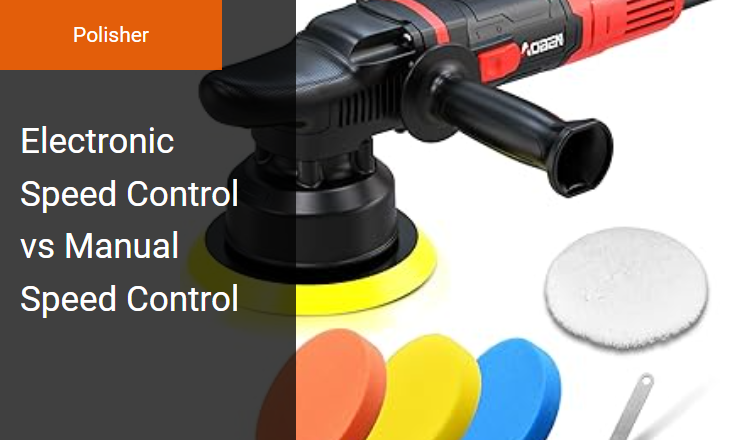
Achieving a flawless, swirl-free finish is a meticulous process, yet detailers constantly struggle with polisher stall and sudden RPM drops when navigating curved panels. Traditionally, operators rely on raw motor wattage-the standard power delivery source-to muscle through these resistance points. However, simply pushing more raw power through the circuit often leads to heat build-up and paint damage.
This is where advanced speed regulation becomes vital, as it grants technicians the ability to maintain constant torque and uninterrupted cutting power under load. Crucially, this requires the stipulation that operator technique must still align with the tool's mechanical limits. For instance, when compounding heavily oxidized clear coats on curved fender flares, maintaining consistent rotation is the difference between a perfect correction and a burned edge. Below, we analyze how Electronic Speed Control compares directly to Manual Speed Control, examining their impact on torque preservation and overall correction efficiency.
| Factor | Summary |
|---|---|
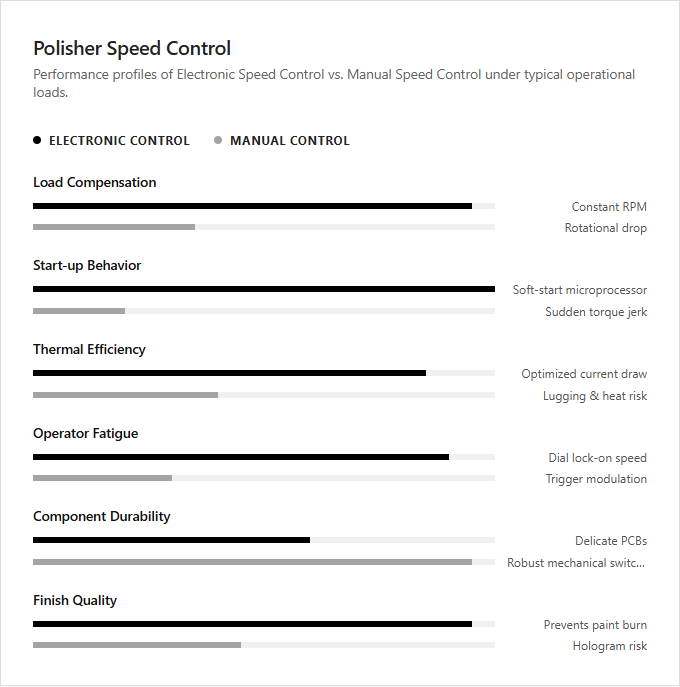
| Load Compensation | Electronic speed control utilizes a feedback circuit to maintain constant revolutions per minute (RPM) under load, whereas manual control suffers from rotational speed drop when downward pressure is applied. |
| Start-up Behavior | Electronic systems typically feature a soft-start microprocessor that gradually increases motor velocity to prevent sudden torque jerks and compound slinging, which is absent in manual trigger-operated switches. |
| Thermal Efficiency | Manual speed regulation can cause motor lugging under load, increasing current draw and thermal overload risk, while electronic controllers optimize energy distribution to mitigate heat buildup. |
| Operator Fatigue | Manual speed tools require continuous trigger modulation to sustain the desired velocity, whereas electronic dial lock-on systems allow the user to focus entirely on machine guidance. |
| Component Durability | Manual control systems rely on simpler rheostats and mechanical switches that resist dust intrusion better than delicate electronic printed circuit boards (PCBs). |
| Finish Quality | Electronic speed feedback loops provide the consistent rotational velocity necessary to prevent paint burn and holograms on sensitive clear coats. |
Back-EMF Feedback Maintains Constant Spindle Speed Under Load
Manual speed control in polishers relies on fixed power input, which often causes the spindle speed to drop significantly under downward pressure. In contrast, electronic speed control utilizes a closed-loop feedback system powered by Back-EMF (Electromotive Force) sensing. When the user applies downward force, the controller detects the change in motor voltage and instantly increases current to maintain a constant spindle speed, preventing stalling and ensuring consistent material removal.
This automated regulation eliminates the need for manual compensation, protecting surfaces from heat build-up and uneven finishes. Manual speed control is highly suitable for budget-conscious hobbyists performing light, occasional touch-ups, while electronic speed control is the ideal choice for professional detailers and restoration specialists who require precision and reliable performance under demanding workloads.
Active Load Compensation Prevents Orbital Pad Stalling
Electronic speed control in polishers represents a significant advancement over manual speed control by introducing active load compensation. When an operator applies downward pressure during paint correction, manual polishers often suffer from pad stalling, which drastically reduces defect removal efficiency. Electronic systems automatically detect this resistance and dynamically adjust power to maintain a constant orbital rotation, ensuring uniform and predictable cutting performance under varying loads.
Manual speed control relies entirely on the operator to anticipate friction and manually adjust the dial, which can lead to uneven finishes if not meticulously managed. While electronic speed control is highly suited for professional detailers requiring effortless consistency and high-precision defect removal, manual speed control remains a practical choice for experienced hobbyists who prefer tactile, hands-on control and are working within a strict budget.
PWM Optimizes Low-Speed Torque Without Overheating
When selecting a power polisher, the mechanism of speed regulation significantly impacts both performance and tool longevity. Manual speed control relies on resistive voltage reduction, which inherently decreases torque and increases heat generation at lower speeds. In contrast, modern electronic speed control utilizing Pulse-Width Modulation (PWM) maintains consistent power. By rapidly switching the voltage on and off rather than restricting it, PWM optimizes torque delivery at low rotational speeds without motor overheating.
This electronic regulation ensures the polisher sustains necessary working pressure under heavy load conditions, preventing stalling while preserving the electric motor's service life. Manual speed control polishers are ideal for budget-conscious DIY hobbyists undertaking occasional, light-duty projects, whereas electronic speed control models are essential for professional detailers requiring precise, sustained paint correction.
Consistent Kinetic Energy Prevents Paint Burn-Through
When detailing automotive finishes, maintaining consistent kinetic energy is vital for safety and precision. Electronic speed control systems monitor the polisher's load in real time, automatically adjusting power to maintain a constant rotation speed under pressure. This steady output prevents sudden friction spikes, significantly minimizing the risk of paint burn-through on delicate clear coats.
In contrast, manual speed control relies entirely on the operator to modulate pressure and trigger depth to maintain speed. Without automated regulation, sudden changes in surface resistance can cause unpredictable fluctuations in kinetic energy and heat. Professional detailers seeking flawless, risk-free paint correction benefit most from electronic speed control, while experienced hobbyists performing basic paint maintenance often find manual speed control sufficient for their needs.
Stabilized velocity profiles ensure uniform abrasive breakdown of polishing compounds
When selecting a professional polisher, the mechanism of speed regulation directly impacts finishing quality. Electronic speed control utilizes internal feedback sensors to maintain a constant motor RPM regardless of the downward pressure applied by the operator. This stabilized velocity profile is critical because it ensures the uniform abrasive breakdown of polishing compounds, preventing premature compound drying and achieving a flawless, hologram-free finish.
Manual speed control, conversely, relies on basic rheostat dials without load compensation, causing motor velocity to drop when resistance increases. This fluctuation can lead to uneven compound performance and inconsistent paint correction. Precision-driven detailing professionals requiring predictable heat management benefit most from electronic speed control, whereas budget-conscious hobbyists performing occasional, light-duty corrections often prefer manual speed control.
Microprocessor-controlled soft-start features eliminate sling by regulating initial rotational inertia
Electronic speed control in modern polishers offers precise velocity management under varying loads. A key benefit of this system is the integration of microprocessor-controlled soft-start features. By regulating the tool's initial rotational inertia, this technology prevents the sudden torque spike that typically causes polishing compounds to sling off the pad, ensuring a cleaner work environment and more consistent product application.
In contrast, manual speed control relies on direct mechanical or basic resistive adjustments, which lack active load compensation. This traditional method requires the operator to manually feather the trigger to manage the initial inertia and avoid compound sling. Electronic speed control is ideal for professional detailers seeking flawless finishes and efficiency, while manual speed control suits budget-conscious DIYers or traditional operators who prefer tactile, direct tool response.
Dynamic Current Regulation Minimizes Drag and Operator Fatigue
Electronic speed control in professional polishers utilizes smart microprocessors to provide dynamic current regulation. By matching the electrical current directly to the instantaneous torque demand on the polishing pad, this technology maintains consistent rotational velocity even under heavy load. This constant feedback loop minimizes mechanical drag, stabilizes the tool's movement, and significantly reduces physical strain and operator fatigue during extended detailing sessions.
In contrast, manual speed control relies on static resistance settings, requiring the operator to physically compensate for rotational speed drops by altering their applied pressure. Electronic speed control is highly suited for high-volume automotive detailing professionals requiring effortless precision, whereas manual speed control is best for budget-conscious hobbyists performing occasional, light-duty surface restoration.
Leave a comment