
Manufacturing engineers and shop managers often struggle to balance high-tonnage force requirements with operator fatigue and cycle-time constraints on the assembly line. When evaluating tool upgrades, teams typically turn to standard capital expenditure budgets and equipment funding sources to justify the acquisition. However, selecting the optimal actuation method grants production lines a level of consistency, safety, and long-term ROI that far exceeds the initial capital outlay.
As a critical stipulation, buyers must understand that force delivery is not uniform; over-specifying pneumatic systems can drastically inflate compressed air costs. For high-precision applications-such as press-fit bearing insertion or metal riveting-the choice between manual mechanical advantage and fluid power is pivotal. This guide compares manual and pneumatic arbor presses, examining force profiles, operational costs, and footprint to help you select the right high-tonnage tool for your facility.
| Factor | Summary |
|---|---|
| Power Source | Manual arbor presses rely on human-operated mechanical leverage via a rack and pinion system, whereas pneumatic presses utilize compressed air and a pneumatic cylinder for actuation. |
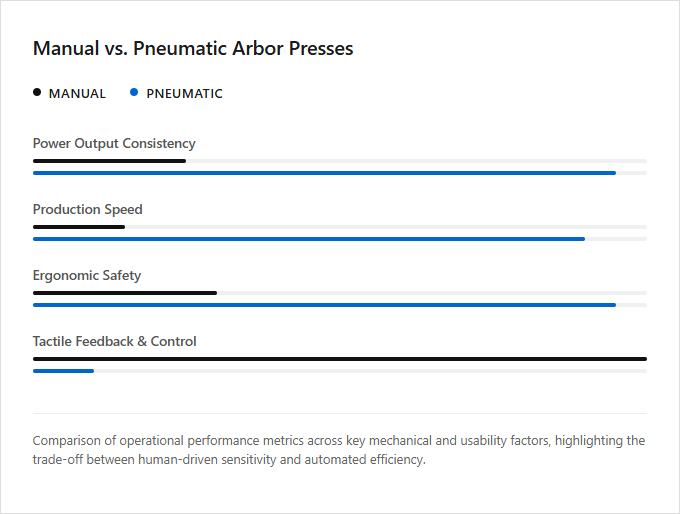
| Force Output | Pneumatic presses deliver highly consistent tonnage capacity through adjustable pressure regulators, while manual presses rely entirely on the physical strength and force applied by the operator. |
| Production Speed | Pneumatic arbor presses significantly reduce cycle time in high-volume assembly lines, whereas manual presses are better suited for low-throughput workshop environments. |
| Ergonomics | Manual operation can lead to repetitive strain injuries over long shifts, but pneumatic systems eliminate operator fatigue through hands-free foot-pedal actuation. |
| Tactile Feedback | Manual presses offer superior tactile feedback allowing operators to feel physical resistance during interference fits, a capability that is absent in automated pneumatic systems. |
Leverage vs. Pneumatic Bore for High-Tonnage Output
In high-tonnage manufacturing, manual arbor presses rely on mechanical advantage, where the leverage ratio of the handle and pinion multiplies operator input to generate force. This system provides precise tactile feedback, allowing operators to feel the resistance during press-fit applications. Achieving high tonnage manually requires substantial physical effort and is determined by the length of the lever arm and gear design.
Pneumatic arbor presses replace manual effort with compressed air, where the output tonnage is determined by the pneumatic cylinder bore size and input pressure. A larger cylinder bore size increases the surface area, translating standard shop air into high-force output with consistent, repeatable strokes. Manual presses are ideal for low-volume prototype developers requiring precise feel, while pneumatic presses are suited for high-volume assembly technicians prioritizing speed and ergonomic safety.
Operator tactile feedback versus pneumatic pressure regulator precision control
Manual arbor presses rely entirely on physical leverage, offering unparalleled tactile feedback. This direct mechanical connection allows operators to feel the resistance of the work material in real-time, making it easy to detect misalignments or subtle structural shifts during the press cycle.
In contrast, pneumatic arbor presses replace manual effort with compressed air, utilizing integrated pressure regulators for precise, repeatable force control. This system ensures consistent pressure application across high-volume production runs, eliminating human variance and physical fatigue.
Manual presses are ideal for low-volume craftsmen who require delicate physical control and sensory feedback, while pneumatic systems suit high-throughput industrial manufacturers demanding uniform precision and speed.
Variable manual stroke rate versus consistent pneumatic cycle time
Manual arbor presses rely on operator leverage, resulting in a variable stroke rate. This tactile feedback allows operators to feel resistance during assembly, enabling real-time adjustments to force and speed. This variability is highly beneficial for delicate, low-volume tasks where precision and manual control are paramount.
In contrast, pneumatic arbor presses utilize compressed air to deliver consistent cycle times and uniform force. By eliminating operator fatigue, these systems ensure repeatable accuracy across high-volume production runs. The standardized stroke maintains identical pressure and speed with every cycle to maximize throughput and efficiency.
Manual presses are best suited for prototype developers and low-volume craftspeople who require tactile precision, while pneumatic systems are ideal for high-throughput industrial operators seeking speed and repeatability.
Mechanical advantage efficiency versus pneumatic CFM utility requirements
Manual arbor presses rely entirely on mechanical advantage, utilizing leverage from a hand-operated lever and gear system to amplify human force. This design delivers exceptional energy efficiency and precise tactile feedback without requiring external power utilities. The operator retains complete, real-time control over the applied pressure throughout the stroke, making it a highly reliable and cost-effective option for low-frequency tasks.
Pneumatic arbor presses replace manual labor with compressed air, demanding a consistent volume-to-pressure ratio (CFM) from an industrial air compressor. This utility requirement enables rapid, high-volume production cycles and highly consistent force application across hundreds of repetitions. While pneumatic systems require more shop infrastructure, they eliminate operator fatigue in high-production environments.
Manual presses are ideal for prototype developers and low-volume craftsmen requiring tactile feedback, while pneumatic models best serve high-throughput industrial technicians prioritizing speed and automated repeatability.
Low-maintenance rack and pinion versus FRL unit air filtration maintenance
Manual arbor presses utilize a simple, robust rack and pinion mechanism. This mechanical design requires minimal maintenance, typically demanding only occasional lubrication and debris removal to ensure smooth gear engagement and long-term reliability.
Pneumatic arbor presses offer increased speed and force but rely on a dedicated Filter, Regulator, and Lubricator (FRL) unit. Proper maintenance of these pneumatic systems involves regularly draining water traps, replacing filter elements, and monitoring oil levels to protect internal cylinders from moisture and contamination.
Manual presses are ideal for low-volume workshop technicians seeking simple, hands-on control, while pneumatic models suit high-production manufacturing operators requiring consistent, automated force.
Physical operator fatigue versus automated solenoid valve actuation
Manual arbor presses rely entirely on mechanical leverage, requiring operators to physically pull a lever to exert force. Over extended production runs, this repetitive manual exertion leads to significant physical fatigue, which can decrease overall throughput and introduce variance in assembly quality.
Pneumatic arbor presses eliminate this physical strain by utilizing automated solenoid valve actuation. Triggered by a foot pedal or dual-hand switches, these power tools deliver consistent, repeatable pressure instantly, ensuring uniform force application across high-volume manufacturing cycles without operator exhaustion.
Manual presses are ideal for low-volume workshop technicians requiring precise tactile feedback, while pneumatic models are best suited for high-production industrial operators prioritizing speed and ergonomic safety.
Mechanical stroke stops versus pneumatic two-hand safety valves
Manual arbor presses rely on mechanical stroke stops to deliver highly precise, repeatable depth control. This rigid physical barrier allows operators to achieve consistent press depths through manual lever control, providing immediate tactile feedback that ensures quality control without complex programming.
Pneumatic arbor presses utilize compressed air for power, necessitating advanced safety features such as two-hand safety valves. These pneumatic control systems mandate that the operator uses both hands simultaneously to initiate the press cycle, effectively keeping hands clear of the hazard zone during rapid actuation. Manual presses with mechanical stops are best suited for detailed craftsmen requiring tactile precision, whereas pneumatic systems with two-hand controls are ideal for high-volume production workers prioritizing speed and physical safety.
Leave a comment