
Manufacturing engineers frequently struggle to balance tight dimensional tolerances with operator fatigue during high-volume assembly, often leading to costly part damage and inconsistent force application.
While standard capital expenditure (CAPEX) budgets and equipment modernization grants typically fund these production line upgrades, selecting the wrong press architecture can quickly deplete those hard-won resources.
However, choosing the appropriate system grants production managers unparalleled process control. Stipulation: This optimization is fully realized only if critical tool-alignment and stroke-limit parameters are strictly maintained during setup.
For instance, in high-precision environments like medical device crimping and micro-bearing insertion, the choice of equipment is defining. This guide compares mechanical rack-and-pinion arbor presses against pneumatic toggle presses, analyzing their force curves, accuracy, and operational efficiency to help you select the optimal tool for your assembly needs.
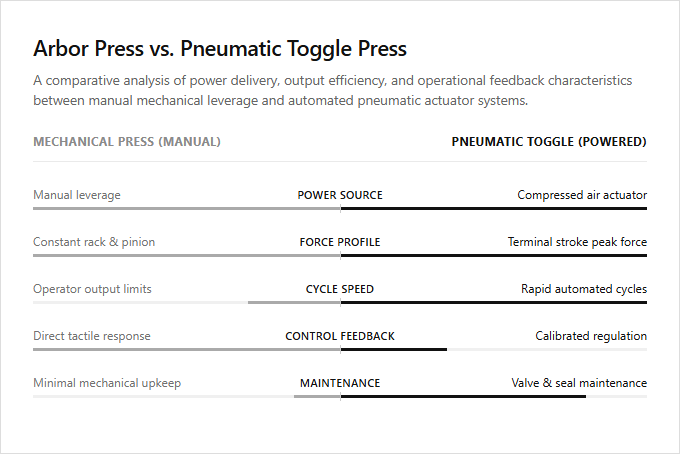
| Factor | Summary |
|---|---|
| Power Source | While the mechanical arbor press relies on manual leverage applied by an operator, the pneumatic toggle press utilizes compressed air to drive a pneumatic actuator. |
| Force Profile | A mechanical arbor press delivers a constant force via a rack and pinion system, whereas a pneumatic toggle press achieves maximum mechanical advantage at the very end of its stroke. |
| Cycle Speed | Mechanical presses are limited by human physical output, whereas pneumatic toggle presses offer highly rapid and consistent cycle times for automated production lines. |
| Control and Feedback | Operators of mechanical arbor presses benefit from direct tactile feedback during components insertion, while pneumatic toggle presses require calibrated pressure regulators for force consistency. |
| Maintenance Complexity | The mechanical arbor press features a simple design requiring minimal upkeep, whereas the pneumatic toggle press involves pneumatic valves and seals that necessitate periodic preventative maintenance. |
Rack and Pinion Mechanical Advantage for Constant Force
Mechanical arbor presses utilize a rack and pinion system to deliver a consistent force throughout the entire stroke. This design ensures the mechanical advantage remains constant from start to finish, making it essential for precision applications like broaching and press-fitting where uniform pressure prevents component damage.
In contrast, pneumatic toggle presses leverage air pressure to deliver peak force only at the end of the stroke. While pneumatic systems increase production speed, they lack the linear, controlled force distribution of manual rack and pinion setups.
Manual mechanical presses are best suited for skilled craftsmen requiring precise, low-volume tactile feedback, while pneumatic toggle presses are ideal for production-line operators executing high-volume, repetitive assembly tasks.
Toggle Kinematics for Exponential End-Stroke Force
While a mechanical arbor press relies on direct, linear force application via a manual rack and pinion system, the pneumatic toggle press utilizes sophisticated linkage kinematics. The defining advantage of the pneumatic toggle design is its ability to deliver exponential force multiplication as the linkage approaches the end-point of its stroke. As the toggle joints straighten, the mechanical advantage rises dramatically, allowing a compact pneumatic cylinder to generate immense compressive force at the critical final millimeter of travel.
In contrast, mechanical arbor presses maintain a constant force profile throughout the entire downward stroke, offering excellent tactile feedback but requiring significant physical effort for high-force applications. High-volume industrial operators requiring effortless power for repetitive staking or riveting tasks are ideal candidates for the pneumatic toggle press, whereas precision machinists performing low-volume, variable-depth assembly work are best served by the tactile feedback of a mechanical arbor press.
Tactile Lever for Detecting Interference-Fit Tolerances
When selecting assembly equipment, the choice between a mechanical arbor press and a pneumatic toggle press depends on the required level of operator control. The mechanical arbor press utilizes a manual lever that provides direct tactile feedback, allowing operators to feel resistance and detect minor interference-fit tolerances during the press cycle. This physical connection prevents component damage by alerting the operator to misalignments or oversized parts instantly.
Pneumatic toggle presses offer high-speed, repeatable force through pneumatic cylinders, which maximizes throughput but lacks tactile responsiveness. The mechanical arbor press is ideal for skilled technicians performing precise, low-volume assemblies, while the pneumatic toggle press is best suited for production line workers executing high-volume, standardized operations.
Precision Micrometer Stop Collars for Depth Control
In precision assembly, achieving consistent stroke depth is critical for component integrity. Both mechanical arbor presses and pneumatic toggle presses can utilize adjustable micrometer stop collars to resolve this challenge. These precision collars allow operators to fine-tune the downward stroke limit with extreme accuracy, ensuring high-repeatability depth control that prevents component damage and guarantees uniform output across production cycles.
While the mechanical press relies on manual leverage for tactile feedback, the pneumatic toggle press uses compressed air to deliver rapid, consistent force. The manual mechanical press is ideal for low-volume prototyping technicians who require delicate, sensory control, whereas the pneumatic toggle press is best suited for high-throughput manufacturing operators who demand automated speed and reduced physical fatigue.
Double-acting pneumatic cylinder integration for high-duty cycle automated production
While manual mechanical arbor presses rely entirely on operator leverage for low-volume tasks, pneumatic toggle presses utilize compressed air to deliver consistent, high-force output. Integrating a double-acting pneumatic cylinder transforms the toggle press into a highly efficient power tool, driving both the downward power stroke and the upward return stroke. This integration supports high-duty cycle automated production lines, ensuring rapid cycle times and reduced operator fatigue.
The continuous, automated operation enabled by double-acting cylinders minimizes downtime and maintains precise force repeatability across high-volume manufacturing environments. Mechanical arbor presses are best suited for prototype developers and low-volume maintenance technicians, whereas pneumatic toggle presses are ideal for manufacturing engineers managing high-throughput, automated assembly lines.
In-line load cells and LVDT sensors for digital force-displacement monitoring
In precision manufacturing, integrating digital force-displacement monitoring into press systems ensures rigorous quality control. A manual mechanical arbor press equipped with in-line load cells and Linear Variable Differential Transformers (LVDTs) measures operator-applied force against precise physical displacement. This configuration provides exceptional tactile feedback and real-time data capture during highly variable assembly processes.
A pneumatic toggle press utilizes compressed air to deliver rapid, high-force output at the end of the stroke. Integrating the same load cells and LVDT sensors automates defect detection during high-speed, repetitive cycles. Manual mechanical presses are best suited for laboratory technicians requiring precise tactile feedback, while pneumatic toggle presses are ideal for high-volume production engineers seeking automated, rapid consistency.
Precision Rectangular Rams for Low-Deflection Pressing
When selecting high-performance pressing equipment, the choice between mechanical arbor presses and pneumatic toggle presses often depends on structural rigidity. Both systems benefit significantly from precision-ground rectangular rams. This specific geometry minimizes lateral structural deflection during intense pressing operations, ensuring that force is delivered along a strictly axial path. By preventing shifting or twisting under load, these rectangular rams protect sensitive tooling and enhance overall part consistency.
Mechanical arbor presses provide direct manual feedback throughout the stroke, allowing operators to feel resistance during delicate assemblies. Pneumatic toggle presses utilize compressed air to deliver rapid, high-impact force with consistent repeatability at the end of the stroke. Manual mechanical models are ideal for low-volume craftsmen needing tactile control, while pneumatic toggle units suit high-production manufacturers requiring rapid, automated precision.
Leave a comment