
Workshop operators often struggle to balance force output with precision during high-repetition pressing tasks. Choosing between manual leverage and mechanical advantage frequently leads to production bottlenecks or costly component damage. While upgrading to high-capacity machinery typically relies on traditional capital equipment budgets or industrial modernization grants, maximizing your workshop's return on investment requires analyzing tool mechanics first.
A high-quality rack and pinion arbor press grants operators unparalleled control over downward pressure, with the stipulation that proper stroke alignment and frame rigidity are strictly maintained. For instance, precision automotive machine shops rely heavily on these systems for press-fitting bearings without distorting delicate housings.
In this article, we will compare the engineering profiles of the arbor press versus the fly press, evaluating their force delivery, spatial footprints, and operational speed to help you select the ideal tool for your workshop.
| Factor | Summary |
|---|---|
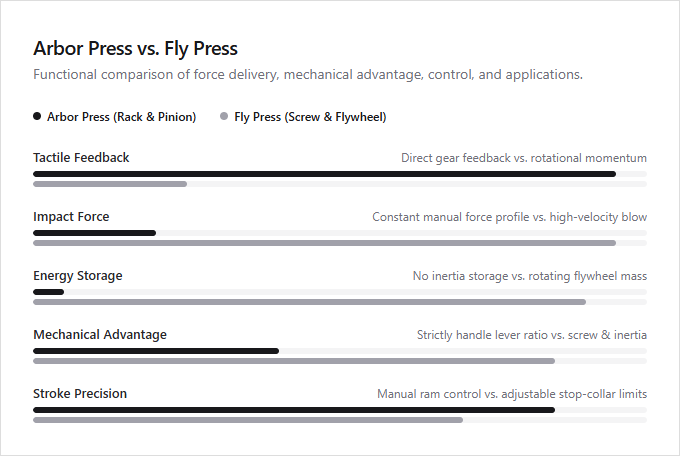
| Operating Mechanism | While an arbor press uses a rack and pinion gear system to translate lever movement into linear force, a fly press utilizes a coarse-pitch lead screw driven by a weighted flywheel. |
| Force Delivery | Arbor presses deliver a constant, manual force profile throughout the stroke, whereas fly presses leverage kinetic energy stored in rotating weights to deliver a high-impact blow. |
| Precision and Control | The direct mechanical linkage of the arbor press offers superior tactile feedback for delicate press-fit operations, while the fly press relies on momentum to execute high-force deformation. |
| Ideal Applications | Arbor presses are primarily used for installing bushings, broaching keyways, and seating bearings, while fly presses are preferred for sheet metal stamping, forging, and embossing. |
| Stroke Adjustment | Adjusting the stroke depth on an arbor press is typically controlled via the manual ram position, whereas a fly press controls travel using adjustable stop nuts on the central screw spindle. |
| Mechanical Advantage | The arbor press relies strictly on the leverage ratio of its handle and gears, while the fly press multiplies operator input through rotational inertia. |
Arbor vs. Fly Press Mechanisms Compared
In industrial manufacturing, selecting the appropriate machinery depends heavily on the required force delivery. Arbor presses utilize a rack and pinion mechanism to apply a constant linear force throughout the entire downstroke. This mechanical design ensures steady, predictable pressure, which is essential for precision assembly tasks like seating bearings and installing bushings.
Fly presses rely on a multi-start lead screw to convert rotational inertia from a weighted wheel into a powerful kinetic impact. This configuration generates massive force at the point of contact, making it highly effective for metal-forming applications such as stamping, bending, and riveting.
Arbor presses are best suited for precision assembly technicians requiring controlled, continuous pressure, while fly presses are ideal for metal fabricators and blacksmiths who need high-impact energy for shaping materials.
Why Arbor Presses Provide Superior Tactile Feedback
When selecting press machinery, the primary distinction between an arbor press and a fly press lies in force delivery and operational control. The direct mechanical linkage of an arbor press provides superior tactile feedback compared to the high kinetic energy generated by fly press weighted arms. Because the operator directly controls the leverage through a manual rack-and-pinion system, they can feel the exact resistance of the workpiece, allowing for precise adjustments during delicate assembly or pressing operations.
Conversely, a fly press utilizes heavy, spinning counterweights to store and deliver massive, sudden impact force with minimal continuous physical effort. While this momentum is excellent for forging, punching, and deep stamping, it sacrifices the sensitive manual feel inherent to leverage-based designs. Precision technicians and instrument makers benefit most from the controlled, tactile feel of an arbor press, whereas blacksmiths and metal fabricators requiring high-impact force are better suited for the fly press.
Rack and Pinion vs. Fly Presses: Alignment vs. Impact
In industrial assembly, selecting the appropriate machinery depends heavily on the mechanical requirements of the task. The arbor press, utilizing a rack and pinion drive system, excels at maintaining precise axial alignment throughout its stroke. This controlled, linear force makes it highly effective for interference fit insertions, such as pressing bearings, where axial deviation can ruin the components.
In contrast, the fly press operates on a quick-acting lead screw powered by weighted arms, designed specifically for high-tonnage impact forming. This kinetic energy mechanism is ideal for stamping, bending, and forging operations requiring sudden, intense force. Precision-focused instrument makers and machinists requiring meticulous alignment control favor the arbor press, while blacksmiths and metal fabricators executing heavy-duty forming tasks are better suited for the fly press.
Arbor vs. Fly Presses: Consistent vs. Exponential Force
When selecting manual workshop machinery, understanding the mechanical delivery of force is crucial. An arbor press utilizes a rack-and-pinion mechanism to deliver a consistent mechanical advantage throughout the entire stroke. This predictable, constant force makes it highly effective for precision operations such as seating bearings or installing bushings where control is paramount.
In contrast, a fly press relies on rotational inertia, using weighted arms and a coarse lead screw to multiply force exponentially upon impact loading. This rapid accumulation of kinetic energy allows the fly press to deliver massive blows suitable for heavy metal forming, stamping, and embossing.
Engineers requiring steady, measured pressure prefer the arbor press, while metalworkers and blacksmiths needing rapid, high-impact force find the fly press indispensable.
Depth Control: Rack & Pinion vs. Fly Presses
When comparing manual workshop machinery, the mechanism of depth control is a key differentiator between an arbor press and a fly press. In a standard rack and pinion arbor press, depth control is regulated by an adjustable stroke stop. This mechanical limit allows operators to achieve highly consistent, repeatable depths on downward strokes, which is essential for precision press-fit applications.
A fly press operates on a different mechanical principle, relying on the rotational limit of the ram spindle to determine depth. The force and travel are dictated by the momentum of the weighted fly arms, requiring the operator to manage the press depth through tactile feedback and rotational limits. High-volume assembly technicians requiring rapid, identical stroke limits benefit most from the arbor press, whereas metalworkers and artisans needing variable, high-impact force prefer the adaptable control of a fly press.
Wear Points in Arbor vs. Fly Presses
When selecting workshop machinery, understanding wear mechanics is essential for long-term maintenance planning. In an arbor press, mechanical wear is highly concentrated on the pinion gear teeth and the mating rack, where force is repeatedly transferred during the downward stroke. Conversely, fly presses operate via a heavy screw mechanism, experiencing significant friction and gradual wear along the bronze nut and the screw threads under high-load operations.
These distinct wear patterns directly influence the service life and ideal application of each machine. Engineers and assembly technicians requiring rapid, light-duty pressing benefit most from the quick, linear action of an arbor press, while blacksmiths and metal fabricators require the immense, controlled force of a fly press for complex shaping and forging tasks.
Rack and Pinion vs. Fly Press Velocity Control
When selecting manual workshop machinery, the key distinction between an arbor press and a fly press lies in their force delivery mechanisms. The ram velocity of a rack and pinion press is manually controlled by the operator lever, allowing for constant tactile feedback and highly precise, incremental pressure throughout the stroke. In contrast, a fly press utilizes flywheel momentum for rapid acceleration, converting rotational energy into a powerful, high-impact force at the point of contact.
This mechanical variance dictates their suitability for specific manufacturing and metalworking tasks. Precision assembly technicians requiring delicate, controlled force for bearings and bushings benefit most from the arbor press, while blacksmiths and fabricators needing rapid, heavy force for stamping and embossing find the fly press more suitable.
Leave a comment