
Achieving perfectly flat, dimensioned stock with a hand planer often leaves woodworkers caught in a frustrating compromise between raw, continuous power and spatial maneuverability. Historically, craftsmen have relied on standard workshop grid power and stationary jointer-planer setups to guarantee the relentless RPMs required for clean cuts.
Yet, choosing the right configuration of hand planer grants woodworkers unprecedented surface-finishing precision directly at the workpiece. To manage expectations, a critical stipulation must be noted: even the most advanced rotary cutterhead relies entirely on consistent feed rates and sharp knives, irrespective of the tool's power source. For instance, dimensioning heavy, rough-sawn oak timbers on-site demands vastly different torque profiles than beveling pine door edges in a workshop.
In this analysis, we will compare corded and cordless hand planers across critical metrics-including torque consistency, runtime under load, and overall ergonomics-to help you select the optimal tool for your thicknessing applications.
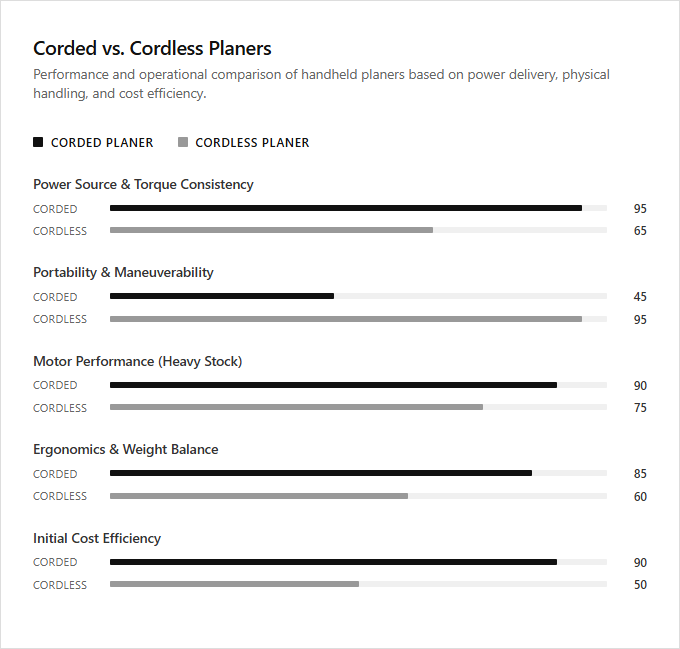
| Factor | Summary |
|---|---|
| Power Source | Corded planers utilize continuous AC power to deliver constant torque, whereas cordless planers rely on DC lithium-ion battery packs that can experience voltage drop. |
| Portability | Cordless planers offer superior maneuverability on job sites without the restriction of cord management, while corded units are limited by the reach of an electrical outlet. |
| Motor Performance | Corded models often feature high-amperage motors optimized for heavy-duty stock removal, while cordless models rely on brushless motor technology to maximize battery efficiency. |
| Weight and Balance | The addition of a high-capacity rechargeable battery increases the overall mass of cordless planers, which alters the tool's center of gravity and ergonomics. |
| Initial Cost | Cordless systems require a higher initial investment due to the added expense of proprietary batteries and external charging stations. |
Stable RPM Under Load for Consistent Surface Finish
Corded hand planers excel in delivering continuous, high-speed power directly from an electrical outlet. This constant power supply ensures the motor maintains a sustained rate of revolutions per minute (RPM), even when pushing through dense hardwoods or making deep cuts. Because the cutter head does not suffer from power drops, it delivers a highly consistent, ripple-free surface finish across long workpieces.
In contrast, cordless planers offer unmatched mobility but can experience RPM fluctuations under heavy, sustained loads. As the battery depletes, the motor may struggle to maintain the peak rotational speeds necessary for an immaculate finish on demanding tasks. While modern brushless motors mitigate this loss, they cannot fully replicate the relentless speed stability of a plug-in counterpart during prolonged operation.
Corded models are ideal for workshop woodworkers requiring flawless, continuous finishes on large-scale projects, whereas cordless planers are best suited for job-site carpenters who prioritize quick, cordless portability for trimming doors and framing adjustments.
Continuous duty cycle limitations without battery thermal protection shutdown
Corded hand planers excel in high-demand, continuous planing applications because they draw uninterrupted power directly from an electrical outlet. Free from the limitations of battery chemistry, these tools can run indefinitely under heavy loads without the risk of power drop-offs. This continuous duty cycle is critical when dimensioning large timber stocks, where stopping mid-pass to manage tool status would compromise the finish quality.
In contrast, cordless planers are bound by the thermal thresholds of lithium-ion batteries. Under continuous, heavy duty cycles, high current draw generates significant internal heat, triggering the battery's thermal protection circuit to shut down the tool to prevent cell damage. Corded planers are best suited for stationary workshop artisans managing large-volume stock preparation, while cordless models are ideal for mobile installers needing rapid, intermittent trimming capabilities on-site.
Torque output requirements for driving multi-knife helical rotary cutterheads
Driving multi-knife helical rotary cutterheads requires substantial, sustained torque to cleanly shear wood fibers without bogging down. Corded planers excel in these high-demand applications, leveraging continuous AC power to maintain maximum RPMs under heavy, prolonged loads. Conversely, cordless planers rely on battery voltage, where managing both peak torque demands and thermal limits can lead to power sag during deep cuts in dense stock.
While modern brushless cordless motors offer impressive instantaneous torque for rapid material removal, they struggle to match the endless duty cycle of corded units. Workshop professionals processing bulk hardwood require the sustained, high-torque output of a corded planer, whereas mobile carpenters prioritizing quick jobsite adjustments are better served by the agility of a cordless model.
Voltage sag impact on maximum depth of cut consistency
Corded planers utilize a continuous AC power source, which virtually eliminates voltage sag during operation. This stable electrical supply allows the tool to maintain maximum motor RPM and torque, ensuring consistent depth-of-cut performance from the beginning of the pass to the end of the board.
In comparison, cordless planers are susceptible to voltage sag as the battery charge depletes or under high-load resistance. This temporary power drop reduces motor speed, which can lead to uneven depths of cut and a diminished surface finish during intensive tasks. Corded models are best suited for workshop artisans undertaking continuous, heavy-duty stock preparation, whereas cordless versions excel for mobile installers needing quick, on-the-go trim adjustments.
Amp-hour (Ah) capacity consumption during heavy stock removal
When performing heavy stock removal, planers demand continuous high-torque output. Cordless models rely heavily on battery Amp-hour (Ah) capacity to sustain this workload; rapid material extraction quickly drains low-Ah batteries, risking thermal overload. High-capacity batteries, such as 5.0 Ah or greater, provide the necessary current draw to maintain motor RPMs, though they require frequent recharging during extended tasks.
Corded planers bypass battery limitations, delivering consistent, uninterrupted power from an electrical outlet. This constant supply ensures maximum cutting velocity without voltage drops during deep passes. Corded models are ideal for stationary workshop woodworkers requiring continuous, high-volume production, while cordless planers suit mobile contractors needing rapid, short-duration adjustments on-site.
Brushless motor efficiency compared to corded amperage power delivery
When selecting a power planer, the choice between corded and cordless models hinges on power delivery dynamics. Traditional corded planers draw continuous amperage directly from the electrical grid, ensuring relentless torque and consistent blade speed under heavy loads. This uninterrupted power supply eliminates performance degradation during prolonged, deep-cutting surfacing tasks.
Conversely, modern cordless planers utilize advanced brushless motors to close the performance gap. By electronically regulating energy distribution, brushless technology optimizes battery efficiency, delivering high-torque performance that closely rivals corded power without the energy loss associated with carbon brushes. While brushless electronics provide impressive peak power, the tool's runtime remains bound by battery capacity.
Corded planers are best suited for workshop artisans undertaking continuous, high-volume stock removal, whereas cordless brushless planers are ideal for mobile contractors and trim carpenters requiring maximum portability for rapid, on-site adjustments.
Chip ejection velocity and dust extraction port static pressure demand
Corded electric planers deliver continuous, high-voltage power that maintains consistent cutterhead speeds under heavy loads. This sustained power translates to a consistently high chip ejection velocity, rapidly clearing large volumes of waste. To manage this intense output and prevent port clogging during deep passes, corded models demand a dust extraction system with high static pressure capability to effectively pull debris through the port.
Cordless planers offer mobility but experience fluctuating cutterhead speeds as the battery drains, resulting in a more variable chip ejection velocity. These battery-powered units typically generate less immediate debris volume, requiring lower static pressure from extraction systems and making them highly compatible with portable shop vacuums. Corded planers are ideal for high-volume workshop professionals requiring continuous, heavy-duty stock removal, while cordless planers best serve mobile carpenters who prioritize jobsite portability for quick, intermittent trimming tasks.
Leave a comment