
Achieving a glass-smooth finish on highly figured hardwoods often feels like an uphill battle, frequently resulting in devastating tear-out and hours of tedious corrective sanding. To combat this, woodworkers typically rely on aggressive post-planing sanding regimens or manual pressure adjustments to salvage workpiece surfaces. However, mastering the mechanics of feed rates and Cuts Per Inch (CPI) grants craftsmen near-total control over surface quality right out of the machine.
Crucially, this optimization stipulates that your planer knives are sharp and properly aligned, as feed speed adjustments cannot compensate for dull tooling. For instance, shifting a dual-speed planer to its slower finishing speed when dimensioning figured maple prevents the deep grain tear-out that single-speed units often cause.
Below, we will analyze the technical differences between single- and dual-speed feed rates, calculate how CPI impacts various wood species, and determine the optimal setup for your workshop's finishing needs.
| Factor | Summary |
|---|---|
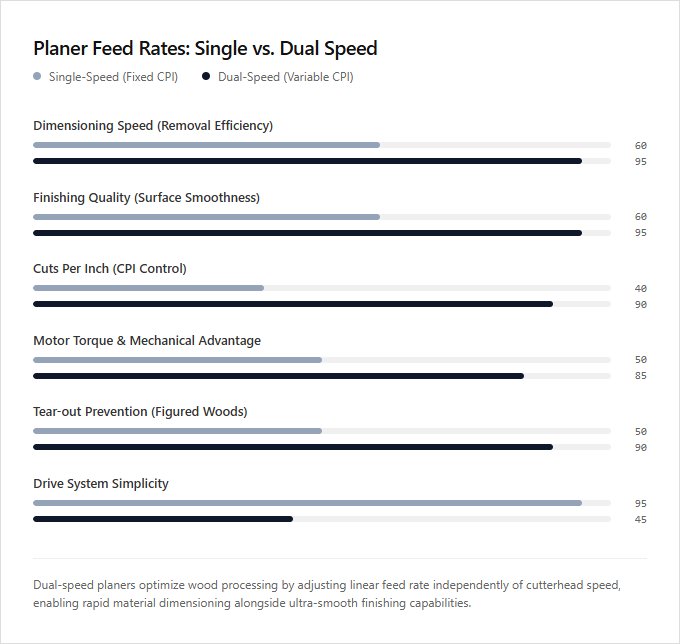
| Dimensioning Speed | A higher feed rate in dual-speed planers maximizes material removal efficiency during initial dimensioning but reduces the overall cuts per inch. |
| Finishing Speed | The slower feed rate setting increases the cuts per inch to produce an ultra-smooth surface finish and minimize tear-out on figured timber. |
| Cuts Per Inch (CPI) | Dual-speed models allow users to manipulate the cuts per inch by changing the linear feed rate while keeping the cutterhead rotational speed constant. |
| Motor Load and Wear | Single-speed planers subject the drive motor to a fixed load, whereas dual-speed gearboxes alter mechanical advantage to optimize torque during heavy stock removal. |
| Gearbox Complexity | Dual-speed planers utilize a multi-gear transmission system to switch sprocket ratios, which introduces more mechanical complexity than a simple single-speed drive chain. |
| Tear-out Prevention | Utilizing the slow-feed rate on dual-speed planers reduces the chip load per cutter insert, significantly decreasing the likelihood of grain tear-out on highly figured hardwoods. |
How Dual-Speed Planers Control Knife Mark Density
Thickness planers utilize feed rates, measured in Feet Per Minute (FPM), to determine how quickly stock passes beneath the cutterhead. While single-speed planers operate at a fixed FPM, dual-speed models offer two distinct feed rates to directly control the density of the knife marks left on the wood.
Reducing the FPM on a dual-speed planer increases the cuts per inch, yielding an ultra-smooth finish that requires minimal sanding. The faster FPM setting maximizes efficiency during initial dimensioning when rapid material removal is the primary goal.
Single-speed planers are highly suitable for budget-conscious DIYers focusing on general dimensioning, while dual-speed planers are ideal for furniture makers and professionals who require both rapid thicknessing and flawless final finishes.
Higher CPI: Smoother Finishes with Less Sanding
Thickness planers utilize feed rates to control how quickly timber passes through the cutterhead, directly influencing the final texture of the wood. Dual-speed planers offer a distinct advantage over single-speed models by allowing users to select a lower feed rate. This slower speed significantly increases the cuts per inch (CPI), resulting in a highly refined surface finish that minimizes the need for subsequent sanding.
Single-speed planers operate at a fixed, compromise rate that balances material removal speed with acceptable surface quality. Single-speed models are ideal for construction workers and general DIYers prioritizing rapid material dimensioning, whereas dual-speed units are best suited for fine woodworkers and furniture makers who require precision finishing on premium hardwoods.
Lower Feed Rate Reduces Planer Chip Load
Thickness planers operate with either single or dual-speed feed rates to control how fast wood passes through the cutterhead. While single-speed planers maintain a constant rate, dual-speed models offer greater control over the final surface quality. Decreasing the feed rate on a dual-speed planer reduces the chip load per cutterhead knife. This reduction means each knife takes smaller bites, resulting in more cuts per inch and a significantly smoother finish that minimizes tear-out on figured timber.
The choice between these configurations depends on production goals and material sensitivity. Single-speed machines maximize efficiency for dimensioning rough lumber quickly, whereas the slower speed on dual-speed units is essential for final dimensioning and working with delicate hardwoods. Single-speed planers suit general contractors and carpenters focusing on rapid stock removal, while dual-speed planers are ideal for fine furniture makers and luthiers requiring pristine, ready-to-finish surfaces.
Single-Speed Planers: Speed vs. Finish Quality
When selecting a thickness planer, the feed rate configuration significantly influences both workshop efficiency and surface finish. Single-speed planers utilize a fixed feed-to-cutterhead ratio, which compromises between rapid stock removal and a high-quality, smooth finish. This single setting must balance the speed at which lumber passes through the machine with the number of cuts per inch, meaning users cannot optimize the machine specifically for rough dimensioning or final ultra-smooth passes.
Dual-speed planers resolve this compromise by offering separate settings for dimensioning and finishing. The high-speed feed rate maximizes material removal during initial passes, while the low-speed setting increases the cuts-per-inch ratio to deliver an exceptionally smooth surface. Single-speed models are best suited for casual hobbyists prioritizing budget and simplicity, whereas dual-speed units are ideal for professional woodworkers who require precise finish control on figured hardwoods.
Slower Feed Rates Minimize Lumber Scallop Depth
When selecting a thickness planer, the choice between single-speed and dual-speed feed rates directly impacts the quality of the finished surface. Dual-speed models offer a slower finish feed rate that increases the cuts-per-inch ratio. This slower rate minimizes scallop depth along the face of the planed lumber, producing a highly polished finish that requires virtually no sanding.
A single-speed planer operates at a fixed, faster pace designed for rapid material thickness reduction, though it leaves more noticeable tooling marks. Single-speed models are best suited for construction carpenters who prioritize speed and bulk dimensioning, while dual-speed planers are ideal for fine furniture makers who require precision finishing on premium hardwoods.
Adjusting Planer Gearbox Changes Feed Speed Independently
When selecting a thickness planer, understanding the distinction between single-speed and dual-speed feed rates is essential for achieving the desired wood finish. Single-speed planers operate at a fixed feed rate, balancing stock removal efficiency with surface quality. In contrast, dual-speed models feature a mechanical gearbox that allows operators to select between dimensioning and finishing speeds. Adjusting this gearbox changes the feed roller velocity without altering the cutterhead RPM, ensuring consistent cutting power and cuts-per-inch control.
Selecting the appropriate configuration depends heavily on your workflow and the variety of materials processed. Single-speed planers are ideal for DIY hobbyists focusing on standard construction lumber, while dual-speed models are best suited for professional woodworkers who regularly transition between rapid thicknessing and finishing highly figured hardwoods.
High-Speed Roughing Prevents Heat and Knife Dwell
When selecting a thickness planer, the choice between single-speed and dual-speed feed rates significantly impacts material processing efficiency. Dual-speed models offer a distinct advantage during bulk stock removal by providing a fast feed option. This high-speed roughing pass minimizes the time the cutting knives remain in contact with the wood, which reduces heat buildup and prevents knife dwell, preserving blade sharpness and preventing workpiece burning.
A slower finishing speed increases cuts-per-inch to deliver an ultra-smooth surface ready for final assembly. Single-speed planers operate at a compromised, fixed velocity designed for standard, everyday tasks. Budget-conscious hobbyists undertaking basic projects typically prefer the simplicity of single-speed planers, whereas professional woodworkers requiring precision dimensioning and superior finishes choose dual-speed models.
Leave a comment