
For woodworkers striving for flawless surfaces, battling tear-out and deep ripple marks on figured stock is a constant, frustrating bottleneck. While relying on standard entry-level benchtop planers or aggressive drum sanders represents the traditional approach to dimensioning rough lumber, these standard tools often demand extensive, labor-intensive sanding afterward.
Optimizing your cutterhead configuration grants you the ability to drastically increase cuts per inch (CPI), yielding a glass-like finish directly from the machine. However, achieving these results requires a clear stipulation: higher knife counts demand a proportional balance of motor horsepower and feed speed management to prevent wood burning.
Whether you are evaluating a standard utility model or upgrading to a three-knife powerhouse like the DeWalt DW735, the right choice depends on your specific production demands. This article compares two-knife and three-knife cutterheads, examining their mechanics, finish quality, and long-term maintenance costs to help you select the ideal planer for your shop.
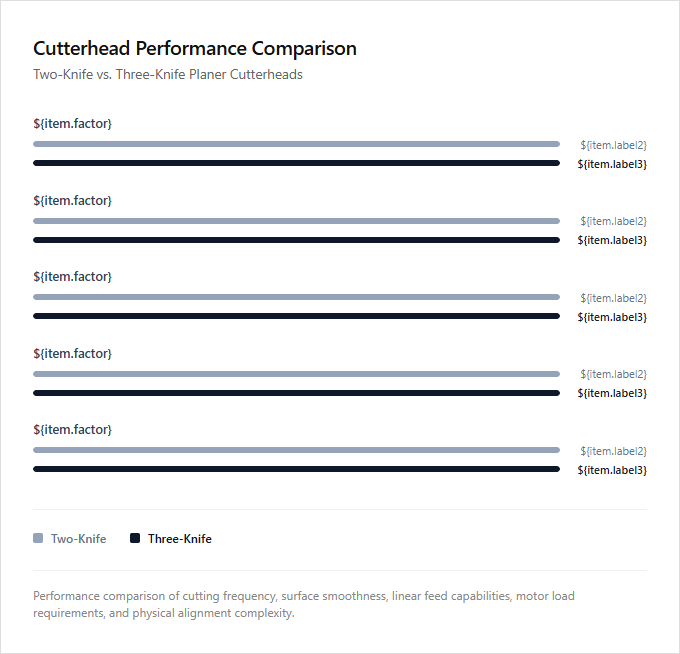
| Factor | Summary |
|---|---|
| Cuts Per Minute (CPM) | Three-knife cutterheads inherently achieve a fifty percent higher cuts-per-minute rate than two-knife configurations at identical spindle speeds. |
| Surface Finish | The increased frequency of the three-knife design significantly reduces scallop spacing on the wood, leading to a smoother planed surface. |
| Feed Speed | Planers with three-knife cutterheads can maintain a faster linear feed rate without experiencing the tear-out common in slower two-knife models. |
| Operating Torque | Three-knife cutterheads distribute the chip load per tooth more evenly, stabilizing cutting forces but requiring a robust motor to maintain rotation. |
| Maintenance Overhead | Two-knife cutterheads minimize downtime and blade replacement costs because there are fewer knife edges to align and calibrate. |
Three-Knife Cutterheads Deliver Higher Cuts Per Inch
When selecting a thickness planer, the cutterhead configuration is a primary determinant of surface finish quality. The fundamental difference between a two-knife and a three-knife cutterhead lies in the frequency of blade contact with the wood. At a constant feed rate, a three-knife cutterhead delivers a significantly higher Cuts Per Inch (CPI) rating. This increased CPI translates to a smoother, cleaner surface with minimal tear-out, as the wood is sheared more frequently per inch of travel.
Two-knife cutterheads require slower feed rates to achieve a comparable finish, which can increase production time. Three-knife configurations optimize workshop efficiency by producing superior finishes at standard speeds, though they require more maintenance during blade replacements. Light-duty hobbyists prioritizing affordability favor two-knife models, while professional woodworkers requiring high-volume, paint-ready finishes benefit most from three-knife systems.
Three Knives Reduce Scallop Height for Smoother Finish
When selecting a thickness planer, the cutterhead configuration directly influences mill quality. The primary difference between a two-knife and a three-knife cutterhead lies in the cuts per inch. Increasing the knife count from two to three reduces the scallop height-the tiny ridges left on the wood by the rotating blades-yielding a significantly smoother surface finish and reducing the need for post-planing sanding.
Two-knife models offer simpler maintenance and lower operating costs, though they leave larger scallops. Three-knife cutterheads deliver more cuts per minute, which minimizes tear-out on figured grain. Two-knife planers are highly suitable for casual DIY hobbyists undertaking rough construction, while three-knife cutterheads are ideal for professional woodworkers requiring precision joinery and flawless finishes.
Three-Knife Cutterheads Produce 50% More Cuts
When selecting a thickness planer, the cutterhead design plays a critical role in determining both surface finish quality and processing efficiency. The primary distinction between a two-knife and a three-knife cutterhead lies in their cutting frequency. At identical revolutions per minute (RPM), a three-knife cutterhead produces 50% more cuts per minute than a two-knife cutterhead. This increased frequency reduces the spacing between individual knife impacts, which significantly minimizes tear-out and yields a smoother, burn-free finish on dense hardwoods.
While a two-knife cutterhead is more cost-effective to maintain and simpler to align, it typically requires a slower feed rate to achieve comparable smoothness. Budget-conscious DIY hobbyists find the straightforward two-knife model ideal for general construction lumber, whereas professional woodworkers requiring pristine finishes on figured timbers benefit most from the high-performance three-knife system.
Three-Knife Cutterheads Extend Tool Life
When selecting a planer, the cutterhead configuration significantly impacts machine efficiency and blade longevity. A three-knife cutterhead offers a distinct mechanical advantage by distributing the cutting workload across more edges. By engaging three blades per rotation, this system reduces the individual chip load per knife, which minimizes wear, dissipates heat more effectively, and extends overall tool life. Additionally, the increased cuts per inch produce a cleaner, smoother finish on difficult wood grains.
Two-knife cutterheads, while simpler, place a higher physical demand on each blade, leading to faster dulling. Budget-conscious hobbyists and occasional DIYers will find the straightforward maintenance of a two-knife planer sufficient for light duty, whereas professionals and high-volume woodworkers requiring superior surface quality and minimal downtime should opt for a three-knife system.
Two-Knife Cutterheads Require Slower Feed Speeds
When selecting a benchtop thickness planer, the choice between a two-knife and a three-knife cutterhead directly impacts both surface finish quality and workshop efficiency. A three-knife cutterhead naturally delivers more cuts per inch at any given feed rate, producing a remarkably smooth finish. To match this superior surface quality, a two-knife cutterhead system requires a significantly slower feed speed to ensure the blades make sufficient contact with the wood fibers.
While both configurations can produce professional-grade results, the three-knife system accomplishes the task in much less time. Budget-conscious DIYers who do not mind slower production speeds find the two-knife planer ideal, while professional carpenters and high-volume woodworkers requiring rapid, pristine finishes benefit most from a three-knife cutterhead.
Precision Indexing for Three-Knife Cutterheads
When selecting a thickness planer, the choice between a two-knife and a three-knife cutterhead significantly impacts finish quality and maintenance. A three-knife system offers more cuts per minute at a given feed rate, yielding a smoother surface. This design demands highly precise knife indexing to ensure all cutting edges sit on the exact same cutting circle. Without perfect alignment, only the highest knife finishes the wood, which accelerates uneven blade wear and negates the benefits of the third blade.
Two-knife cutterheads are simpler to align, making them forgiving during routine maintenance. Three-knife systems require meticulous calibration to reach their full potential but deliver superior results when properly set up. Casual hobbyists prioritize the straightforward upkeep of a two-knife model, whereas production shops and detail-oriented professionals require the flawless finish quality offered by a three-knife setup.
Three-Knife Cutterheads Increase Motor Load and Amperage
When selecting a thickness planer, the choice between a two-knife and a three-knife cutterhead significantly impacts machine performance and longevity. While a three-knife system delivers a smoother finish by increasing cuts per inch, it also introduces greater cutting resistance. During heavy stock removal, this additional contact increases the motor load and elevates the amperage draw, which can strain standard workshop circuits and accelerate motor wear under continuous use.
In contrast, a two-knife cutterhead encounters less resistance, allowing the motor to run cooler and more efficiently during aggressive dimensioning. This design minimizes power demands and reduces the risk of thermal overload during deep passes. Standard two-knife planers are highly suitable for DIY hobbyists prioritizing utility and lower power demands, whereas three-knife models are ideal for professional woodworkers requiring superior surface finishes on dense hardwoods.
Leave a comment