

Achieving a flawless profile with a woodworking router can be highly frustrating. Woodworkers frequently struggle with unsightly burn marks, grain tear-outs, and destructive chatter, which often ruin expensive stock in the final stages of fabrication.
While craftsmen traditionally look to resolve these issues by upgrading standard shop machinery-treating high-horsepower motors as the primary solution-power alone cannot solve thermal friction. Optimizing spindle speed grants the operator the critical ability to manipulate torque and surface feet per minute (SFM), preserving both the cutter edge and the workpiece.
However, realizing these benefits carries the strict stipulation that rotation speeds must be dynamically matched to cutter geometry. For example, running a wide 3-inch panel-raising bit at the same 22,000 RPM default speed used for a narrow 1/4-inch straight bit is highly hazardous and guarantees burnt wood.
This article will compare fixed and variable speed routers, define exact RPM ranges for varying bit diameters, and outline a strategic framework for maximizing shop safety and cut quality.
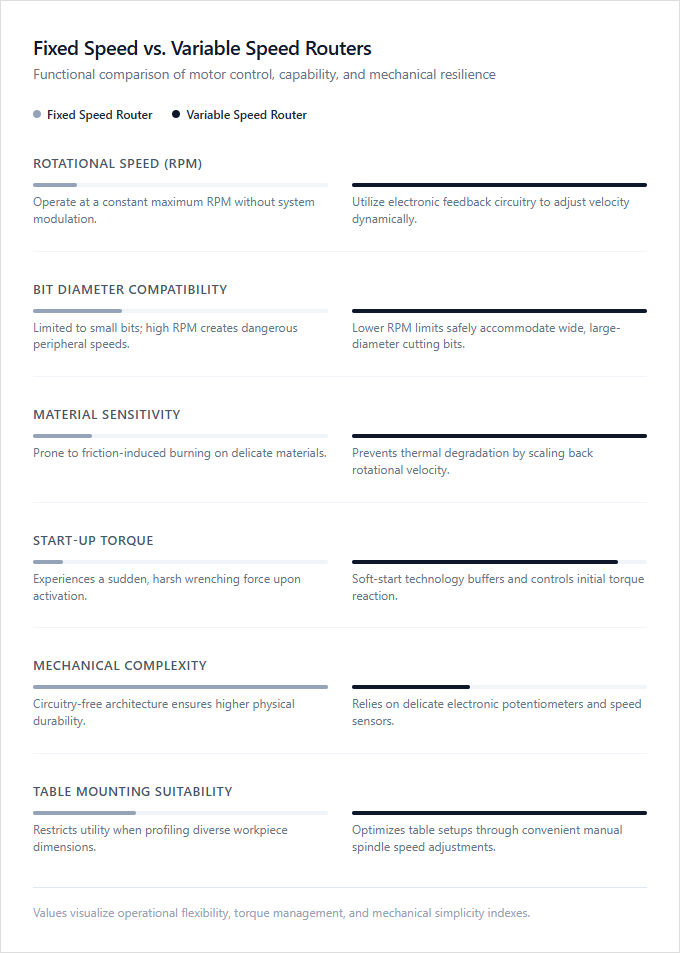
| Factor | Summary |
|---|---|
| Rotational Speed (RPM) | Fixed speed routers operate at a constant maximum RPM, whereas variable speed routers utilize electronic feedback circuitry to adjust velocity for different applications. |
| Bit Diameter Compatibility | Large-diameter cutting bits require the lower RPM limits of variable speed routers to prevent dangerous peripheral speeds and excessive friction. |
| Material Sensitivity | Variable speed routers prevent thermal degradation and burning on delicate substrates like acrylics by allowing the operator to reduce the cutter's rotational velocity. |
| Start-up Torque | Variable speed models often feature soft-start technology to minimize the initial torque reaction, while fixed speed models experience a sudden wrenching force upon activation. |
| Mechanical Complexity | Fixed speed routers possess simpler circuitry-free designs that increase durability, whereas variable speed routers depend on complex potentiometers and speed sensors. |
| Table Mounting Suitability | When mounted in a router table, variable speed units offer greater utility for profiling large workpieces because they allow manual adjustments to the spindle speed. |
Optimizing surface feet per minute based on cutting edge diameter
Optimizing surface feet per minute (SFPM) is critical for achieving clean, burn-free routing results. Because SFPM is a function of both spindle speed and cutting edge diameter, maintaining the correct velocity prevents material burning and premature tool wear. Fixed-speed routers operate at a single high RPM, which works efficiently with small-diameter bits but becomes unsafe and ineffective for larger cutters that require lower rotational speeds to maintain safe rim velocities.
Variable-speed routers solve this limitation by allowing operators to decrease the RPM as cutter diameter increases, ensuring a consistent and optimal SFPM. This flexibility prevents the outer edges of large bits from spinning too fast and scorching the workpiece. Fixed-speed models are best suited for production specialists performing repetitive, single-bit tasks, whereas variable-speed units are ideal for custom woodworkers utilizing a wide array of cutter profiles.
Calculating feed rate correlation to maintain recommended chip load
To maintain the manufacturer's recommended chip load-the thickness of material sheared by each cutting edge-the physical feed rate must correlate directly with the router's rotational speed. With a fixed-speed router operating at a single high RPM, achieving the target chip load requires the operator to guide the tool faster. If the manual feed rate is too slow for the fixed high speed, the bit rubs rather than cuts, generating excessive heat and accelerating tool wear.
Variable-speed routers simplify this mathematical relationship by allowing adjustments to the spindle speed to match the operator's natural feed rate and cutter diameter. Lowering the RPM for larger diameter bits maintains the optimal chip load without requiring unsustainably fast manual feed rates. Fixed-speed models suit production woodworkers running identical, small-diameter bits continuously, while variable-speed routers are ideal for custom craftspeople utilizing diverse cutter diameters and materials.
Reducing Angular Velocity to Mitigate Large-Bit Centrifugal Force
When operating a router, managing the rotational dynamics of the cutting bit is critical for safety and finish quality. Large diameter bits, such as panel raisers, generate substantial centrifugal force at high speeds. To prevent excessive vibration and potential tool failure, operators must reduce the angular velocity of the spindle.
Fixed-speed routers operate at a constant high RPM, making them unsuitable for larger profiles due to the inability to control speed. Conversely, variable-speed routers allow operators to dial down the RPM to safely match the bit's diameter, effectively mitigating centrifugal stress.
Fixed-speed units suit production workers focusing on repetitive, small-bit tasks, while variable-speed routers are best for versatile craftsmen requiring flexibility for diverse cutter sizes.
Sustaining Low-RPM Torque via Electronic Speed Control
Standard fixed-speed routers operate at a constant, high RPM, which is highly efficient for uniform cuts in standard lumber using smaller bits. Without the ability to adjust velocity, these tools risk burning larger workpieces or damaging specialized cutters that require slower operational speeds.
Variable-speed routers overcome this limitation through electronic speed control, which sustains motor torque at lower RPMs. When encountering resistance under heavy loads, the internal circuitry automatically regulates power to prevent stalling, allowing precise routing of dense hardwoods and large-diameter bits.
Fixed-speed models suit production-line operators performing repetitive, single-bit tasks, whereas variable-speed units are ideal for versatile craftsmen working with diverse materials and varying bit sizes.
Preventing workpiece thermal degradation and burning through speed adjustment
During routing operations, excessive heat buildup can cause severe thermal degradation and unsightly burn marks on the workpiece. Fixed-speed routers run continuously at a high maximum RPM, which increases friction and the risk of scorching when using large-diameter bits or working with dense hardwoods and plastics.
In contrast, variable-speed routers allow operators to decrease the spindle speed to match the specific thermal tolerance of the material and the diameter of the cutter. Adjusting the RPM downward prevents heat accumulation, ensuring clean cuts without damaging the wood fibers or melting synthetic materials. Fixed-speed units are highly practical for dedicated workshop stations performing repetitive cuts on standard softwoods, whereas variable-speed models are indispensable for versatile woodworkers who regularly handle diverse materials and intricate profiles.
Reducing harmonic chatter and bit deflection in deep profiles
Deep profile routing requires precise control to mitigate harmonic chatter and bit deflection, which compromise surface finish and accelerate tool wear. Fixed-speed routers operate at a constant, high RPM, typically optimized for small-diameter cutters. When paired with larger profiling bits, this unchanging speed can induce severe resonant vibrations and lateral deflection, as the outer edges of the bit exceed safe linear cutting speeds.
Variable-speed routers address this challenge by allowing operators to reduce the RPM to match the specific cutter diameter. Lowering the spindle speed dampens harmonic chatter and stabilizes the bit during heavy cuts, ensuring cleaner profiles. Fixed-speed models are suited for production specialists utilizing uniform, small-diameter bits, whereas variable-speed units are ideal for versatile woodworkers executing diverse, deep-profile assignments with varied bit sizes.
Limits of Max-RPM Fixed-Speed Routers
Fixed-speed routers operate at a constant maximum rate, typically locked between 20,000 and 25,000 RPM. While highly efficient for small trimming bits, this rigid velocity poses significant operational limitations when utilizing larger-diameter cutters. Spin-rates this high on wide bits generate excessive friction, which scorches the workpiece, accelerates tool wear, and increases safety risks.
Variable-speed routers mitigate these hazards by allowing operators to decrease the RPM, ensuring clean, controlled cuts across various material densities and cutter profiles. Fixed-speed models best suit production-line specialists performing repetitive, light-duty edge trimming, while variable-speed units are ideal for custom furniture makers who require versatility for diverse bit sizes.
Leave a comment