

Managing the sudden, violent jerk of a high-horsepower router upon activation is a frustrating challenge familiar to many woodworkers. This abrupt burst of rotational force can easily mar a delicate workpiece or compromise operator control. While standard workshop funding sources and equipment budgets typically prioritize raw motor horsepower, focusing solely on these baseline metrics overlooks the critical engineering of power delivery.
Opting for a soft-start mechanism grants operators a vital window of control by gradually ramping the motor up to its target RPM. Under the stipulation that advanced electronics never replace the fundamental necessity of proper hand placement and workpiece securing, this technology-standard in heavy-duty plunge routers used by professional cabinetmakers-serves as a proven safeguard against slip-ups. Below, we will compare soft start versus instant start systems, analyzing motor torque dynamics and guiding you toward the optimal configuration for your precision routing needs.
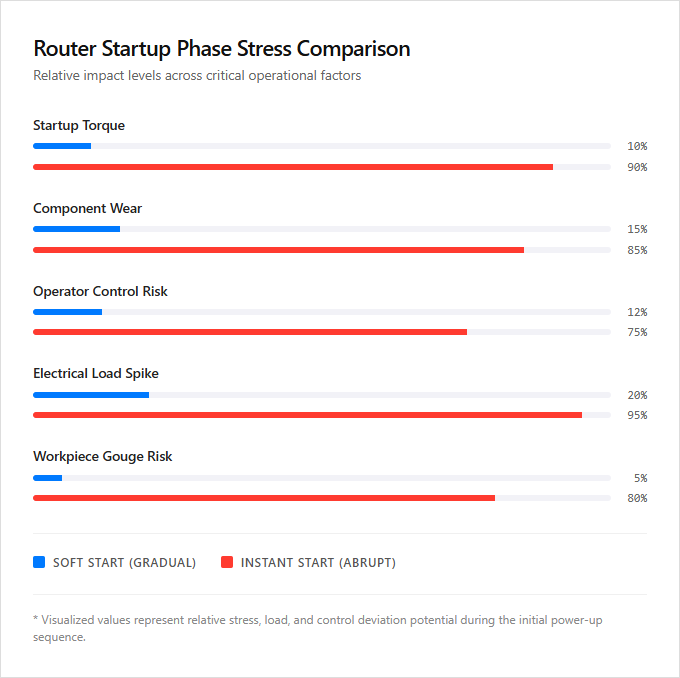
| Factor | Summary |
|---|---|
| Startup Torque | Soft start gradually increases voltage to mitigate reactive torque, whereas instant start delivers full power immediately, causing a sudden physical jerk. |
| Component Wear | Soft start reduces mechanical and thermal stress on the motor's armature and carbon brushes, while instant start accelerates wear due to abrupt friction. |
| Operator Control | Soft start prevents accidental deviation from the cut line by neutralizing the gyroscopic effect during power-up, whereas instant start requires a firm grip to counteract sudden motion. |
| Electrical Load | Soft start prevents voltage sag and nuisance circuit breaker tripping by limiting the initial inrush current, while instant start draws maximum amperage instantly. |
| Workpiece Safety | Soft start allows the router bit to reach its optimal operating RPM smoothly before contacting the wood, eliminating the risk of gouging inherent to instant start-up. |
Mitigation of transient inrush current spikes
High-power wood routers experience significant transient inrush current upon startup, often exceeding rated circuit capacities. Soft start technology mitigates these spikes by gradually ramping up the voltage delivered to the motor, which prevents sudden voltage drops and minimizes mechanical kickback.
Instant start systems deliver immediate full voltage. While this achieves maximum operating speed instantly, the resulting unrestricted current surge can trip circuit breakers and accelerate wear on internal electrical components over time.
Soft start models are highly suited for precision-oriented craftspeople prioritizing control and workshop safety, while instant start routers are preferred by industrial operators requiring immediate peak performance for rapid, high-volume production tasks.
Reduction of starting torque and gyroscopic reaction force
Soft start routers gradually accelerate the motor to full operating speed, which significantly mitigates the sudden spike in starting torque. This controlled ramp-up minimizes the gyroscopic reaction force-the abrupt twisting motion that can destabilize the tool upon activation. By dampening this physical force, soft start technology ensures a smoother, safer entry into the workpiece.
Instant start routers deliver immediate full power, resulting in a pronounced rotational jerk that requires a firm grip to manage. While this rapid delivery offers immediate readiness, it demands greater physical effort to resist the sudden gyroscopic deflection.
Instant start models are best suited for experienced production woodworkers prioritizing speed, whereas soft start units are ideal for hobbyists and precision craftsmen seeking maximum control and reduced hand fatigue.
Prevention of initial workpiece kickback and gouging
Soft start routers gradually ramp up to full operating speed over several seconds. This progressive acceleration eliminates the sudden torque jerk upon activation, significantly reducing the risk of the bit catching the wood and causing initial workpiece kickback or surface gouging. This controlled power delivery allows operators to maintain firm, stable contact with the guide surface from the moment the switch is flipped.
Conversely, instant start routers reach maximum RPM immediately. This rapid engagement can cause the tool to twist slightly in the operator's hands, potentially leading to immediate gouging if the bit is improperly positioned near the stock. Instant start models are well-suited for experienced production professionals performing high-volume, jig-mounted operations, while soft start units are ideal for hand-held routing enthusiasts seeking maximum control and safety.
Minimization of mechanical stress on carbon brushes and commutators
In electric router design, the choice between soft start and instant start technology significantly impacts motor longevity. Soft start systems gradually ramp up voltage, preventing the massive inrush current typical of electric motors. This controlled acceleration minimizes mechanical shock and electrical arcing at the interface of the carbon brushes and commutator, substantially reducing wear on these critical wear-prone components. Conversely, instant start motors deliver immediate full power, subjecting the brush-commutator interface to abrupt torque forces and intense initial thermal stress during every startup cycle.
Selecting the appropriate starting mechanism depends on specific operational demands. Soft start routers are highly suitable for detail-oriented artisans who prioritize tool longevity, safety, and precise control, whereas instant start models are best suited for production-line operators who require immediate peak speed for rapid, high-volume cutting tasks.
Implementation of triac-based phase-angle voltage modulation
In electric routers, the distinction between soft start and instant start relies on how the triac-based phase-angle voltage modulation is managed. Instant-start routers immediately apply full mains voltage to the universal motor by firing the triac at the very beginning of each AC half-cycle. This delivers maximum torque instantly but subjects the mechanical components and the operator to a violent torque reaction.
Soft-start systems employ control circuitry to gradually shift the triac's firing angle over a brief interval, incrementally increasing the root-mean-square voltage. This controlled ramp-up eliminates the harsh startup kickback, reducing mechanical wear and preventing circuit breaker tripping from high inrush currents. Instant-start units are best suited for high-volume production operators prioritizing rapid cycle times, while soft-start models are ideal for precision woodworkers demanding superior control and tool longevity.
Elimination of sudden angular momentum transfer to the operator
Woodworking routers with instant start motors deliver full voltage immediately, creating a rapid acceleration that transfers sudden angular momentum to the operator. This sudden torque reaction can cause the tool to wrench or twist unpredictably upon activation. Soft start technology gradually ramps up the motor speed, mitigating this abrupt kinetic energy transfer and ensuring a smooth, highly controllable transition to maximum RPM.
By eliminating the initial jerk, soft start systems significantly enhance safety and precision during hand-held operations. Instant start models, though lacking this controlled acceleration, provide immediate, lag-free power. Soft start routers are ideal for hand-held craftsmen seeking maximum control and safety, while instant start models are best suited for experienced production woodworkers using stable, table-mounted setups.
Compatibility of soft start with electronic feedback speed regulation
Soft start technology gradually accelerates a router's motor, significantly reducing the initial torque jerk and protecting internal components from premature wear. This system integrates seamlessly with electronic feedback speed regulation, as both rely on advanced microprocessor control to manage voltage delivery and maintain a constant RPM under varying work loads. In contrast, instant start motors deliver immediate maximum power upon activation, bypassing sophisticated electronic modulation in favor of mechanical simplicity and rapid deployment.
Choosing between these systems depends on your specific application and workflow requirements. Precision craftsmen requiring superior control, heavy-duty material removal, and constant speeds under load are ideally suited for soft start routers, whereas production-line operators performing rapid, repetitive cuts on uniform materials typically prefer the direct simplicity of instant start machines.
Leave a comment