
Machinists and CNC retrofitters frequently struggle with backlash and tracking errors in milling machine feed drives, which directly compromise surface finish and dimensional accuracy. While many facilities rely on standard capital upgrade budgets or OEM-specified replacement programs to address these mechanical deficiencies, selecting the correct transmission component is crucial before committing your resources.
Optimizing this critical subsystem grants operators micro-inch positioning precision, virtually eliminating mechanical play and drastically reducing scrap rates. However, we must stipulate that achieving this performance level requires balancing axial load capacities against speed and budget limits, as observed in high-precision aerospace prototyping compared to standard Bridgeport manual retrofits.
This article provides a comprehensive comparison of ball screws versus lead screws, analyzing efficiency, friction, cost, and longevity to help you select the ideal linear motion technology for your milling machine feed drives.
| Factor | Summary |
|---|---|
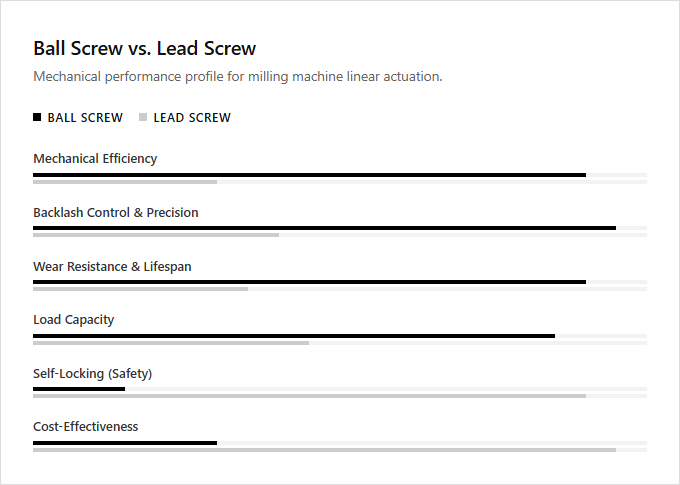
| Mechanical Efficiency | Ball screws utilize rolling ball bearings to achieve up to 90% mechanical efficiency, whereas lead screws rely on sliding friction that dissipates energy as heat. |
| Backlash and Precision | Ball screws can be configured with preloaded ball nuts to eliminate backlash, making them ideal for high-precision CNC milling applications. |
| Wear and Lifespan | The rolling contact design of ball screws significantly reduces abrasive wear and extends operational lifespan compared to the high sliding friction of lead screws. |
| Load Capacity | Ball screws handle much higher dynamic loads because the forces are distributed across multiple rolling elements rather than sliding thread interfaces. |
| Self-Locking (Backdriving) | Lead screws inherently prevent backdriving due to high static friction, whereas highly efficient ball screws require a braking system to prevent the axis from falling under gravity. |
| Cost and Complexity | Lead screws offer a highly cost-effective and simpler manufacturing process, while ball screws require precise helical groove machining and complex sealing systems. |
Mechanical efficiency differential due to rolling versus sliding friction contact
In milling machine design, the choice between a ball screw and a lead screw centers on the physics of their contact interfaces. Ball screws utilize recirculating ball bearings to achieve rolling friction, yielding a mechanical efficiency often exceeding 90 percent. Conversely, lead screws rely on direct sliding contact between the nut and the screw threads, which creates significant sliding friction and limits efficiency to between 30 and 70 percent. This thermal and mechanical differential directly impacts axis drive power requirements, heat generation, and overall system precision.
The high efficiency of ball screws minimizes stick-slip phenomena, making them essential for continuous, high-speed CNC machining. Lead screws, while less efficient, offer high static load capacity and inherent self-locking capabilities that prevent backdriving. Ball screws are ideal for CNC professionals requiring high-duty cycles and sub-micron positioning, whereas lead screws suit manual machinists or hobbyists prioritizing cost-effective, self-locking setups for light-duty prototyping.
Axial backlash elimination utilizing preloaded ball nuts
When selecting linear drive systems for milling machines, the choice between ball screws and lead screws dictates the machine's ultimate precision. Standard lead screws rely on sliding friction, which inevitably introduces axial backlash as components wear. Ball screws mitigate this by using rolling ball bearings within the nut. To achieve near-zero axial backlash, ball screws utilize preloaded ball nuts-either through a double-nut tension system or oversized ball bearings-to eliminate internal clearance and ensure instantaneous bidirectional movement under load.
While lead screws offer simplicity and high static friction that prevents backdriving, ball screws provide the low friction and thermal stability required for continuous operation. Budget-conscious hobbyists performing manual, light-duty machining benefit from the simplicity of lead screws, whereas professional CNC operators requiring high-speed precision and continuous duty cycles rely on preloaded ball screws.
Axial stiffness and rigidity under dynamic cutting forces
In milling machinery, the choice between ball screws and lead screws directly dictates the system's rigidity under dynamic cutting forces. Ball screws employ recirculating steel balls to transfer loads, providing exceptionally high axial stiffness. This rolling contact minimizes elastic deformation and eliminates backlash under fluctuating cutting pressures, ensuring superior dimensional accuracy during heavy-duty operations.
Lead screws rely on sliding contact, which inherently offers lower axial stiffness and is more susceptible to deflection under heavy, intermittent forces. While preloading can mitigate some deflection, it introduces significant friction and accelerated wear. High-precision CNC programmers requiring rigid, continuous machining excel with ball screws, whereas manual hobbyists focused on low-duty prototyping are best suited for the simplicity of lead screws.
Lead accuracy grades and cumulative travel deviation standards
When selecting drive mechanisms for milling machines, understanding lead accuracy grades and cumulative travel deviation standards is critical. Ball screws conform to ISO and JIS standards ranging from C0 to C10, with high-precision ground variants maintaining cumulative travel deviations as low as 3.5 micrometers per 300 millimeters. This high-efficiency system minimizes axial play, ensuring repeatable positioning under demanding dynamic loads.
In contrast, lead screws typically operate within lower accuracy grades, such as C7 to C10, exhibiting larger cumulative travel deviations. While they suffer from greater friction, their sliding contact provides inherent self-locking capabilities and excellent vibration damping at a lower cost threshold.
Ball screws are ideal for industrial CNC operators requiring high-speed precision and continuous duty cycles, whereas lead screws suit manual machinists and hobbyists prioritizing system simplicity and cost-effectiveness.
Reduced driving torque requirements minimizing thermal expansion errors
In precision milling, the choice between ball screws and lead screws directly impacts machining accuracy through thermal management. Ball screws utilize rolling ball bearings to convert sliding friction into rolling motion, significantly reducing the driving torque required to move the machine axes. This high mechanical efficiency minimizes heat generation during intensive operations, effectively preventing the thermal expansion errors that cause dimensional drift in finished workpieces.
In contrast, lead screws rely on direct sliding contact, which demands greater driving torque and generates substantial friction-induced heat. This thermal buildup makes lead screws less stable over long production runs. Manual hobbyists seeking cost-effective, intermittent machining will find lead screws highly practical, while professional CNC machinists demanding continuous high-speed precision are best suited for ball screw systems.
Self-locking capability versus gravitational back-driving on the vertical axis
In vertical milling machine axes, the choice between lead screws and ball screws hinges on friction dynamics. Lead screws rely on high sliding friction, which provides an inherent self-locking capability that prevents the spindle head from dropping under its own weight when the motor is de-energized. Conversely, ball screws use rolling elements to maximize efficiency and minimize friction. This absence of resistance makes ball screws highly susceptible to gravitational back-driving on the vertical axis, necessitating an auxiliary mechanical brake or counterweight system to maintain position during power loss.
Selecting the appropriate drive mechanism depends on the specific operational requirements and control systems. Lead screws are suitable for manual machinists seeking cost-effective, secure vertical holding power without complex braking systems, while ball screws are ideal for CNC programmers demanding high-speed precision and continuous, automated Z-axis movement.
Elimination of the stick-slip effect to optimize positional repeatability
In precision milling, the choice between ball screws and lead screws directly impacts machining accuracy. Lead screws rely on sliding friction, which inherently introduces the "stick-slip" effect-a phenomenon where static friction exceeds dynamic friction, causing jerky micro-movements during fine adjustments. Conversely, ball screws utilize recirculating ball bearings to transition from sliding to rolling friction, virtually eliminating stick-slip and ensuring highly predictable, continuous linear motion.
This elimination of frictional resistance optimizes positional repeatability, allowing for precise micro-positioning under heavy loads. Ball screws are ideal for CNC programmers and high-precision machinists requiring automated, sub-micron accuracy, whereas lead screws are best suited for manual workshop operators prioritizing cost-efficiency and self-locking safety.
Leave a comment