
Machinists and shop managers frequently struggle to maximize Material Removal Rates (MRR) without causing premature tool failure or compromising part tolerance. To address this efficiency bottleneck, operations typically rely on standard tooling budgets and conventional High-Speed Steel (HSS) cutters to manage upfront costs. However, strategically upgrading to carbide tooling grants operations the superior thermal resistance and edge retention needed to triple cutting speeds and feeds.
To unlock these high-performance benefits, a critical stipulation must be managed: your milling machine setup must possess the structural rigidity and spindle power to prevent tool deflection. For example, precision aerospace manufacturers machining Grade 5 titanium routinely leverage carbide's hardness to achieve dramatic cycle-time reductions that standard HSS simply cannot sustain.
This article provides a comparative analysis of Carbide and HSS cutters, examining their metallurgical differences, cost-per-part efficiency, and specific operational parameters to help you optimize your milling machine's throughput.
| Factor | Summary |
|---|---|
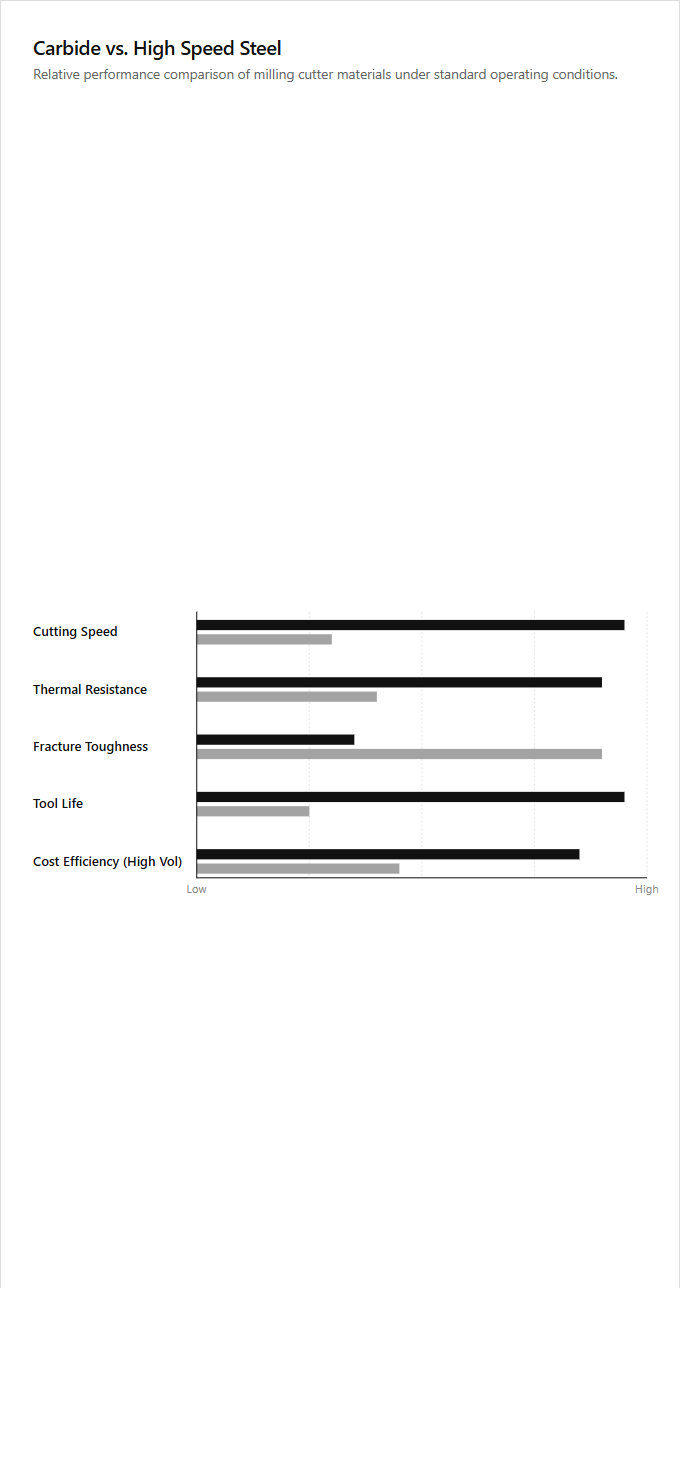
| Material Composition | Carbide cutters are manufactured from a sintered composite of tungsten carbide and cobalt, whereas High Speed Steel cutters are made from a carbon steel alloy containing elements like chromium, vanadium, and molybdenum. |
| Cutting Speed | Carbide cutters can operate at significantly higher surface feet per minute (SFM) than High Speed Steel, allowing for much faster material removal rates during CNC milling operations. |
| Thermal Resistance | Carbide exhibits superior red hardness, allowing the cutting edge to withstand high temperatures that would otherwise cause thermal softening and rapid degradation in High Speed Steel cutters. |
| Fracture Toughness | High Speed Steel possesses much higher fracture toughness than carbide, making it less susceptible to chipping during interrupted cuts or when machining on less rigid manual milling setups. |
| Tool Life | Due to their extreme resistance to abrasive wear, carbide cutters maintain their dimensional tolerance and sharp edges significantly longer than High Speed Steel tools. |
| Cost Efficiency | While High Speed Steel has a lower initial procurement cost, carbide cutters offer superior cost-effectiveness in high-volume production due to reduced cycle times and less frequent tool changes. |
Carbide Cutters Achieve Higher SFM Than High-Speed Steel
When selecting tooling for milling machines, the choice between carbide and high-speed steel (HSS) cutters heavily dictates machining efficiency. The primary differentiator lies in cutting speed capability; carbide cutters sustain significantly higher surface feet per minute (SFM) compared to HSS, often running at speeds three to four times faster. This superior thermal and wear resistance allows carbide to maintain its structural integrity at extreme temperatures, drastically reducing cycle times in production environments.
In contrast, high-speed steel cutters operate at lower SFM thresholds but offer greater physical toughness and resistance to chipping under interrupted cuts. Carbide tooling is ideal for high-volume manufacturing professionals seeking maximum throughput, whereas HSS remains best suited for hobbyists, prototype machinists, and operators utilizing less rigid, manual machinery.
Carbide's High Modulus Minimizes Tool Deflection
When selecting milling machine cutters, the choice between solid carbide and High Speed Steel (HSS) hinges on structural rigidity and machining demands. Carbide cutters possess a significantly higher modulus of elasticity compared to HSS. This exceptional stiffness minimizes tool deflection during aggressive material removal rates, ensuring superior dimensional accuracy and excellent surface finishes even under high-load conditions.
In contrast, High Speed Steel cutters offer greater fracture toughness and resistance to impact, making them highly effective in less rigid setups or when handling interrupted cuts. High-volume industrial machinists requiring extreme precision and high-speed production benefit most from carbide, whereas general-purpose maintenance technicians and hobbyists operating manual machinery find HSS to be the more suitable and cost-effective choice.
High-Speed Steel Resists Chipping in Interrupted Cuts
In milling operations, selecting the appropriate cutting tool material is critical for maximizing machining efficiency and part quality. While carbide cutters offer superior hardness and heat resistance for high-speed production, high-speed steel (HSS) cutters remain indispensable in challenging machining environments. High-speed steel exhibits greater fracture toughness to withstand interrupted cuts without catastrophic chipping, making it highly resilient under variable loads and unstable setups.
Carbide tooling thrives in rigid, high-velocity CNC setups where continuous cutting forces remain stable and heat dissipation is managed. In contrast, HSS absorbs the mechanical shocks common in older milling machines or when machining complex geometries with frequent entry and exit cycles. High-production manufacturers requiring maximum throughput benefit from carbide, while general machinists and hobbyists operating manual equipment are better suited to high-speed steel.
Carbide's Red Hardness Prevents Thermal Softening in Machining
When selecting milling machine cutters, the choice between Carbide and High-Speed Steel (HSS) significantly impacts machining efficiency. Carbide cutters excel in demanding environments due to their exceptional thermal stability. Unlike HSS, carbide maintains its red hardness at elevated temperatures, which prevents thermal softening during high-speed machining operations and extends tool life under extreme friction.
High-Speed Steel cutters offer greater physical toughness and resistance to fracturing under interrupted cuts, performing reliably at lower operating speeds. High-speed steel is ideal for hobbyists and manual machinists seeking cost-effective versatility, whereas carbide is best suited for industrial CNC operators requiring continuous, high-volume production.
Advanced PVD Coatings Boost Carbide Metal Removal
When selecting milling machine cutters, the choice between High-Speed Steel (HSS) and carbide significantly impacts machining efficiency. HSS cutters offer excellent toughness and resistance to shock, making them highly reliable in less rigid setups. In contrast, solid carbide cutters deliver superior hardness and thermal resistance, allowing for much higher cutting speeds and prolonged tool life under demanding conditions.
The performance of carbide is elevated through advanced physical vapor deposition (PVD) coatings. These ultra-thin, wear-resistant layers reduce friction and thermal transfer to the tool substrate, which further increases the allowable metal removal rate. This thermal protection allows operators to run machinery at maximum parameters while maintaining excellent surface finishes.
HSS cutters are ideal for hobbyists and maintenance technicians who require versatile, forgiving tools for varied manual setups, whereas carbide cutters are best suited for industrial CNC machinists demanding high-volume throughput and precision.
Carbide Boosts Feed Rates for Optimal Chip Load
When selecting milling machine cutters, the choice between carbide and high-speed steel (HSS) directly impacts machining efficiency. Carbide cutters possess superior hardness and thermal resistance, which facilitates significantly higher feed per tooth (IPT) values compared to HSS. This capability allows operators to optimize the chip load, ensuring efficient material removal and preventing work hardening of the workpiece.
High-speed steel cutters offer greater flexibility and resistance to chipping under less rigid setups, though they require lower cutting speeds and feed rates. While HSS remains highly effective for complex, low-volume prototypes, carbide excels in high-production environments demanding maximum throughput. High-speed steel is ideal for hobbyists and manual machinists prioritizing cost-effective versatility, whereas carbide is best suited for CNC professionals requiring high-volume precision and speed.
Trochoidal Milling: Chip Thinning Maximizes Radial Depth
Carbide cutters offer superior thermal resistance and hardness compared to High-Speed Steel (HSS) cutters, making them ideal for high-efficiency machining. Implementing trochoidal milling strategies with solid carbide tooling exploits the chip thinning effect, which allows operators to drastically increase the radial depth of cut (ae) while maintaining manageable cutting forces and lower temperatures. This specialized toolpath utilizes the full flute length, distributing wear evenly and significantly accelerating material removal rates beyond the capabilities of traditional slotting.
In contrast, HSS cutters provide superior toughness and flexibility, resisting chipping under interrupted cuts or in less rigid machine setups. While HSS remains a cost-effective choice for general-purpose applications and manual operations, carbide is essential for optimizing automated, high-production environments. Generally, HSS is best suited for maintenance technicians and hobbyists requiring forgiving tool characteristics on manual machines, whereas carbide is ideal for CNC programmers and manufacturing engineers aiming to maximize throughput and precision.
Leave a comment