
Selecting a primary milling machine is one of the most high-stakes decisions a workshop faces, often leading to analysis paralysis over tool deflection and setup limitations. Typically, production managers navigate this acquisition through capital expenditure budgets or equipment leasing programs, bridging the gap between current processing bottlenecks and expanded shop capabilities. Making the correct choice is critical, as matching your specific workflow to the right machine architecture grants your operations immediate advantages in structural rigidity and geometric accuracy. However, an essential educational stipulation remains: neither platform is a universal solution, and pushing a machine past its structural limits will compromise tool life. For instance, while a heavy bed mill excels at heavy-die slicing and machining large engine blocks, a knee mill provides unmatched manual dexterity for multi-angle fixtures. Below, we provide an executive comparison of knee mills versus bed mills, analyzing spindle rigidity, table travel mechanics, and total workpiece capacity to guide your next machinery investment.
| Factor | Summary |
|---|---|
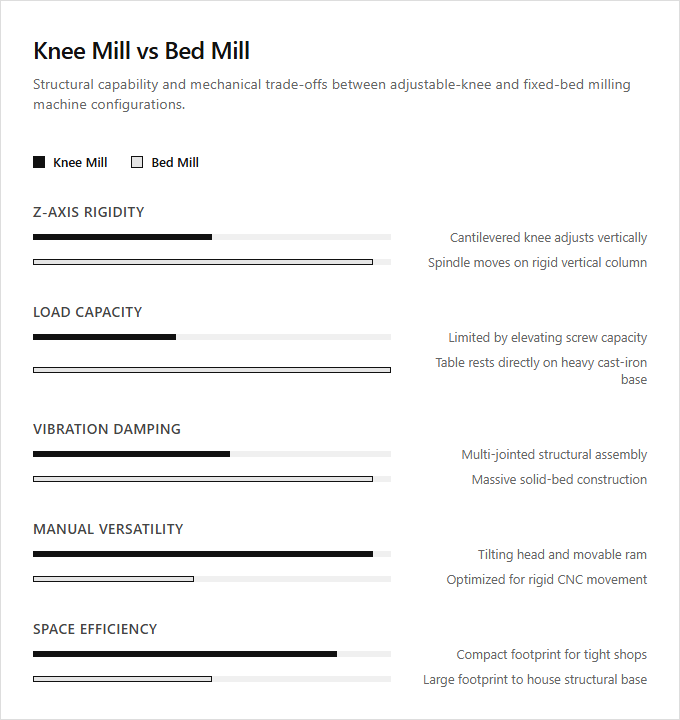
| Z-Axis Movement | Knee mills adjust the Z-axis by moving the entire worktable vertically on a cantilevered knee, whereas bed mills move the spindle head along the vertical column to maintain a constant table height. |
| Load Capacity | Bed mills support significantly heavier workpieces because the table rests directly on a rigid, cast-iron base, while knee mills are limited by the mechanical load capacity of the knee's elevating screw. |
| Structural Rigidity | The fixed-bed design of a bed mill offers superior structural rigidity and vibration damping during heavy-duty roughing cuts compared to the multi-jointed construction of a knee mill. |
| Machining Versatility | Knee mills provide greater manual versatility for angular machining due to a tilting spindle head and moveable ram, whereas bed mills are prioritized for high-precision CNC production. |
| Footprint and Space | Knee mills generally feature a more compact workshop footprint, making them ideal for toolrooms, while bed mills require substantial floor space to accommodate their massive structural base. |
Cantilevered knee load capacity versus rigid cast-iron bed support
Knee mills utilize a cantilevered knee design where the worktable moves vertically along the column. While highly versatile for multi-axis setups, this cantilevered structure limits load capacity, as heavy workpieces can deflect the knee and compromise machining accuracy. In contrast, bed mills feature a rigid, stationary cast-iron bed that supports the table directly on the machine base. This solid configuration eliminates vertical table deflection, allowing the machine to support significantly heavier loads and handle high-vibration cutting forces with exceptional stability.
Knee mills are ideal for toolmakers and prototype machinists requiring frequent manual adjustments on lighter parts, while bed mills are best suited for production facilities and heavy-industry operators handling massive, high-precision workpieces.
Z-axis movement via spindle headstock travel versus manual knee elevation
Knee mills feature a worktable resting on a vertically adjustable knee. Z-axis positioning requires manually cranking this heavy knee assembly up and down along the column. While this design provides excellent versatility for varied setups, lifting the knee and workpiece manually can be physically demanding and slower during repetitive machining operations.
In contrast, bed mills utilize a fixed-height table supported by a rigid, stationary base. The Z-axis movement is achieved by traveling the spindle headstock vertically along the column, a mechanism that is typically motorized. This configuration offers superior structural rigidity, dampens vibration during heavy-duty cutting, and eliminates the physical strain of manual table elevation.
Knee mills are ideal for prototype machinists and repair shops requiring manual versatility, whereas bed mills are best suited for production facilities and CNC operators handling heavy, high-precision workpieces.
Vibration dampening and harmonic resonance attenuation in heavy bed castings
In precision machining, structural mass directly influences surface finish and tool longevity. Bed mills excel in vibration dampening due to their massive, integrated base castings. This substantial, low-slung foundation effectively attenuates harmonic resonance generated during heavy cutting operations, ensuring exceptional stability under high-load conditions.
In contrast, knee mills feature a movable knee assembly that introduces mechanical joints, slightly compromising absolute rigidity and resonance absorption. Knee mills are ideal for prototype developers and toolmakers requiring rapid, versatile setups for varied, low-volume tasks, whereas bed mills are best suited for production machinists executing heavy-duty, high-precision operations on large, dense workpieces.
Spindle rigidity degradation during quill extension versus fixed-headstock spindle configurations
Knee mills utilize a movable quill to feed the cutting tool along the Z-axis. While this design offers excellent manual control, extending the quill increases the distance between the spindle bearings and the headstock housing. This leverage effect degrades spindle rigidity, making the setup susceptible to deflection and vibration during heavy cuts.
In contrast, bed mills feature a fixed-headstock configuration where the entire head casting moves along rigid column ways for Z-axis travel. Because the spindle bearings remain fully supported within the robust housing at all depths, the machine maintains constant structural integrity and dampens cutting forces far more effectively.
Knee mills are ideal for prototyping specialists and maintenance machinists requiring rapid, versatile setups, whereas bed mills are best suited for production manufacturers and mold makers demanding maximum rigidity for heavy-duty metal removal.
Worktable geometric deflection under high-mass workpiece payloads
When machining heavy workpieces, the structural design of a milling machine dictates its precision. In a knee mill, the worktable rests on a cantilevered knee that moves vertically along the column. Under high-mass payloads, this cantilevered design is highly susceptible to angular deflection and sagging at the table extremities, which compromises geometric accuracy during heavy cuts.
By comparison, a bed mill features a worktable supported directly by a fixed, rigid base resting on the foundation. This configuration distributes heavy payloads evenly across the entire saddle, minimizing geometric deflection and maintaining tight tolerances under extreme downward forces. Precision-focused heavy industrial manufacturers require the rigid stability of a bed mill, whereas prototype developers and general machinists are best suited for the versatile manual control of a knee mill.
Swivel Head Versatility vs. Box-Way Column Stability
Knee mills are highly valued for their exceptional angular versatility, primarily driven by an articulating swivel head. This design allows operators to tilt and rotate the spindle across multiple axes, making it simple to machine complex angles and compound curves without elaborate fixturing. The adjustable knee moves vertically along the column, providing excellent flexibility for lightweight to medium-duty prototyping.
In contrast, bed mills prioritize rigid box-way column stability over articulation. Because the spindle head moves only vertically along a fixed, heavy-duty column and the table rests directly on a broad, stationary bed, this configuration minimizes deflection under intense cutting forces. This structural rigidity enables high-precision, deep-cut machining on massive workpieces.
Knee mills are ideal for toolmakers and prototype machinists requiring maximum setup flexibility, while bed mills are best suited for heavy industrial manufacturers handling large-scale, high-volume components.
X-Y axis saddle travel envelopes and volumetric capacity limitations
When comparing milling machines, the structural architecture dictates their physical capacities. Knee mills feature a saddle riding on a vertically adjustable knee, which limits the X-Y axis travel envelope and introduces deflection risks under heavy loads. Conversely, bed mills utilize a fixed-height base where the saddle rests directly on the machine foundation. This configuration supports significantly larger X-Y travel envelopes and greater volumetric capacity, as the workpiece weight remains supported by the main casting rather than a cantilevered knee.
The volumetric limitations of the knee mill restrict its use to lighter, more compact workpieces. Bed mills overcome these constraints by moving the spindle head vertically along the column, allowing them to handle massive, oversized parts without sacrificing geometric accuracy. Toolrooms and prototyping specialists benefit most from the versatile, easily adjusted knee mill, whereas production facilities and heavy-duty machinists requiring maximum rigidity for large components are best suited for the bed mill.
Leave a comment