
Selecting the right milling platform often leaves shop owners and manufacturing engineers struggling to balance high-speed surface precision with heavy material removal rates without causing tool deflection. While standard equipment financing and capital expenditure budgets provide the necessary funding to acquire new machinery, the true operational ROI hinges on the physical architecture of the machine itself.
Specifying the optimal guideway system is the critical factor that grants your shop superior geometric accuracy and extended tool life. However, this benefit comes with the strict stipulation that proper lubrication and load-capacity limits are continuously monitored. For example, in heavy-duty steel mold-making or high-speed aerospace aluminum profiling, selecting the wrong guide interface can lead to catastrophic harmonic chatter or rapid way wear.
In this article, we will examine the mechanical differences between linear guides and box ways, evaluate their respective load capacities and damping characteristics, and outline a clear framework to help you select the ideal guideway system for your specific machining applications.
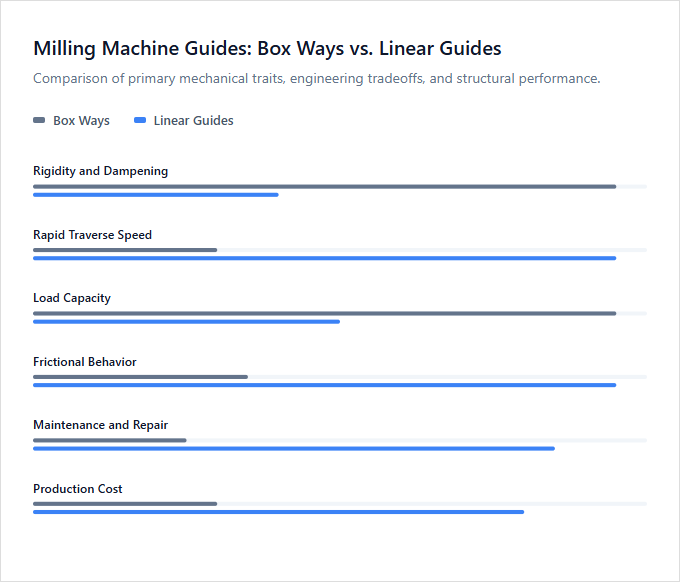
| Factor | Summary |
|---|---|
| Rigidity and Dampening | Box ways offer superior structural dampening and torsional rigidity due to their broad surface-to-surface contact, whereas linear guides rely on line or point contact which is more prone to high-frequency chatter. |
| Rapid Traverse Speed | Linear guides facilitate significantly higher rapid traverse rates and acceleration because they utilize recirculating roller bearings that exhibit a very low coefficient of friction compared to sliding ways. |
| Load Capacity | Box ways excel at supporting heavy-duty cutting forces and massive workpieces due to their large physical footprint, while linear guides can suffer from elastic deformation under extreme shock loads. |
| Frictional Behavior | Linear guides virtually eliminate the stick-slip phenomenon for highly precise micro-positioning, whereas box ways require continuous hydrodynamic lubrication to prevent static friction stiction. |
| Maintenance and Repair | Linear guides feature a modular design that allows for simple replacement of pre-loaded bearing trucks, whereas restoring worn box ways requires highly skilled manual hand-scraping and Turcite replacement. |
| Production Cost | Milling machines utilizing linear guides are generally less expensive to manufacture due to simplified bolt-on installation, whereas integrated box ways require labor-intensive precision grinding of the machine casting. |
Box Ways: Superior Stiffness for Heavy-Duty Machining
When selecting a milling machine, the choice between guideway designs directly influences machining capability and workpiece quality. Box ways are highly regarded for heavy-duty applications due to their broad surface contact, which provides superior vibration damping capacity and exceptional static stiffness. This physical integration allows the machine structure to absorb immense cutting forces, minimizing tool chatter and ensuring precise, deep cuts in difficult materials.
Linear guides utilize rolling element bearings to offer lower friction, faster feed rates, and outstanding agility for lighter-duty operations. Box ways are ideal for heavy-industry machinists focused on high-torque, aggressive metal removal, whereas linear guides are best suited for high-speed precision programmers requiring rapid cycle times and intricate detail work.
Linear Guides Eliminate Stick-Slip in Feed Movements
In precision milling, the choice between linear guides and box ways dictates the machine's dynamic behavior. Linear guides utilize rolling elements to significantly lower the coefficient of friction, effectively eliminating the stick-slip phenomenon during feed movements. This reduction in static friction ensures smooth, continuous motion at high speeds, which is essential for high-speed machining and intricate contouring.
Traditional box ways rely on sliding friction across wider contact surfaces, offering superior vibration dampening and rigidity for heavy-duty cutting. While box ways excel in absorbing massive cutting forces, linear guides provide the rapid acceleration and positioning accuracy required for modern, high-speed operations. Linear guides are ideal for operators demanding high-speed, high-precision component manufacturing, while box ways suit machinists performing heavy, high-torque material removal.
Minimizing Box Way Wear with Turcite and Scraping
When selecting a milling machine, the choice between linear guides and box ways significantly impacts machining performance. Box ways are traditional, heavy-duty slideways known for exceptional rigidity and vibration dampening. To minimize friction and wear, these systems rely on meticulously hand-scraped structural surfaces laminated with Turcite-B, a specialized low-friction fluoropolymer wear strip that ensures smooth, stick-slip-free movement under heavy loads.
Linear guides utilize recirculating ball or roller bearings, offering rapid travel speeds and simplified maintenance. While linear guides excel in high-speed, light-to-medium milling operations, the robust, dampening construction of box ways remains essential for heavy-duty, high-torque material removal. High-speed mold makers and high-volume precision parts manufacturers typically prefer linear guides, whereas heavy-industrial machinists requiring maximum rigidity for deep cuts benefit most from box ways.
Adjustable Preload Optimizes Linear Guide Rigidity and Precision
In CNC milling machine design, the choice between linear guides and box ways dictates the machine's structural behavior. Linear guides utilize adjustable rolling-element preload to optimize system rigidity and precision. By packing ball or roller bearings under specific tension, this design eliminates clearance, minimizes elastic deformation, and enables high-speed acceleration with exceptional positioning accuracy.
Conversely, box ways employ direct, sliding contact over a broader surface area, which provides superior vibration dampening for heavy-duty cutting forces but results in higher friction. Linear guide machines are highly suited for high-speed mold makers and medical parts manufacturers requiring rapid positioning, whereas box way machines are preferred by heavy-industry machinists focusing on aggressive material removal and large steel components.
Box Ways Offer Superior Cutting Force Distribution
When selecting a milling machine, the choice between box ways and linear guides significantly impacts machining performance. Box ways feature wide mating surfaces that distribute cutting forces over a large surface area, providing exceptional damping capacity and rigidity under heavy loads. In contrast, linear roller guides rely on narrow line contact, which reduces friction to facilitate rapid movement and high positioning accuracy.
These structural differences dictate their optimal application in manufacturing. Heavy-duty machinists requiring maximum material removal and superior vibration dampening benefit most from box ways, whereas high-speed mold makers and high-volume component manufacturers favor the agility of linear guides.
Linear Guides for High-Speed, Dynamic Motion
In CNC milling machine design, the choice between linear guides and box ways significantly impacts overall machining performance. Linear guides utilize rolling element bearings that drastically reduce friction. This minimal friction enables high rapid traverse rates and superior dynamic response, allowing the machine tool to accelerate quickly and transition smoothly during complex, high-speed contouring operations.
Box ways rely on wide, flat mating surfaces that offer maximum rigidity and superior vibration dampening. This design is highly effective for heavy-duty, intermittent cutting of tough materials, though it operates at lower speeds. Linear guides are ideal for high-speed precision machinists requiring rapid cycle times, while box ways suit heavy-industry operators focused on high-torque, deep-cut steel fabrication.
Linear Guides Reduce Axis Thermal Displacement
In precision milling, the choice between linear guides and box ways significantly impacts machining accuracy. Linear guides utilize rolling-element bearings that drastically minimize frictional heat generation during high-speed travel. This reduction in friction limits thermal expansion, preventing the thermal displacement of machine axes and ensuring consistent dimensional accuracy over long production runs.
Traditional box ways rely on direct sliding contact, which provides superior vibration dampening and rigidity for heavy-duty cutting, though at the cost of higher heat generation and lower rapid feed rates. High-speed precision machinists requiring rapid movements and thermal stability benefit most from linear guides, whereas heavy-metal-removal specialists prioritizing maximum rigidity under extreme cutting forces should select box ways.
Leave a comment