
Selecting an air compressor that delivers maximum Cubic Feet per Minute (CFM) often leaves professionals caught in a frustrating compromise between power capacity and operational mobility. While standard shop-bound 120V electric hookups offer clean, reliable indoor utility, they frequently fall short when high-demand pneumatic tools require sustained, heavy-duty airflow.
Choosing the correct power source grants operators uninterrupted peak performance and eliminates costly job-site downtime. However, high CFM output comes with a critical stipulation: raw volume must be balanced against your physical environment, as gas units require strict outdoor ventilation while high-output electric models demand specialized electrical infrastructure. For example, running a continuous-use 1-inch impact wrench on a remote job site quickly reveals how the wrong power configuration can stall an entire crew.
Below, we will analyze the key performance differences between electric and gas-powered air compressors, evaluate their real-world CFM delivery, and help you select the ideal configuration for your operational demands.
| Factor | Summary |
|---|---|
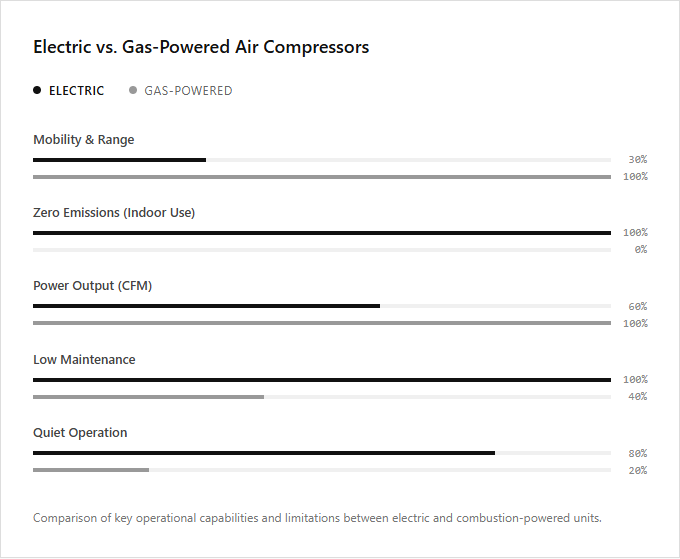
| Power Source & Mobility | Gas-powered compressors utilize an internal combustion engine for complete mobility on remote jobsites, while electric models are restricted by the reach of a power cord or generator. |
| Exhaust and Emissions | Electric compressors produce zero exhaust emissions, making them safe for indoor operation, whereas gas models emit carbon monoxide and must only be used outdoors. |
| Performance & Output | Gas-powered units typically deliver higher CFM (Cubic Feet per Minute) ratings, making them superior for running heavy-duty pneumatic machinery continuously. |
| Maintenance Needs | Electric models require minimal upkeep, whereas gas-powered compressors demand regular maintenance of spark plugs, fuel filters, and engine oil. |
| Noise Level | Electric air compressors operate at significantly lower decibel (dB) levels, creating a safer and quieter environment for indoor workspaces. |
Gas Power: Higher Horsepower, Superior CFM
When selecting an industrial or commercial air compressor, the decision between electric and gas-powered systems dictates your operational efficiency. Gas-powered models leverage higher engine horsepower (HP) to generate superior Cubic Feet per Minute (CFM) ratings, providing the high-volume airflow necessary for heavy-duty pneumatic machinery. This substantial mechanical advantage ensures sustained performance in remote field locations where electrical infrastructure is entirely absent.
Electric air compressors provide a quieter, emission-free operation suited for enclosed environments with accessible power grids. Indoor workshop technicians and residential DIYers thrive with clean-running electric units, whereas mobile contractors and industrial road crews require the high-HP portability of gas-powered systems to run demanding tools at off-grid jobsites.
Three-Phase Power Needed to Match Gas CFM Output
When selecting industrial air compressors, the choice between electric and gas-powered models involves evaluating performance capabilities against facility infrastructure. Gas-powered compressors excel in high-output, remote applications, offering superior CFM ratings without relying on the power grid. To match these heavy-duty gas CFM outputs, electric alternatives demand significant electrical infrastructure, specifically requiring three-phase power configurations. This specialized setup delivers the consistent voltage necessary for heavy-duty electric motors to maintain high-capacity operational demands.
Electric compressors provide clean, quiet operation suitable for indoor environments, whereas gas units offer unmatched mobility on rugged, outdoor jobsites. Stationary electric systems are best suited for facility managers with established three-phase utility access, while gas-powered models are ideal for mobile contractors requiring independent power in remote locations.
Pilot Valve Unloaders Maximize Gas Compressor CFM
Selecting between electric and gas-powered air compressors requires understanding their distinct operational mechanisms. Gas-powered models excel on rugged, remote jobsites, relying on continuous-run pilot valve unloaders to manage pressure. Instead of shutting down the engine when target pressure is reached, these specialized valves vent excess air to the atmosphere, keeping the engine running at optimal speeds to maintain maximum Cubic Feet per Minute (CFM) delivery for demanding pneumatic tools.
Electric compressors utilize pressure switches that cycle the motor on and off to maintain tank pressure, ensuring quiet, emission-free operation. Electric models suit DIY homeowners and shop technicians requiring low-maintenance, indoor-safe power, whereas gas models are designed for mobile contractors and industrial operators working in remote environments.
Two-Stage Pumps Required for High CFM and PSI
Selecting between electric and gas-powered air compressors requires a clear understanding of their performance capabilities under heavy workloads. Both configurations utilize two-stage compression pumps to maximize cubic feet per minute (CFM) at high pounds per square inch (PSI). By compressing the air in two distinct stages with an intermediary cooling phase, these systems significantly reduce heat buildup and deliver the consistent, high-volume airflow necessary for heavy-duty industrial pneumatic tools.
Power source selection dictates the ideal environment for each system, with electric models offering quiet, emissions-free indoor operation and gas units providing unmatched job site mobility. Stationary electric compressors suit workshop technicians and automotive garage owners who require reliable in-shop power, whereas rugged gas-powered units are designed for mobile contractors and agricultural operators who work in remote locations without electrical grid access.
Gas Engines Deliver Continuous High-Volume Pneumatics
When selecting an industrial air compressor, the choice between electric and gas-powered models depends heavily on your operational environment and demand. Gas-powered air compressors are engineered for demanding environments, offering a continuous 100% duty cycle. This constant operation ensures an uninterrupted, high-volume pneumatic flow capable of running heavy-duty tools without the cool-down periods required by many electric alternatives.
Electric models provide a quieter, emission-free solution ideal for indoor workshops and fixed job sites with reliable power access. Stationary craftsmen and indoor contractors benefit most from the low-maintenance nature of electric units, while remote construction crews and mobile mechanics require the rugged independence and high-output performance of gas-powered compressors.
Why Stationary Compressors Require Magnetic Starters
When selecting an industrial air compressor, the choice between electric and gas-powered models depends heavily on your operational environment and power infrastructure. Stationary electric compressors are highly efficient for indoor facilities but demand robust electrical management. To deliver peak cubic feet per minute (CFM), these high-capacity electric units require magnetic starters to safely handle the initial high-amperage draw, protecting the motor and ensuring consistent performance.
In contrast, gas-powered compressors offer unmatched mobility for outdoor jobsites where electrical hookups are unavailable. These rugged units rely on internal combustion engines to generate high pressure in remote locations. Stationary electric models are ideal for workshop technicians requiring low-emission, continuous indoor power, while gas-powered units are suited for mobile contractors and agricultural operators working in off-grid environments.
SCFM Temperature and Altitude Corrections for Gas Models
Electric and gas-powered air compressors serve distinct operational environments. While electric models provide consistent performance indoors, gas-powered units offer unmatched mobility for remote job sites. However, gas engines are highly susceptible to environmental variations. Operating these units at high altitudes or in extreme temperatures requires precise Standard Cubic Feet per Minute (SCFM) correction calculations. Because air density decreases at higher elevations and elevated temperatures, the compressor's actual output drops, requiring operators to mathematically adjust equipment ratings to ensure adequate pneumatic power.
Electric compressors bypass these complex atmospheric calculations due to their reliance on stable electrical power. Electric units are ideal for workshop technicians and indoor hobbyists seeking low-maintenance, plug-and-play reliability, whereas gas-powered models are best suited for mobile contractors and industrial operators working in rugged, off-grid environments.
Leave a comment