
Selecting the right air compressor often frustrates operators who find their pneumatic tools unexpectedly stalling or losing torque mid-task. Traditionally, buyers rely on standard metrics like horsepower or tank capacity to guide their procurement decisions, assuming these figures guarantee performance.
Yet, mastering the distinction between CFM and SCFM grants you the ability to precisely match tool consumption with compressor output, safeguarding your operations against costly downtime. It is crucial to stipulate, however, that atmospheric variables like temperature, barometric pressure, and relative humidity directly dictate how these volumetric flow rates perform in real-world environments. For instance, operating a high-demand 1/2-inch pneumatic impact wrench requires a firm grasp of these variables to prevent sudden pressure drops.
In this guide, we will define both CFM and SCFM, analyze how environmental conditions alter actual air delivery, and provide a practical framework to help you size your system with mathematical precision.
| Factor | Summary |
|---|---|
| CFM Definition | CFM measures the actual volume of air flow delivered by the compressor per minute under its current operating temperature and pressure. |
| SCFM Definition | SCFM represents the volumetric flow rate of air corrected to standard environmental conditions of temperature, pressure, and relative humidity. |
| Standard Reference Point | SCFM calculations are standardized at 14.7 psia of atmospheric pressure, 68 degrees Fahrenheit, and 36 percent relative humidity. |
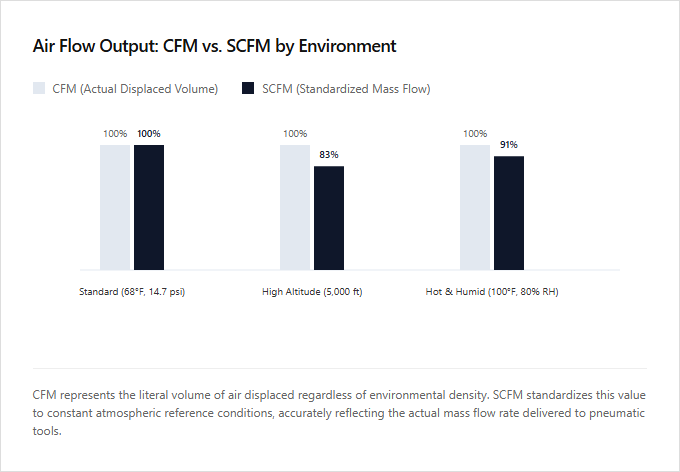
| Atmospheric Variables | CFM values fluctuate significantly with changes in altitude, ambient temperature, and barometric pressure, whereas SCFM remains constant. |
| Pneumatic Tool Requirements | Air tool manufacturers specify consumption in SCFM to ensure the compressor provides sufficient mass flow rate regardless of local elevation. |
SCFM: Mass Flow Rate at Standard Conditions
When selecting an air compressor, understanding the distinction between CFM (Cubic Feet per Minute) and SCFM (Standard Cubic Feet per Minute) is essential for accurate performance evaluation. CFM measures the actual volume of air flow under current, fluctuating ambient conditions. In contrast, SCFM represents the mass flow rate calculated at standardized reference conditions of temperature and pressure, typically defined as 14.7 psia, 68°F, and 36% relative humidity, providing a consistent baseline for comparison.
Evaluating these metrics ensures pneumatic tools receive adequate power regardless of environmental changes. Stationary industrial operators requiring precise, environment-independent calculations rely on SCFM ratings, while DIY hobbyists operating standard tools in residential garages find actual CFM ratings sufficient for their daily needs.
CFM: Measuring Actual Volumetric Flow Rate
When selecting pneumatic equipment, understanding the distinction between SCFM (Standard Cubic Feet per Minute) and CFM (Cubic Feet per Minute) is essential. While SCFM represents flow rate under standardized temperature and pressure conditions, CFM measures the actual volumetric flow rate under the specific, real-time operating conditions of the system. This actual measurement directly reflects how environmental variables, such as local altitude, humidity, and ambient temperature, impact the air density and compressor output during operation.
Evaluating actual CFM is crucial because field environments rarely align with standard laboratory baselines. Professional engineers and industrial contractors require CFM calculations to guarantee precise tool performance in challenging or high-altitude job sites, while DIY homeowners and hobbyists will find SCFM ratings sufficient for matching standard tools with workshop compressors.
Converting SCFM to CFM via the Ideal Gas Law
When selecting air compressors, understanding the distinction between CFM (Cubic Feet per Minute) and SCFM (Standard Cubic Feet per Minute) is essential. CFM measures the actual volume of air displaced under local operating conditions, which fluctuate with temperature and atmospheric pressure. To ensure accurate performance comparisons, SCFM standardizes these measurements to a specific baseline of 14.7 psia and 68°F. The conversion between SCFM and CFM is governed by the Ideal Gas Law to adjust for changes in air density.
Accounting for these environmental variables prevents pneumatic equipment underperformance in high-altitude or extreme-temperature environments. CFM is the critical metric for DIY hobbyists operating in stable, local workshop settings, while SCFM is indispensable for industrial engineers and commercial contractors designing systems across varying geographic elevations.
Standardizing SCFM Calculations to 14.7 PSI
When evaluating air compressor performance, understanding the distinction between CFM (Cubic Feet per Minute) and SCFM (Standard Cubic Feet per Minute) is essential. CFM measures the actual volume of air delivered under current operating conditions, which fluctuate based on temperature, humidity, and altitude. In contrast, SCFM calculations require standardizing to an absolute pressure of fourteen point seven pounds per square inch, a temperature of 68°F, and 36% relative humidity, providing an accurate baseline for uniform comparison.
This standardization ensures that equipment power is measured consistently regardless of geographic location. Hobbyists operating light-duty tools in stable home environments typically rely on CFM ratings for simplicity, whereas professional contractors and industrial operators working across diverse climates require SCFM metrics to ensure precise tool compatibility.
How Altitude and Temperature Affect CFM
CFM measures the actual volume of air displaced by a compressor under current operating conditions. Because variations in altitude and ambient temperature directly alter atmospheric pressure, CFM fluctuates significantly based on the local environment. In contrast, SCFM calculates flow rate under standardized conditions-typically 14.7 psi and 68°F-providing a consistent baseline regardless of elevation or weather changes.
Understanding this distinction ensures precise tool performance and prevents equipment underpowering during operation. While SCFM serves as the industry standard for rating pneumatic tools, CFM reflects the real-world output at a specific job site. Contractors working in extreme elevations or variable climates rely on CFM to calculate actual tool performance, whereas engineers and purchasing agents utilize SCFM to standardize equipment specifications across different regions.
Humidity Correction for True SCFM Calculations
Understanding the distinction between CFM (Cubic Feet per Minute) and SCFM (Standard Cubic Feet per Minute) is critical for optimal pneumatic system design. While CFM measures the actual volume of air displaced under current operating conditions, SCFM standardizes this measurement to specific environmental benchmarks. Atmospheric water vapor and relative humidity significantly alter the partial pressure of the air, displacing dry air molecules and necessitating precise mathematical corrections to determine the true SCFM performance.
Failing to account for these humidity fluctuations can lead to underestimated compressor capacity and diminished tool performance. Engineers and industrial system designers rely on precise SCFM ratings to guarantee consistent machinery operation in climate-sensitive facilities, whereas DIY hobbyists and framing contractors generally depend on raw CFM metrics for selecting portable tools for standard jobsite applications.
Evaluating Compressor SCFM for Proper Pneumatic Sizing
When selecting air compressors, distinguishing between CFM (Cubic Feet per Minute) and SCFM (Standard Cubic Feet per Minute) is critical for operational success. CFM measures the actual volume of air displaced under current, fluctuating ambient conditions. To ensure accuracy, compressor performance and volumetric efficiency must be evaluated using SCFM to properly size pneumatic systems. This standardizes variables like temperature and pressure, providing a reliable baseline of the compressor's true output.
Utilizing SCFM prevents system under-sizing, which often results in equipment starvation and accelerated wear. CFM measurements are ideal for field technicians monitoring real-time tool operation under specific environmental conditions, whereas SCFM is the indispensable standard for system engineers and industrial planners designing high-demand pneumatic networks.
Leave a comment