
Achieving a consistent, streak-free surface profile during abrasive blasting is a constant struggle for operators. Technicians frequently battle fluctuating media flow, premature nozzle wear, and costly material waste that halts production. While many attempt to resolve these inefficiencies by adjusting compressor PSI or investing in alternative abrasive brands, the true bottleneck often lies in the nozzle's mixing geometry.
Selecting the correct mixing configuration grants operators absolute command over the media-to-air ratio, dramatically reducing media consumption while optimizing impact velocity. However, this efficiency gains require a critical stipulation: operators must align the nozzle design with the specific physical properties of the media used. For instance, using an internal mix nozzle for aggressive aluminum oxide descaling demands a vastly different operational approach than deploying an external mix nozzle for delicate soda-blasting on thin aluminum panels.
In this article, we will evaluate the mechanical differences between internal and external mix nozzles, compare their performance across various applications, and outline key criteria to help you select the optimal configuration for your blasting system.
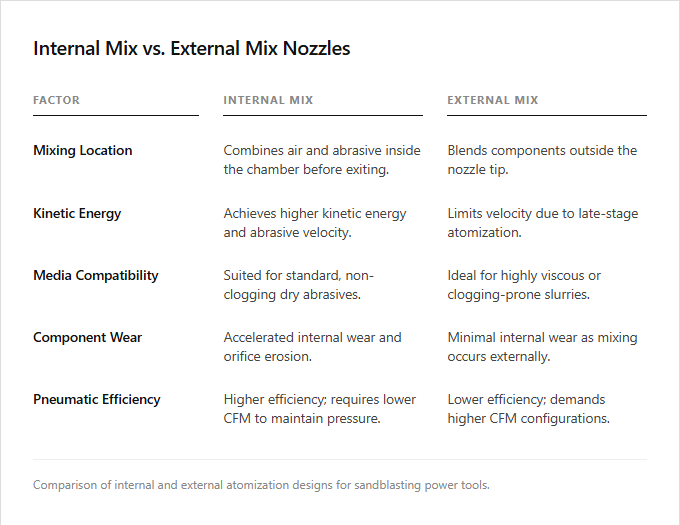
| Factor | Summary |
|---|---|
| Mixing Location | Internal mix nozzles combine air and abrasive inside the chamber before exiting, whereas external mix nozzles blend them outside the nozzle tip. |
| Kinetic Energy | Internal mix designs typically achieve higher kinetic energy and velocity of the abrasive media, whereas external mix designs limit velocity due to late-stage atomization. |
| Media Compatibility | External mix nozzles are better suited for highly viscous or clogging-prone abrasive slurries because the fluid and pressurized air do not meet inside a confined orifice. |
| Component Wear | Internal mix nozzles experience accelerated abrasive wear and orifice erosion due to high-velocity friction inside the nozzle bore. |
| Pneumatic Efficiency | Internal mix systems offer superior pneumatic efficiency and require lower CFM to maintain effective blasting pressure compared to external mix configurations. |
How Internal Mix Nozzles Blend Air and Media
In abrasive blasting, the choice between internal and external mix nozzles significantly impacts blasting efficiency and finish quality. Internal mix nozzles combine the compressed air and abrasive media inside a mixing chamber prior to the exit orifice. This internal blending creates a highly concentrated, consistent stream that delivers maximum impact velocity for demanding applications.
External mix nozzles introduce the abrasive media to the airflow outside the nozzle tip. This design minimizes internal wear on nozzle components and allows for precise control over the spray pattern. Internal mix systems are ideal for heavy-duty industrial operators requiring rapid paint and rust removal, whereas external mix configurations suit artisans and detailers performing delicate surface etching.
External Mix Nozzles Prevent Internal Liner Wear
In abrasive blasting, selecting the correct nozzle design directly impacts both equipment longevity and operational efficiency. External mix nozzles introduce the abrasive media to the high-velocity air stream outside the nozzle tip. By utilizing the Venturi effect externally, this design accelerates the media without dragging harsh abrasive particles along the internal nozzle liner, which effectively prevents internal wear and extends the service life of the tool.
Internal mix nozzles combine the air and media inside a mixing chamber before discharge, resulting in a highly concentrated, powerful stream but accelerating internal component erosion. High-production industrial operators requiring maximum velocity and deep surface profiling benefit from internal mix nozzles, whereas maintenance technicians and hobbyists prioritizing low maintenance and equipment longevity are better suited for external mix designs.
Internal Mixing Optimizes Precision Spot Blasting
In abrasive blasting, the design of the nozzle chamber dictates the velocity and concentration of the media stream. Internal mix nozzles combine the pressurized air and abrasive media prior to exiting the orifice. This internal mixing optimizes kinetic energy transfer and maximizes particle velocity, producing a highly concentrated stream engineered for precise spot blasting and localized target areas.
External mix nozzles introduce the abrasive media into the air stream outside the nozzle tip. This configuration minimizes internal wear and creates a wider, more dispersed spray pattern. Detail-oriented technicians performing intricate restoration work benefit most from the precision of internal mix nozzles, while large-scale industrial operators requiring rapid, broad-area coverage are best suited for external mix systems.
External Mix: Higher CFM for Heavy Abrasives
In abrasive blasting, nozzle design directly dictates system efficiency and media acceleration. Internal mix nozzles combine air and abrasive inside the chamber, maximizing velocity with lower air consumption. External mix configurations, however, introduce the abrasive outside the nozzle tip, requiring significantly higher volumetric flow rates measured in CFM to accelerate heavy abrasives effectively.
This demand for elevated CFM makes external mix systems highly dependent on high-capacity air compressors. While internal mix setups offer superior efficiency for standard applications, external designs excel in preventing nozzle wear from highly aggressive media. Internal mix nozzles are ideal for DIY hobbyists requiring precision on lighter projects, whereas external mix nozzles suit industrial operators handling heavy-duty, high-volume surface preparation.
Wet Slurry Blasting via Internal Mix Atomization
In sandblasting, the choice between internal and external mix nozzles dictates fluid dynamics and surface impact efficiency. Internal mix nozzles combine pressurized air and abrasive media inside the chamber before expulsion. This design is highly effective for wet slurry blasting, where internal mix atomization maintains a cohesive fluid-abrasive stream that prevents premature dispersion and delivers a consistent, dust-free finish.
External mix nozzles introduce the media to the air stream outside the nozzle tip, reducing internal wear and allowing independent control of air and material flow. Internal mix systems suit precision restorers requiring dust-free wet processing, while external mix configurations are best for industrial contractors managing dry, high-volume coating removal.
Internal CD Nozzles Maximize Velocity Over External Mixing
In abrasive blasting, the choice between internal and external mix nozzles dictates stream velocity and overall efficiency. Internal mix nozzles utilize a convergent-divergent internal geometry to constrict and then expand the air-media flow. This design maximizes particle exit velocity by converting pressure into kinetic energy before the mixture leaves the nozzle. External mix nozzles direct separate streams of air and media to collide outside the nozzle tip, which disperses kinetic energy and results in a lower-velocity impact.
Industrial operators requiring rapid, high-production paint and rust removal benefit most from the high-velocity performance of internal mix nozzles, whereas hobbyists and restoration specialists working on fragile substrates prefer the precise, low-pressure control of external mix setups.
External Mix Nozzles Prevent Large-Grit Clogging
Industrial sandblasting applications require careful selection between internal and external mix nozzles to optimize media flow and project efficiency. Internal mix nozzles combine air and abrasive within the nozzle chamber, which provides a highly concentrated stream but increases the risk of blockages when using coarse materials. In contrast, external mix designs introduce the abrasive to the air stream outside the nozzle tip. This separation significantly reduces nozzle orifice clogging when utilizing large or inconsistent abrasive grit sizes, ensuring an uninterrupted flow during demanding operations.
Choosing the correct configuration depends heavily on the specific project demands and the consistency of the blasting media. Internal mix nozzles are ideal for precision technicians performing detailed etching with fine, uniform abrasives, whereas external mix nozzles are best suited for high-volume industrial operators managing heavy rust removal with varied, low-cost slag.
Leave a comment