
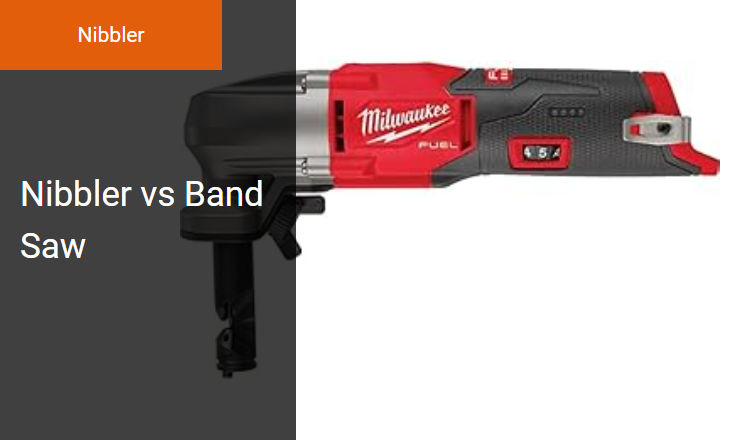
Achieving clean, precise cuts in sheet metal fabrication without warping the material remains a persistent challenge for metalworkers. Historically, fabricators have relied on traditional workshop band saws or manual shears to manage these demanding tasks. While these standard tools are highly effective for straight lines, they often struggle with tight radiuses and can introduce structural distortion. This is where the punch-and-die nibbler offers a distinct advantage, granting operators the unique ability to execute distortion-free, multi-directional cuts with exceptional maneuverability.
However, utilizing a nibbler comes with specific stipulations; because it functions by rapidly punching out tiny semi-circular "chips," it creates continuous kerf waste that requires cleanup, unlike the clean line of a band saw. In practical applications such as modifying HVAC ductwork or fitting corrugated steel roofing, this material trade-off is easily justified by the tool's unmatched agility.
This article provides a head-to-head comparison of the nibbler versus the band saw, evaluating their cutting mechanics, material limits, and operational efficiency to help you select the optimal tool for your fabrication workflow.
| Factor | Summary |
|---|---|
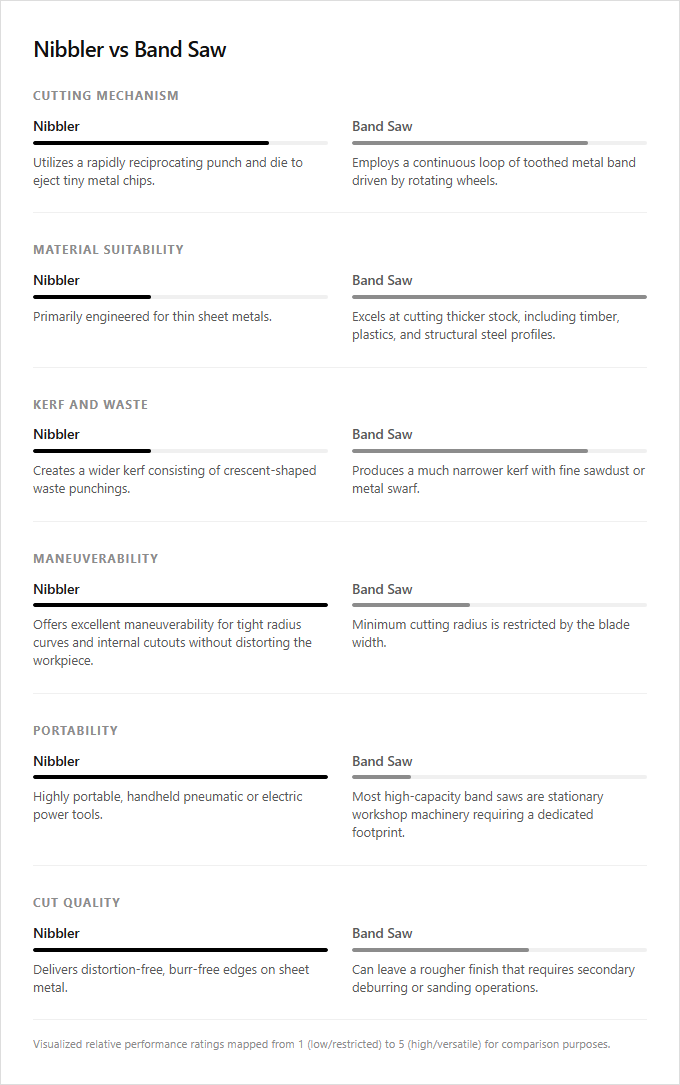
| Cutting Mechanism | A nibbler utilizes a rapidly reciprocating punch and die to eject tiny metal chips, whereas a band saw employs a continuous loop of toothed metal band driven by rotating wheels. |
| Material Suitability | Nibblers are primarily engineered for thin sheet metals, while band saws excel at cutting thicker stock, including timber, plastics, and structural steel profiles. |
| Kerf and Waste | Nibblers create a wider kerf consisting of crescent-shaped waste punchings, whereas band saws produce a much narrower kerf with fine sawdust or metal swarf. |
| Maneuverability | The hand-held nibbler offers excellent maneuverability for tight radius curves and internal cutouts without distorting the workpiece, while a band saw's minimum cutting radius is restricted by the blade width. |
| Portability | Nibblers are highly portable, handheld pneumatic or electric power tools, whereas most high-capacity band saws are stationary workshop machinery requiring a dedicated footprint. |
| Cut Quality | Nibblers deliver distortion-free, burr-free edges on sheet metal, while band saws can leave a rougher finish that requires secondary deburring or sanding operations. |
Internal cutout versatility via a pilot hole without blade splitting
When executing intricate internal cutouts in sheet metal, the nibbler offers a distinct advantage over the band saw. A nibbler requires only a small pilot hole to begin cutting, allowing the operator to plunge directly into the workpiece. Because it cuts by rapidly punching out tiny waste chips, there is no risk of blade splitting, binding, or tension loss when navigating tight curves.
In contrast, a band saw cannot perform internal cutouts without cutting through the outer perimeter of the material first, unless the blade is severed, threaded through a pilot hole, and welded back together. This makes the portable nibbler ideal for HVAC installers and roofers needing on-site cutouts, while the stationary band saw remains best suited for workshop fabricators prioritizing straight, external cuts on thick stock.
Creation of sharp crescent-shaped slugs versus fine band saw swarf
When cutting sheet metal, the choice between a nibbler and a band saw significantly impacts the work environment and waste management. A nibbler operates by rapidly punching out material, resulting in distinct, sharp, crescent-shaped metal slugs. These heavy, cold-cut waste pieces drop directly to the floor without generating airborne dust or heat, though they require careful cleanup to prevent punctures.
A band saw utilizes a continuous toothed blade that produces fine swarf, consisting of tiny metal chips and powder. This fine debris can easily become airborne or cling to machinery, demanding effective vacuum systems to maintain air quality. Precision roofers and HVAC installers requiring clean, spark-free on-site cuts benefit most from the nibbler, while industrial machinists executing thick, straight cuts in dedicated workshops are ideal candidates for the band saw.
Distortion-free cold cutting compared to band saw mechanical deflection
When processing sheet metal, a nibbler excels by utilizing a rapid punch-and-die mechanism to deliver distortion-free cold cutting. Because this process does not introduce intense heat or lateral force, the surrounding material retains its flat profile and structural integrity without warping.
In contrast, band saws operate via a continuous blade that is susceptible to mechanical deflection under pressure. This blade deviation, combined with frictional heat, can lead to minor edge deformation and dimensional inaccuracies on thin-gauge materials.
Heavy-duty fabrication shops requiring straight cuts through thick stock favor the band saw, while roofing installers and precision sheet metal technicians requiring intricate, distortion-free profiles benefit most from the nibbler.
Scalloped edge profile determined by punch reciprocating frequency
When processing sheet metal, choosing between a nibbler and a band saw depends heavily on the required edge geometry. A band saw uses a continuous linear blade to produce uniform, straight cuts. Conversely, a nibbler employs a rapidly reciprocating punch and die that removes tiny semi-circular chips, creating a distinct scalloped edge profile along the cut path.
The precision of this scalloped edge is directly determined by the punch's reciprocating frequency in relation to the operator's feed rate. High-frequency punching yields closely overlapping cuts, resulting in a smoother finish that requires minimal post-process deburring. Slower frequencies or rapid tool advancement produce more pronounced scallops.
Stationary band saws are ideal for workshop fabricators prioritizing straight, clean cuts in thick materials, while portable nibblers are suited for roofers and HVAC technicians requiring maneuverable, distortion-free curved cuts directly on site.
Omnidirectional steering using a rotating punch-and-die assembly
When cutting sheet metal, choosing between a nibbler and a band saw depends heavily on the required maneuverability. A nibbler utilizes a rapid, reciprocating punch-and-die assembly to bite away small metal chips without distorting the surrounding workpiece. Because this assembly can rotate a full 360 degrees, it offers exceptional omnidirectional steering, allowing operators to navigate tight radiuses, intricate stencils, and mid-panel cutouts with precision and ease.
In contrast, a band saw relies on a continuous, linear blade that excels at rapid straight cuts but lacks the agility needed for tight, internal profiles. Industrial fabricators requiring straight, high-volume production cuts on thick stock favor the band saw, whereas HVAC technicians and detailed metal artisans who must execute complex, freehand curves in thin-gauge materials will find the agile nibbler far more suitable.
Thickness Constraints: Tool Shear vs. Blade Tensile Strength
When selecting between a nibbler and a band saw, material thickness constraints are dictated by distinct mechanical limitations. A nibbler utilizes a rapidly reciprocating punch and die, where the maximum cutting capacity is strictly bound by the shear yield strength of the tooling. Exceeding these limits leads to immediate punch breakage or deformation. Conversely, a band saw relies on a continuous looped blade, where thickness limits are governed by the blade's tensile strength and beam stiffness, which must withstand the feed forces required to penetrate thicker, solid sections without deflecting.
These mechanical boundaries define their distinct applications in industrial environments. HVAC technicians and auto body restorers benefit most from the nimble, distortion-free sheet metal maneuvering of the nibbler, while heavy fabricators and machinists require the robust, high-capacity cutting power of the band saw for thick stock.
Shearing Without Thermal Deformation or HAZ
The nibbler operates through a rapid punch-and-die mechanism, offering a distinct advantage over band saws in sheet metal fabrication. Because the nibbler shears material mechanically without generating high friction, it eliminates thermal deformation and the formation of heat-affected zones. This cold-cutting process ensures the metallurgical properties of the workpiece remain entirely unaltered along the cut path.
In contrast, band saws utilize continuous abrasive blade contact, which inevitably generates localized heat capable of warping thin metals or tempering edge hardness. By bypassing this thermal stress, nibblers deliver clean, distortion-free cuts that require no secondary grinding or heat-damage remediation.
Nibblers are ideal for HVAC technicians and roofers needing intricate, warp-free curves in thin sheet metal, while band saws are suited for structural fabricators requiring straight, heavy-duty cuts through thick bar stock and tubing.
Leave a comment