
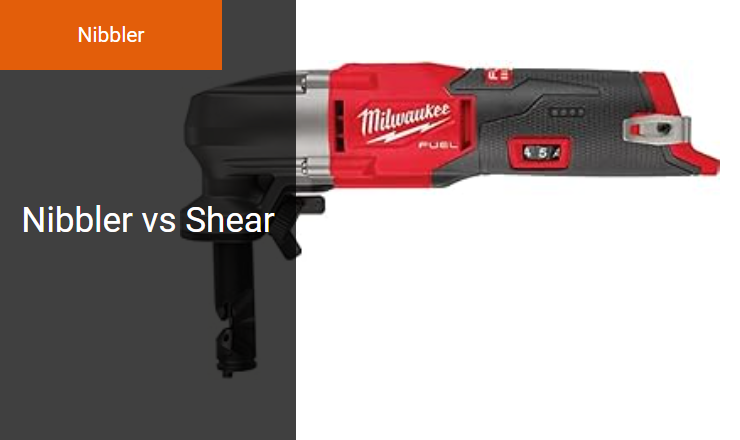
Achieving clean, distortion-free curves in sheet metal is a persistent challenge for fabricators, often resulting in wasted materials and jagged edges. While standard equipment funding sources and workshop budgets typically prioritize traditional reciprocating shears or manual snips, these conventional options frequently deform the workpiece during complex maneuvers.
Integrating a punch-and-die nibbler resolves this bottleneck, granting operators unmatched maneuverability and perfectly flat workpiece profiles without edge distortion. To manage expectations, however, workshops must plan for the stipulation that nibbling produces a continuous trail of tiny, sharp metal waste chips. Nevertheless, the tool's precision makes it highly effective for specialized tasks like corrugated roofing installations and custom HVAC ductwork.
Below, we will directly contrast the punch-and-die nibbler with the traditional power shear, evaluating their cutting mechanics, material capacities, and operational costs to help you choose the right tool for your shop.
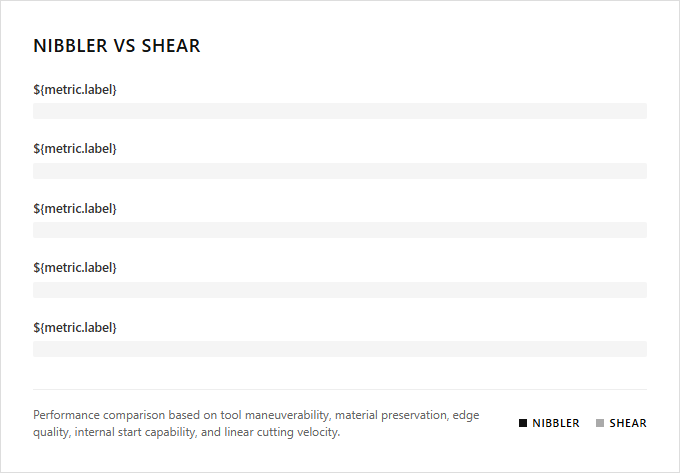
| Factor | Summary |
|---|---|
| Cutting Mechanism | A nibbler utilizes a high-speed reciprocating punch and die to bite out metal, whereas a shear employs two opposing shearing blades to slice the material. |
| Material Waste | Nibblers produce a significant amount of crescent-shaped waste chips known as kerf, while shears offer a virtually waste-free cut with zero material loss. |
| Maneuverability | Nibblers excel at tight radiuses, intricate scrollwork, and cutting corrugated metal, whereas shears are restricted to straight lines or wide-radius cuts. |
| Material Distortion | Nibblers deliver a completely distortion-free cut, unlike single-cut shears which often cause plastic deformation and bending along the cut edge. |
| Internal Cut Capability | Nibblers can initiate a cutout in the center of a workpiece using a pre-drilled pilot hole, whereas shears must always begin cutting from an exposed outer edge. |
| Cutting Speed | Shears typically offer a much higher linear cutting velocity when making straight cuts compared to the slower stroke-by-stroke progress of a nibbler. |
Nibblers vs. Shears: Kerf and Waste Differences
When selecting between a sheet metal nibbler and a shear, the primary distinction lies in how each tool removes material. A nibbler operates by rapidly punching out small, crescent-shaped metal chips along the cut line, which creates a distinct kerf width. In contrast, shears function by slicing directly through the metal without producing any waste chips, preserving the full dimensions of the workpiece with zero material loss.
While nibblers offer superior maneuverability for tight curves and corrugated profiles, they require clean-up of the discarded metal shavings. Shears excel at rapid, straight-line cutting and leave no debris behind. Nibblers are ideal for fabricators and HVAC technicians who frequently cut complex, contoured shapes, while shears are best suited for roofers and installers who require fast, distortion-free straight runs.
Reciprocating Punch and Die Prevents Workpiece Distortion
When selecting sheet metal cutting tools, understanding the mechanical differences between a nibbler and a shear is essential. While shears employ opposing blades that slice through material, a nibbler utilizes a high-speed reciprocating punch and die mechanism. This unique process bites away small, crescent-shaped waste chips rather than forcing the metal apart along a continuous seam.
This reciprocating action prevents workpiece distortion by eliminating lateral shearing force. Because the cutting pressure is applied strictly vertically, the surrounding metal remains perfectly flat and free of the edge curling typically caused by shears. This makes the nibbler highly effective for cutting corrugated materials and tight radiuses without compromising material integrity.
A nibbler is ideal for HVAC technicians and custom fabricators requiring precise, distortion-free cuts on curved or irregular profiles, while a shear is best suited for roofing contractors and installers who need rapid, straight-line cuts on flat metal sheets.
Making Internal Sheet Metal Cutouts with Nibblers
When selecting sheet metal cutting tools, understanding the mechanical differences between nibblers and shears is essential for project efficiency. While shears slice through metal without generating waste, they are generally restricted to starting from an open edge. In contrast, nibblers utilize a rapid punching action that removes small chips of metal, allowing the tool to maneuver in any direction. This distinct mechanism enables nibblers to initiate precise internal cutouts in the center of a workpiece, requiring only a small pre-drilled pilot hole to insert the cutting head.
This capability prevents material distortion and allows for tight, intricate radius curves that shears cannot achieve. Precise HVAC technicians and custom automotive fabricators requiring complex interior cutouts will find the nibbler indispensable, while residential roofing contractors focusing on rapid, straight-line trimming are better served by the clean, waste-free operation of shears.
Small Punch for Tight Contours and Omnidirectional Steering
When selecting between a sheet metal nibbler and a power shear, the primary distinction lies in cutting geometry and maneuverability. While shears slice through metal along a continuous path, nibblers operate by rapidly punching out small metal chips. The small diameter of the punch allows for tight-radius contours and omnidirectional steering, enabling precise navigation through intricate patterns and sharp corners without distorting the workpiece.
Shears excel at rapid, straight-line cuts across large surfaces, leaving clean, waste-free edges. HVAC technicians and roofers prioritizing fast, straight sheet division are ideal candidates for shears, whereas custom auto-body fabricators and artistic metalworkers needing complex, internal cutouts are best suited for the agile capabilities of the nibbler.
Edge Characteristics of Shearing vs. Nibbling
When selecting sheet metal cutting tools, understanding the material impact of each method is essential for high-quality fabrication. Power shears employ a continuous cutting action that excels at rapid straight lines but exerts significant mechanical stress on the workpiece. This localized pressure frequently causes work hardening along the cut edge, which can complicate subsequent bending, shaping, or finishing processes.
A nibbler operates by utilizing a rapidly reciprocating punch to remove small, overlapping semi-circular chips. While this cold-cutting process completely avoids material deformation and structural hardening, it leaves a characteristic scalloped edge that may require minor deburring. Power shears are most suitable for high-volume manufacturers requiring fast, straight-line production, whereas nibblers are ideal for custom fabricators and HVAC installers who frequently execute intricate curves and corrugated profiles.
How SPM Determines Nibbler Feed Rate
When selecting sheet metal cutting tools, understanding the mechanical differences between a nibbler and a shear is essential for project efficiency. The nibbler operates by rapidly punching out small metal chips, where the cutting feed rate is directly governed by the tool's strokes per minute (SPM). A higher SPM allows the operator to achieve a faster forward progression through the material, maintaining clean edges during intricate maneuvers.
In contrast, shears utilize opposing blades to slice metal continuously without material waste, though they lack the tight-radius turning capability of a nibbler. Professional HVAC installers requiring rapid, straight-line duct trimming benefit most from the clean efficiency of shears, while custom automotive fabricators demanding complex, distortion-free radius cuts are better suited for nibblers.
How Sheet Strength and Thickness Affect Tool Life
When selecting between a nibbler and a shear for sheet metal fabrication, understanding how material properties affect equipment longevity is essential. While shears slice through metal with minimal waste, nibblers operate by rapidly punching out small nested chips. Because of this high-impact mechanical action, nibbler tool life is highly dependent on the tensile strength and thickness of the sheet metal being punched. Harder alloys and thicker gauges accelerate wear on the punch and die, requiring more frequent maintenance than the cutting blades of a standard shear.
Each tool serves distinct operational demands based on the geometry of the cut. Shears excel at rapid, distortion-free straight lines, whereas nibblers offer superior maneuverability for tight radiuses and corrugated profiles. Creative fabricators and roofing installers requiring intricate, curved cuts on varied profiles will benefit most from the versatility of a nibbler, while high-production HVAC technicians focusing on straight, rapid ductwork fabrication are better suited for a power shear.
Leave a comment