
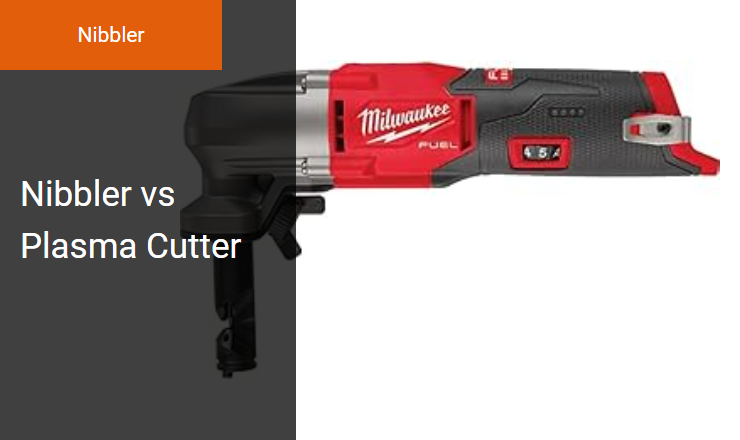
Achieving clean, distortion-free cuts in sheet metal fabrication is a persistent challenge, with fabricators often battling warped edges, hazardous sparks, and jagged finishes that ruin workpiece integrity.
Traditionally, workshops rely on standard cutting implements such as manual tin shears, abrasive angle grinders, or high-end laser systems to manage these tasks. However, upgrading to a reciprocating punch nibbler grants operators a distinct advantage: the ability to execute tight, spark-free radius cuts with zero thermal distortion to the host metal.
As a crucial stipulation, users must anticipate that nibblers generate tiny, razor-sharp crescent waste chips and are typically limited to lighter-gauge materials. Despite these parameters, their precision makes them the gold standard in delicate applications like HVAC ducting fabrication and custom automotive body panel restoration.
This article provides an executive comparison between the reciprocating punch nibbler and the plasma cutter, analyzing cutting speed, edge quality, operating costs, and material thickness limits to help you choose the optimal tool for your shop.
| Factor | Summary |
|---|---|
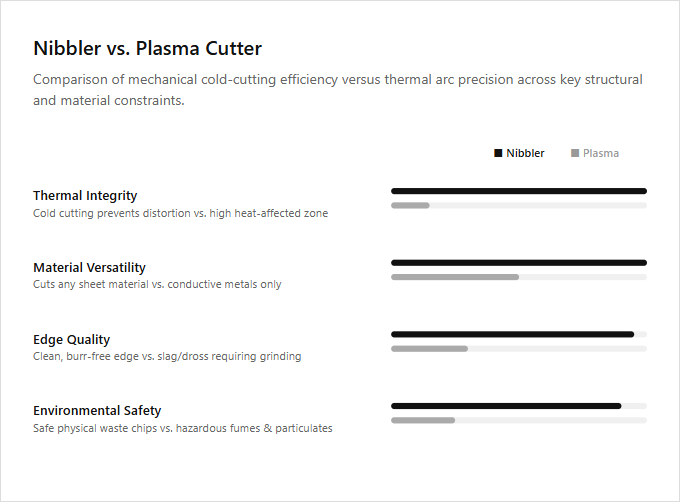
| Cutting Mechanism | A nibbler uses a punch-and-die system to remove small scraps of metal, whereas a plasma cutter utilizes an ionized gas jet to melt and blow away the material. |
| Heat-Affected Zone | Nibblers perform cold cutting which eliminates thermal distortion, while plasma cutters create a significant heat-affected zone that can alter the metal's metallurgical properties. |
| Material Conductivity | Plasma cutters require electrically conductive metals to establish a plasma arc, whereas mechanical nibblers can cut any sheet material regardless of conductivity, including plastics and non-ferrous alloys. |
| Edge Finish | Nibblers produce a clean, burr-free edge with no slag, while plasma cutters often leave dross that requires secondary grinding or abrasive finishing. |
| Kerf and Waste | A nibbler creates a continuous path of crescent-shaped waste chips equal to the punch width, whereas a plasma cutter produces a narrower kerf but generates hazardous fumes and fine particulate matter. |
HAZ-Free Cold Shearing via Nibbler Mechanism
In sheet metal fabrication, selecting between a nibbler and a plasma cutter depends heavily on thermal management. A nibbler utilizes a reciprocating punch and die mechanism to perform cold mechanical shearing. This process removes tiny metal chips without generating heat, entirely avoiding the creation of a heat-affected zone (HAZ) and preserving the material's integrity without warping or discoloration.
In contrast, a plasma cutter uses an accelerated jet of hot plasma to melt through conductive metals. While highly efficient for rapid cutting, this thermal method introduces a significant heat-affected zone that can alter the metal's properties and require secondary finishing.
Nibblers are ideal for precision artisans and auto restorers requiring distortion-free cuts on thin panels, whereas plasma cutters are best suited for industrial fabricators and demolition specialists prioritizing speed and heavy-gauge capacity.
Thermal Distortion of Thin Sheet Metal in Plasma Cutting
When fabricating sheet metal, selecting the appropriate cutting tool is essential for preserving material integrity. A primary differentiator between a nibbler and a plasma cutter is the application of heat. Plasma cutting relies on a high-temperature ionized gas jet that can cause thermal distortion on thin-gauge sheet metal. This intense thermal stress often warps delicate workpieces, necessitating secondary finishing processes to correct the deformation.
A nibbler utilizes a mechanical, cold-cutting punch-and-die system that completely eliminates heat transfer, delivering clean and precise edges. This process ensures the physical properties of the metal remain unaltered during fabrication. The nibbler is ideal for automotive restorers and HVAC technicians working with thin-gauge paneling, whereas the plasma cutter is better suited for heavy-duty demolition specialists and structural steel fabricators.
Nibblers: Burr-Free Edges with Zero Grinding
When choosing between a sheet metal nibbler and a plasma cutter for metal fabrication, edge quality is a primary consideration. Nibblers operate by rapidly punching out small metal paths, which produces a clean, burr-free edge with zero dross. This mechanical process eliminates the need for secondary grinding operations, allowing for immediate assembly or finishing without additional labor.
Plasma cutters use a high-temperature thermal arc to melt through conductive materials. Although plasma cutting offers high-speed processing on thicker materials, the intense heat inevitably leaves behind dross and slag that require post-cut cleanup. Nibblers are ideal for precision workshop fabricators requiring distortion-free sheet metal cuts, whereas plasma cutters are best suited for demolition specialists and industrial workers handling heavy plate steel.
Nibbler Kerf Width: Punch Diameter and Crescent Chips
When selecting metal cutting tools, understanding the material removal process is essential. A nibbler operates by rapidly reciprocating a punch against a die, making it ideal for distortion-free cuts on thin sheet metals. The kerf width of a nibbler is determined by the punch diameter, producing distinctive crescent-shaped waste chips as it advances. This mechanical shearing prevents thermal distortion, preserving the original material properties along the cut edge.
In contrast, a plasma cutter utilizes an accelerated jet of hot plasma to melt through electrically conductive metals, resulting in a narrower kerf but introducing a heat-affected zone. Nibblers are best suited for automotive body technicians requiring precise, spark-free templates on thin sheets, whereas plasma cutters are ideal for industrial welders needing to rapidly dismantle thick structural steel.
Plasma vs. Nibblers: Cutting Non-Conductive Materials
When selecting between a nibbler and a plasma cutter for industrial fabrication, the electrical properties of the workpiece are a primary consideration. Plasma cutters rely on an electric arc to melt and sever metal, which strictly limits their application to conductive materials such as steel, aluminum, and copper. This thermal process delivers rapid, high-precision cuts but remains ineffective on non-metals.
Conversely, mechanical nibblers operate through a rapid punching motion that is entirely independent of electrical conductivity. This physical cutting mechanism allows nibblers to effortlessly process non-conductive cladding, fiberglass, and various plastics without melting the material or requiring a ground connection. Fabricators handling diverse, non-metallic sheeting benefit most from the versatile nibbler, while high-volume metalworking technicians requiring rapid, complex contours in conductive alloys are best served by the plasma cutter.
Nibblers: Distortion-Free Curved and Corrugated Cutting
In metalworking, choosing between a nibbler and a plasma cutter depends heavily on the geometry and material structure of the workpiece. While plasma cutters offer rapid, high-heat thermal cutting for thick plates, they can warp thin metals and struggle with intricate shapes. Nibblers excel at navigating tight radius curves and corrugated profiles without distorting the structural integrity of the sheet, making them indispensable for precision cold-cutting tasks.
Nibblers operate by rapidly punching out tiny overlapping metal chips, leaving a clean, distortion-free edge. This mechanical process prevents thermal stress, preserving pre-painted or coated finishes. Roofers and HVAC technicians benefit greatly from the nibbler's agility on corrugated panels, whereas heavy industrial fabricators requiring high-speed dismantling of thick plate steel are better suited to the power of a plasma cutter.
Plasma Cutting Safety: Hazards and Protection
When selecting between a nibbler and a plasma cutter for metal fabrication, safety and environmental factors are critical considerations. Plasma cutting utilizes an intense electric arc and compressed gas, a process that inherently generates hazardous fumes, toxic gases, and high-frequency radiation. Operating this machinery safely requires robust ventilation systems and specialized personal protective equipment, including respiratory protection and high-grade eye shields, to mitigate health risks. Mechanical nibblers, by comparison, cut sheet metal through a rapid punching action that avoids thermal hazards, sparks, and harmful emissions entirely.
The choice between these tools depends on the working environment and the specific demands of the project. Mechanical nibblers are ideal for HVAC technicians and roofers who require safe, spark-free, on-site maneuverability on thin sheets, whereas plasma cutters are best suited for heavy-duty industrial fabricators who operate in dedicated, well-ventilated workshops.
Leave a comment