
Achieving clean, distortion-free cuts in sheet metal without warping the material or exhausting the operator is a constant challenge in precision fabrication. While standard workshop solutions-such as traditional hand shears, abrasive grinders, or reciprocating saws-are commonly utilized, they frequently deform the workpiece and leave hazardous, jagged edges. This is where professional nibblers provide a critical advantage, granting fabricators the unique ability to glide through complex profiles with surgical precision, leaving the surrounding material entirely unaffected.
However, unlocking this efficiency requires a key stipulation: the tool's performance is deeply tied to its power source. Whether you are cutting corrugated roofing or fabricating heavy-gauge HVAC ductwork, choosing the wrong drive system can bottleneck your workflow. To help you make an informed investment, this guide compares pneumatic and electric nibblers across power output, portability, and operating costs, outlining exactly which tool fits your specific shop environment.
| Factor | Summary |
|---|---|
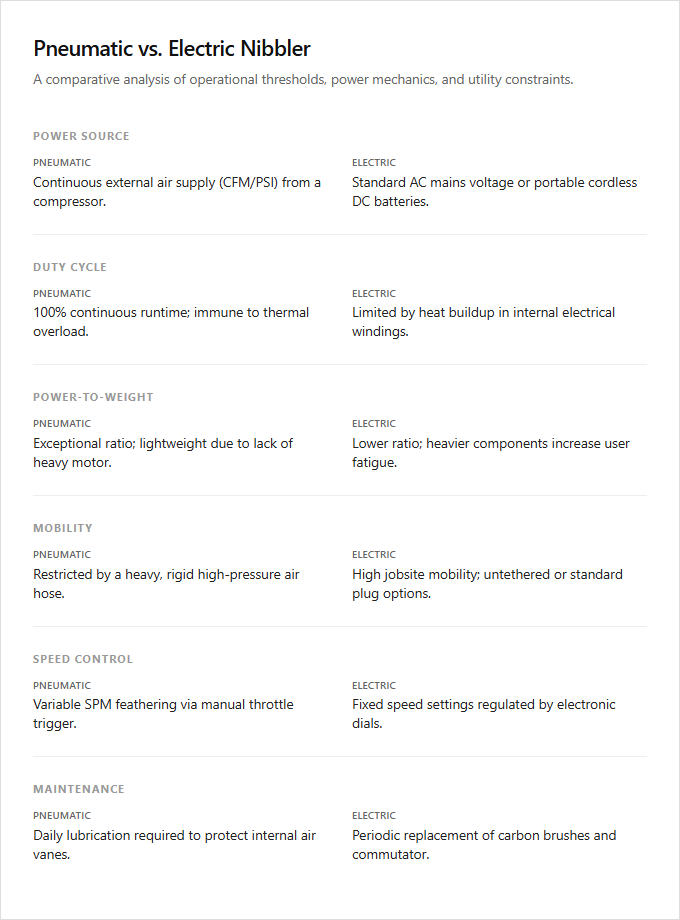
| Power Source | Pneumatic nibblers require a continuous air supply measured in CFM and PSI from an external compressor, whereas electric models run on standard AC mains voltage or cordless DC batteries. |
| Duty Cycle | Pneumatic nibblers can run continuously under a 100% duty cycle because they lack electrical windings that are susceptible to thermal overload. |
| Power-to-Weight Ratio | Without the heavy copper windings of an electric motor, pneumatic nibblers deliver a much higher power-to-weight ratio, which significantly reduces operator fatigue. |
| Mobility | Electric nibblers offer superior jobsite mobility because they do not require a rigid, high-pressure air hose tethered to a stationary compressor. |
| Speed Control | Pneumatic tools allow the user to feather the throttle trigger to instantly adjust the SPM (strokes per minute), while electric variants typically rely on a pre-set electronic speed dial. |
| Maintenance | Pneumatic units require daily lubrication with pneumatic tool oil to protect internal air vanes, whereas electric nibblers require periodic inspection of the carbon brushes and commutator. |
Sizing Air Compressors for Pneumatic Nibblers
When selecting between pneumatic and electric nibblers, the power source is a critical decision point. Pneumatic nibblers offer a lightweight profile but require a dedicated air supply. The tool's air consumption, rated in cubic feet per minute (CFM), directly dictates the compressor size required to sustain continuous operation. Matching the nibbler's CFM demand with a sufficiently rated compressor is essential to prevent pressure drops and maintain optimal cutting performance.
Electric nibblers bypass these infrastructure needs, offering plug-and-play convenience directly from standard outlets or batteries. Electric models are ideal for mobile contractors and DIYers requiring portability across various job sites, whereas pneumatic units are best suited for industrial fabricators and automotive technicians working in workshops with established air systems.
Electric Nibblers: Matching Speed to Metal Hardness
When selecting between pneumatic and electric nibblers, the power source significantly influences tool control and application versatility. Electric nibblers excel in precision due to their advanced variable speed motors. These tools allow operators to precisely regulate the strokes per minute to match different metal hardnesses, protecting both the workpiece and the cutting die. This adjustable stroke rate ensures clean cuts in hardened stainless steel at lower speeds, as well as rapid progress through softer aluminum at higher frequencies.
Pneumatic nibblers offer a lightweight, high-torque alternative that runs cool during extended use, though they lack the nuanced speed adjustments of their electric counterparts. Electric models are ideal for mobile contractors and workshop fabricators who require precise speed control for varied materials, while pneumatic models are best suited for assembly line technicians and industrial workers performing repetitive cuts near a continuous compressed air supply.
Punch-Die Clearance Determines Kerf Width Quality
When selecting between pneumatic and electric nibblers, understanding the cutting mechanism is essential for achieving precise results. In both tool designs, the clearance between the reciprocating punch and the guide die determines the quality of the kerf width. Maintaining the correct clearance ensures clean, burr-free edges, while incorrect spacing leads to material deformation or rapid tool wear.
Pneumatic nibblers offer a lightweight, spark-free operation ideal for high-volume industrial environments, whereas electric models provide excellent portability without the need for an air compressor system. Pneumatic models suit industrial metal fabricators requiring continuous, spark-safe operation, while electric nibblers are ideal for mobile contractors and workshop technicians needing versatile, on-the-go performance.
Brushless Motors Boost Cordless Nibbler Battery Efficiency
When selecting a metal-cutting nibbler, professionals must evaluate the distinct operational advantages of pneumatic versus electric configurations. Cordless electric nibblers have achieved significant performance gains through the integration of brushless motors. By eliminating mechanical brush friction, these advanced motors maximize the energy efficiency of high-capacity lithium-ion batteries, ensuring longer runtimes and sustained torque during heavy-duty cutting tasks.
Conversely, pneumatic nibblers rely on compressed air, offering a lightweight, cool-running alternative that excels in continuous-use environments. Pneumatic nibblers are ideal for stationary industrial fabricators with access to dedicated air compressors, while cordless electric models are best suited for mobile contractors who prioritize portability and independence from utility lines.
Spark-Free Pneumatic Models Prevent Ignition Hazards
When selecting between pneumatic and electric nibblers, safety and the operating environment are critical factors to consider. Electric nibblers offer excellent portability and convenience for standard workshop applications where power outlets are readily available. In contrast, pneumatic nibblers excel in hazardous conditions; utilizing a spark-free air-vane motor, these air-powered models eliminate the risk of electrical arcing, preventing dangerous ignition hazards in volatile environments containing flammable gases, vapors, or combustible dust.
Beyond safety advantages, pneumatic tools typically provide a higher power-to-weight ratio and can run continuously without the risk of motor burnout. Industrial fabricators working in petrochemical plants, aerospace facilities, or marine environments require pneumatic models for hazardous-area compliance, whereas mobile contractors and workshop hobbyists are better suited to the plug-and-play accessibility of electric nibblers.
Continuous Pneumatic Operation Without Thermal Degradation
When comparing pneumatic and electric nibblers for metal fabrication, the primary differentiators are power delivery and thermal management. Pneumatic nibblers excel in high-demand environments due to their design. Continuous operation without thermal degradation is achieved through the high duty cycle of pneumatic systems, as the compressed air flow naturally cools the tool during prolonged use, eliminating the risk of motor burnout.
In contrast, electric nibblers offer excellent portability and plug-and-play convenience, though they require periodic cooling intervals during heavy-duty cutting. High-volume industrial fabricators requiring non-stop assembly line production benefit most from the endurance of pneumatic models, whereas mobile contractors and service technicians seeking cordless freedom find electric nibblers more suitable for intermittent onsite tasks.
Material Strength and Gauge Limit Cutting Performance
When selecting between pneumatic and electric nibblers, understanding material constraints is paramount. Regardless of the power source, a nibbler's cutting performance is strictly limited by the workpiece material's tensile strength and gauge rating. Exceeding these manufacturer-specified limits leads to rapid punch wear, jagged edges, or tool failure, making precise material assessment critical prior to operation.
Pneumatic nibblers offer a high power-to-weight ratio and run cool during continuous operation, though they require a dedicated air supply. Electric models provide plug-and-play portability and consistent power delivery without auxiliary equipment. Pneumatic units are ideal for industrial fabricators in high-volume production shops, while electric nibblers best serve mobile contractors and HVAC technicians needing on-site versatility.
Leave a comment