
Metal fabricators and contractors frequently struggle to balance on-site mobility with the high-torque demand of cutting thick sheet metal without warping the material. While standard shop equipment budgets typically prioritize heavy, stationary fabrication machinery, handheld power shears remain the true workhorse of daily production.
Selecting the optimal power shear grants operators the precision of stationary fabrication alongside unmatched physical maneuverability, significantly reducing labor bottlenecks. However, a critical stipulation must be kept in mind: tool ratings are absolute, and pushing a shear beyond its specified capacity will inevitably lead to motor burnout. For example, consistently slicing through 14-gauge mild steel demands the relentless, uninterrupted current of a heavy-duty corded shear rather than a standard light-duty cordless model.
Below, we break down the critical trade-offs between corded and cordless shears, specifically evaluating how power delivery dictates sheet metal gauge capacity and long-term tool durability.
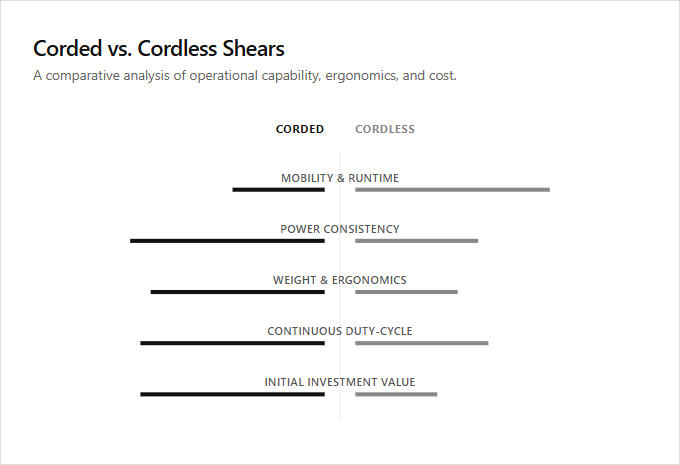
| Factor | Summary |
|---|---|
| Power Source & Mobility | Corded shears offer unlimited runtime via a direct electrical grid connection, whereas cordless shears utilize rechargeable lithium-ion batteries to provide superior jobsite maneuverability. |
| Power Output | Corded models deliver consistent, high-torque wattage for heavy-duty metal gauge cutting, while cordless alternatives can experience performance drop-offs as battery voltage depletes. |
| Weight & Ergonomics | Corded shears are generally lighter due to the absence of a heavy battery pack, which significantly reduces operator fatigue during prolonged cutting applications. |
| Motor Durability | Corded shears often feature robust motors designed for continuous duty-cycles, whereas cordless shears rely on highly efficient brushless motor technology to optimize battery runtime. |
| Initial Investment | Corded shears represent a lower initial capital expenditure because they do not require the additional purchase of proprietary charging stations and spare battery cells. |
How Corded Shears Maintain Torque for Thick Metal
When selecting sheet metal shears, the choice between corded and cordless models depends on your specific project requirements and workspace conditions. Corded shears utilize continuous amperage to maintain the necessary torque for cutting thicker sheet metal gauges without stalling. This uninterrupted power supply ensures consistent performance and reliability during prolonged, heavy-duty fabrication tasks.
Conversely, cordless shears offer excellent portability and maneuverability, allowing operators to make precise cuts in tight spaces without the restrictions of a power cable. High-volume industrial fabricators working with heavy-gauge metals benefit most from the enduring power of corded models, whereas field technicians and contractors requiring high mobility favor cordless designs.
How Battery Specs Affect Cordless Shear Performance
When selecting metal shears, the choice between corded and cordless models depends heavily on your workspace demands. Cordless shears offer unmatched mobility, yet their performance relies strictly on battery voltage and Amp-hours (Ah). These specifications directly dictate the tool's runtime and maximum gauge capacity under load, meaning higher voltage is required for cutting thicker sheet metal without stalling.
In contrast, corded shears provide continuous, uninterrupted power and consistent torque, making them ideal for heavy-duty, stationary shop environments. Corded models are best suited for high-volume fabrication shop workers who require unlimited runtime, while cordless options are ideal for HVAC installers and field technicians who prioritize portability on dynamic jobsites.
High-Speed Brushless Cordless Shears
When selecting power shears, the choice between corded and cordless models depends on your specific operational requirements. Modern cordless shears have closed the performance gap significantly through technological innovation. High-performance cordless shears feature brushless motors to maximize cutting speed measured in strokes per minute, delivering consistent torque and efficient battery utilization without the restriction of a power cord.
Conversely, corded shears offer uninterrupted power and unlimited runtime, making them highly reliable for continuous, heavy-duty applications. Cordless shears are ideal for HVAC technicians and roofers who require maximum mobility on-site, while corded models are best suited for stationary workshop fabricators needing constant, high-volume output.
Stainless vs. Mild Steel: Corded Power for High-Gauge Processing
Selecting the appropriate power shear depends heavily on the tensile strength of the metal being processed. While mild steel is relatively easy to cut, stainless steel possesses a significantly higher tensile strength that demands continuous, unyielding power. For sustained processing of high-gauge stainless steel, corded shears are essential because they deliver consistent torque without the performance degradation associated with battery depletion.
Cordless shears offer unmatched portability for quick, on-site adjustments on lighter-gauge materials where mobility is prioritized. Corded units excel in high-volume shop environments where uninterrupted duty cycles are critical for production. Heavy-duty industrial fabricators working with thick alloys require the relentless power of corded shears, while field technicians and HVAC installers benefit most from the agility of cordless models.
Double-Cut Corded Shears Prevent Material Distortion
When selecting sheet metal shears, the choice between corded and cordless models depends heavily on your workflow and material thickness. Corded shears excel in demanding environments due to their consistent, uninterrupted power delivery. This constant voltage is particularly advantageous in models featuring a double-cut shear head design, which actively prevents material distortion and curling across the tool's maximum rated gauge capacities by removing a thin waste strip.
Cordless shears offer superior maneuverability and convenience for overhead tasks or remote job sites where power outlets are scarce. High-volume shop fabricators requiring continuous, distortion-free cuts on heavy-gauge metal are best suited for corded shears, whereas field installers and roofers who prioritize mobility and quick adjustments will benefit most from cordless models.
Corded Tools: Unlimited Power for Continuous Heavy Cutting
When selecting power shears for metal fabrication, the choice between corded and cordless models depends on your specific workload requirements. Corded shears provide a distinct advantage in high-capacity environments by delivering a consistent, uninterrupted electrical current. This reliable power supply supports an unlimited duty cycle, allowing operators to execute continuous heavy-gauge cutting without the risk of thermal overload or motor stall.
In comparison, cordless shears prioritize mobility and ease of access in tight spaces, though they remain constrained by battery capacity and thermal limits during prolonged use. Stationary workshop fabricators requiring relentless endurance will find corded shears indispensable, while mobile contractors and roofing installers are better served by the flexibility of cordless models.
Voltage Drop Limits Cordless Sheet Metal Capacity
When selecting metal shears, power delivery is a critical factor in performance stability. Corded shears provide continuous, uninterrupted power, maintaining their rated cutting capacity throughout operation. In contrast, cordless models are subject to voltage drop as the battery charge depletes. This decline in voltage directly reduces the tool's effective sheet metal gauge capacity, meaning a cordless shear rated for 14-gauge steel may struggle or stall on that same material once the battery falls below half charge.
To maintain optimal cutting efficiency, cordless users must frequently swap batteries or accept reduced performance on thicker metals. Corded shears are best suited for high-volume shop fabricators requiring sustained, heavy-duty cutting capacity, while cordless models are ideal for field installation technicians who prioritize mobility for quick, light-gauge adjustments.
Leave a comment