
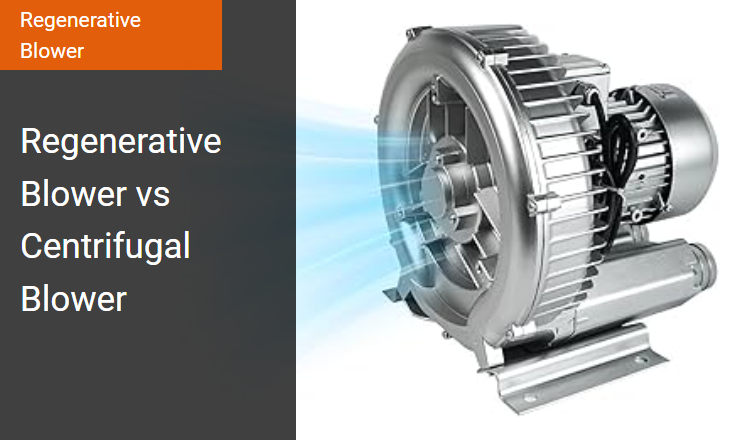
Engineers and plant managers frequently struggle to select an industrial air-moving system that delivers continuous high pressure without skyrocketing energy costs or suffering from premature mechanical failure. Traditionally, facilities have bridged this operational gap by relying on standard plant compressed air or oversized centrifugal fans.
However, integrating a regenerative (side channel) blower optimizes this dynamic, granting operations unparalleled pressure-to-flow efficiency and virtually maintenance-free longevity. It must be stipulated, however, that while regenerative blowers excel at generating impressive pressure differentials, they are specifically engineered for clean, low-to-medium volume displacement rather than high-velocity mass airflow.
In critical applications such as wastewater aeration and vacuum pneumatic conveying, side-channel technology has proven to be the most reliable and cost-effective choice. This guide will contrast regenerative and centrifugal blowers, analyzing their performance curves, footprint requirements, and lifecycle costs to help you select the ideal high-pressure system for your facility.
| Factor | Summary |
|---|---|
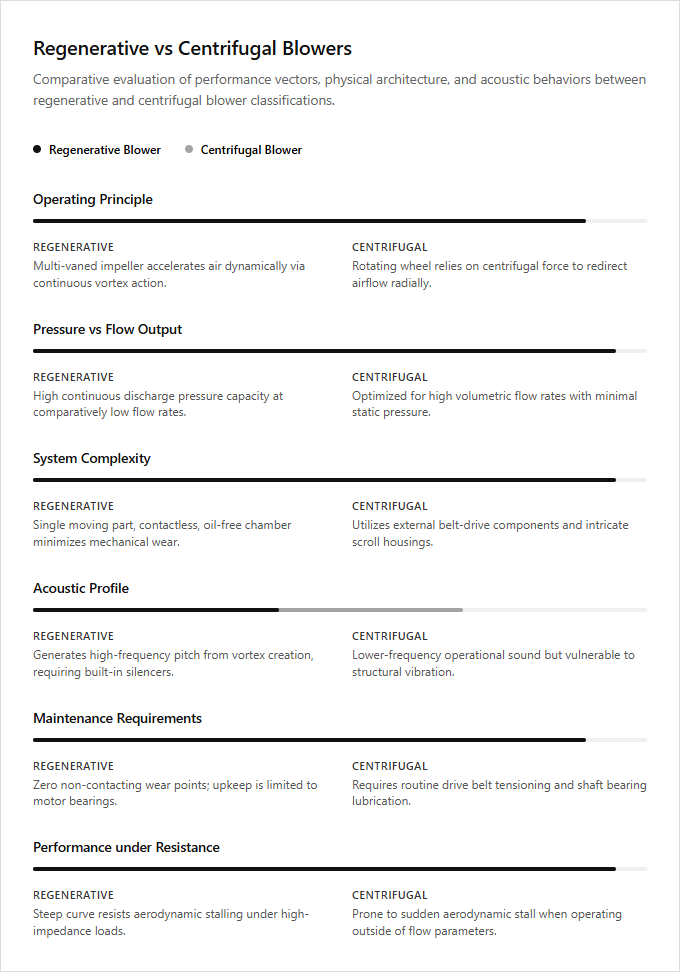
| Operating Principle | Regenerative blowers utilize non-positive displacement via a multi-vaned impeller to continuously accelerate air dynamically, whereas centrifugal blowers rely on centrifugal force from a rotating wheel to redirect airflow radially. |
| Pressure vs Flow Output | Regenerative blowers generate significantly higher discharge pressure at lower flow rates, while centrifugal blowers are optimized for high volumetric flow rates at low static pressure. |
| System Complexity | Featuring a single moving part, regenerative blowers provide an oil-free design that minimizes wear, whereas centrifugal blowers often require belt-drive assemblies or complex scroll housings. |
| Acoustic Profile | Regenerative blowers produce a high-frequency pitch due to internal vortex generation that often requires integrated silencers, whereas centrifugal blowers generate lower-frequency sound but are susceptible to aerodynamic vibration. |
| Maintenance Requirements | The absence of contacting parts in a regenerative blower limits wear to the sealed motor bearings, while centrifugal blowers demand periodic lubrication and belt tensioning to prevent mechanical slippage. |
| Performance under Resistance | Regenerative blowers exhibit a steep performance curve that resists stalling under high system impedance, whereas centrifugal blowers are prone to aerodynamic stall when operating outside their designated flow parameters. |
Toroidal Multi-Stage Compression for High Static Discharge Pressure
Regenerative blowers differ fundamentally from centrifugal blowers in how they manage airflow and pressure. While centrifugal units excel at moving large volumes of air at low resistance, regenerative blowers achieve a significantly higher static discharge pressure. This performance is driven by multi-stage compression occurring within a toroidal ring channel, where a rapidly spinning impeller continuously recirculates the air, building pressure cumulatively with each rotation.
The choice between these technologies depends entirely on the flow resistance of the specific application. Engineers designing large-scale ventilation or cooling systems will benefit most from centrifugal blowers, while operators requiring deep vacuum capabilities, pneumatic conveying, or high-pressure aeration will find regenerative blowers to be the superior choice.
Regenerative Blowers: Prioritizing Pressure Over Flow
Regenerative blowers are engineered for applications requiring significant pressure or vacuum generation. They operate on a dynamic principle where spinning impellers accelerate air through regenerative channels, resulting in a distinctively steep performance curve. This design prioritizes high pressure over high volumetric flow rate, allowing the blower to maintain consistent force even as system resistance increases.
In contrast, centrifugal blowers utilize centrifugal force to move larger volumes of air at much lower pressures. Their flatter performance curve is optimized for high-volume air displacement rather than overcoming systemic resistance.
Engineers designing dense filtration or pneumatic conveying systems require the high-pressure capabilities of regenerative blowers, whereas facility managers focusing on high-volume ventilation or cooling applications are better served by centrifugal units.
Regenerative Acceleration via Vortex-Style Impeller Blades
Regenerative blowers operate by utilizing vortex-style impeller blades to achieve regenerative acceleration. As air enters the system, the rapidly spinning blades force the gas into a spiral path, repeatedly accelerating it and building high pressure through continuous recirculating vortices within the housing channel.
Centrifugal blowers rely on simple radial kinetic energy transfer. These units draw air into the center of a spinning impeller and fling it outward, converting velocity into static pressure in a single, linear pass. This fundamental design difference allows regenerative models to achieve significantly higher pressures than centrifugal systems.
Regenerative blowers are ideal for industrial technicians requiring high-pressure, low-maintenance vacuum systems, whereas centrifugal blowers best suit facility managers overseeing large-scale, high-volume ventilation operations.
Maintenance-Free, Contactless Impeller Design
When comparing regenerative blowers to centrifugal alternatives, the primary differentiator lies in their mechanical design and longevity. Regenerative blowers feature a highly efficient contactless design, where the impeller spins within the housing with zero-wear clearances. Because there is no physical contact between the rotating and stationary parts, internal friction is eliminated, resulting in a virtually maintenance-free operation that requires no lubrication and prevents component degradation.
In contrast, centrifugal blowers typically rely on belts, gears, and seals that require routine inspection, lubrication, and replacement. The contactless architecture of the regenerative system ensures long-term operational reliability and consistently clean, oil-free airflow.
Regenerative blowers are ideal for operators requiring continuous, high-pressure utility with minimal downtime, whereas centrifugal blowers are suited for facilities requiring high-volume, low-pressure airflow where routine maintenance schedules can be easily managed.
Compact physical footprint enabled by a *direct-drive motor* shaft assembly
When evaluating industrial air-moving technologies, the physical footprint is often a key engineering consideration. Regenerative blowers offer a distinct space-saving advantage over traditional centrifugal blowers. By utilizing a direct-drive motor shaft assembly where the impeller mounts directly to the motor shaft, regenerative blowers eliminate the need for bulky belts, pulleys, or external coupling mechanisms. This streamlined configuration results in a highly compact, self-contained unit that easily integrates into tight machinery enclosures.
In contrast, centrifugal blowers typically require larger, externally mounted motors and belt-drive setups, demanding a significantly larger installation envelope. Regenerative blowers are ideal for system integrators needing high-pressure delivery within confined equipment layouts, while centrifugal blowers suit facility managers who require high-volume, low-pressure airflow for spacious ventilation applications.
Dual High-Pressure and Deep Vacuum Without System Modification
When comparing industrial air-moving technologies, the fundamental distinction between regenerative and centrifugal blowers lies in their pressure dynamics. Regenerative blowers excel through a unique dual capability, seamlessly transitioning between high-pressure discharge and deep negative vacuum pressure without requiring system modifications. This versatility is driven by a dynamic impeller design that continuously accelerates air through regenerative sweeps, whereas centrifugal units rely on high-velocity radial discharge optimized primarily for high-volume, low-pressure applications.
Centrifugal blowers require complex mechanical reconfigurations to alter flow paths, making them less adaptable for multi-functional operations. Engineers requiring precise, high-pressure suction for material handling or vacuum lifting will benefit most from regenerative blowers, while facility managers prioritizing continuous, high-volume ventilation are better served by centrifugal systems.
Integrated Silencers Easily Mitigate High-Frequency Noise
Regenerative blowers and centrifugal blowers serve distinct operational needs in industrial air-moving applications. While centrifugal blowers excel at moving high volumes of air at low pressures, regenerative models generate significant pressure utilizing a non-positive displacement method. A notable characteristic of the regenerative design is its high-frequency noise profile, which is produced by the rapid shearing of air within the impeller. Fortunately, this acoustic signature is easily mitigated by integrating specialized intake and discharge silencers directly into the system, ensuring a quiet and compliant workspace.
Selecting the appropriate technology depends entirely on the specific performance demands of your facility. Regenerative blowers are ideal for operators requiring high-pressure suction in compact spaces like vacuum lifting or soil remediation, whereas centrifugal blowers are best suited for plant managers needing high-volume ventilation and bulk material conveying.
Leave a comment