
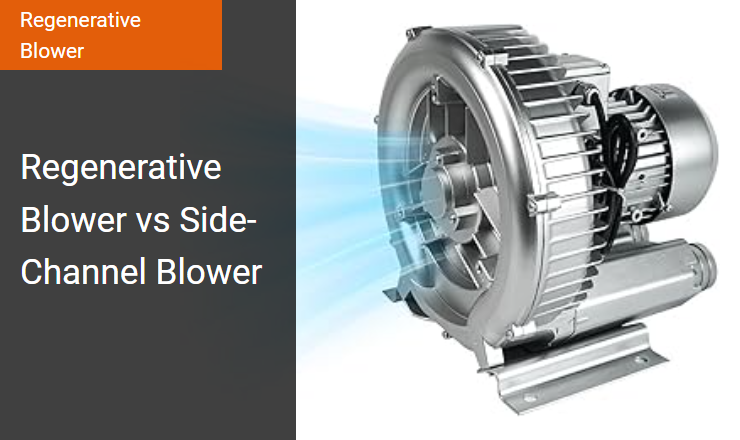
Industrial plant managers and design engineers often struggle with balancing high-volume air movement demands against soaring energy bills and relentless maintenance downtime. While traditional positive displacement blowers or rotary lobe systems are the standard industry starting points, their complex mechanical wear points frequently compromise long-term system reliability.
Transitioning to regenerative (dynamic displacement) technology effectively grants facilities an immediate operational windfall-delivering virtually maintenance-free, continuous airflow that drastically lowers total cost of ownership. Under the stipulation that these systems are engineered specifically for high-flow, low-to-medium pressure applications rather than high-vacuum extremes, they perform exceptionally. Indeed, in real-world environments like wastewater aeration and pneumatic conveying, this technology ensures consistent, pulsation-free delivery.
Below, we demystify the terminology between regenerative and side-channel blowers, analyze key performance curves, and provide a comprehensive framework for optimizing your plant's air-handling efficiency.
| Factor | Summary |
|---|---|
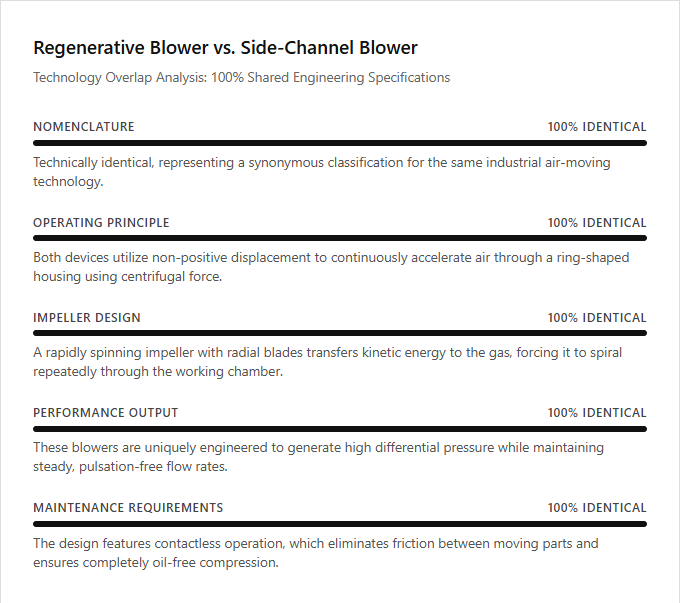
| Nomenclature | Regenerative blowers and side-channel blowers are technically identical, representing a synonymous classification for the same industrial air-moving technology. |
| Operating Principle | Both devices utilize non-positive displacement to continuously accelerate air through a ring-shaped housing using centrifugal force. |
| Impeller Design | A rapidly spinning impeller with radial blades transfers kinetic energy to the gas, forcing it to spiral repeatedly through the working chamber. |
| Performance Output | These blowers are uniquely engineered to generate high differential pressure while maintaining steady, pulsation-free flow rates. |
| Maintenance Requirements | The design features contactless operation, which eliminates friction between moving parts and ensures completely oil-free compression. |
Regenerative and Side-Channel Blowers: The Same Technology
In the industrial fluidics industry, "regenerative blower" and "side-channel blower" are synonymous terms describing the exact same non-positive dynamic displacement technology. The distinction is primarily geographical rather than mechanical; North American markets favor the term regenerative, while European sectors utilize side-channel. Both descriptions refer to a system where a rapidly spinning impeller uses centrifugal force to accelerate air through a ring-shaped housing, continuously building pressure through regenerative vortices.
This non-contact operation ensures minimal maintenance and highly reliable, oil-free air delivery. Environmental engineers requiring continuous, low-pressure aeration for wastewater treatment typically specify regenerative models, whereas European system designers and automation specialists focusing on metric manufacturing standards generally implement side-channel blowers.
How Rotating Impellers Transfer Kinetic Energy to Gas
While often used interchangeably in industrial settings, the terms regenerative blower and side-channel blower describe the same highly efficient technology designed for continuous air movement. The core operation relies on a sophisticated dynamic principle where the high-speed rotation of a multi-vaned impeller transfers kinetic energy to the gas through centrifugal force. As the gas is repeatedly accelerated within the narrow side channel, it undergoes continuous compression to deliver reliable, pulsation-free pressure or vacuum.
This contactless design eliminates physical wear and ensures oil-free discharge, which significantly reduces long-term maintenance costs. Plant engineers requiring precise, localized pressure control for wastewater aeration find side-channel configurations ideal, while industrial woodworkers and packaging technicians needing high-volume debris extraction are better suited for regenerative systems.
Vortex-Driven Pressure Differentials in Side Channels
While often used interchangeably in industrial applications, the regenerative blower and the side-channel blower refer to the same highly efficient, non-displacement fluid technology. The core operating principle relies on an impeller spinning rapidly within a toroidal housing. Continuous vortex formation within the side-channel creates a significant pressure differential, repeatedly accelerating the air to generate impressive pressure or vacuum levels without any mechanical contact.
This design delivers consistent, oil-free airflow with minimal maintenance requirements. Industrial engineers requiring continuous, high-volume aeration for wastewater treatment typically opt for regenerative blowers, whereas laboratory technicians seeking precise, low-noise vacuum holding systems are best suited for side-channel configurations.
Oil-Free Compression via Non-Contact Design
Regenerative blowers and side-channel blowers operate on the same fundamental aerodynamic principles, frequently sharing terminology due to their parallel performance characteristics. The core advantage of both systems lies in their non-contact impeller design, which completely eliminates the need for internal lubrication. By preventing mechanical wear within the compression chamber, these blowers deliver 100% oil-free air, ensuring the downstream environment remains entirely free of contaminants.
Distinctions between the two typically arise in manufacturing standards, pressure tolerances, and specific application efficiencies. Regenerative blowers are best suited for industrial operators requiring high-flow aeration in water treatment, while side-channel blowers are ideal for laboratory specialists seeking precise, contamination-free vacuum performance in sterile environments.
Customizing Flow and Pressure via Stage Configurations
Regenerative blowers, often referred to as side-channel blowers, utilize a non-displacement, dynamic design to move air or gas efficiently. The primary distinction in their performance lies in the impeller configuration. Selecting between single-stage and double-stage models allows operators to customize the relationship between volumetric flow rate and discharge pressure to meet specific industrial demands.
A single-stage blower channels air through the impeller once, generating higher volumetric flow rates at lower discharge pressures. A double-stage configuration routes the air through a second rotation, significantly increasing the discharge pressure at a reduced flow volume. Engineers seeking rapid, low-resistance air movement are best suited for single-stage models, whereas operators managing high-resistance systems or deep vacuum requirements should select double-stage configurations.
Wear-Free Units for Continuous Duty
Regenerative blowers and side-channel blowers utilize non-contact, dynamic compression to move air efficiently. Because these systems operate without wearing parts like reciprocating pistons or sliding vanes, internal friction is virtually eliminated. This specific design feature ensures the units are highly reliable for continuous duty cycles, maintaining consistent performance over long operational periods without degradation.
While the terms are often used interchangeably, subtle variations exist in regional engineering standards and housing designs. Plant engineers requiring uninterrupted, oil-free aeration typically select side-channel models, whereas product developers integrating compact, high-velocity vacuum systems prefer standard regenerative configurations.
Integrated Silencers for High-Frequency Air Shear Noise
While the terms regenerative blower and side-channel blower often describe the same dynamic compression technology, their industrial implementation requires precise acoustic engineering. Both systems utilize non-contact impellers to accelerate air through a circular channel, generating significant velocity. A primary operational challenge in these units is the high-frequency acoustic emissions generated by the rapid shear of air. Integrated silencers are required to manage these noise levels, dampening the high-velocity aerodynamic shearing before it exits the system.
Engineers requiring quiet, continuous-duty pressure for delicate wastewater aeration or pneumatic conveying benefit most from side-channel configurations with advanced silencing, while industrial technicians needing robust, high-volume vacuum extraction for heavy dust removal are best suited for rugged, high-capacity regenerative blowers.
Leave a comment