
Achieving flawless deep mortises and clean grooves with a plunge router often feels like a constant battle against friction, unsightly wood burning, and packed sawdust. To resolve this, woodworkers traditionally rely on standard straight-flute bits as their baseline tooling. While these conventional cutters are highly accessible, they inherently lack the vertical geometry required to pump waste out of a deep cut.
Upgrading to solid carbide spiral bits changes the equation, granting woodworkers superior shear action and continuous chip evacuation that drastically improves edge quality. However, unlocking this professional finish stipulates that you understand how rotational feed forces interact with wood fibers. For instance, utilizing an upcut spiral for deep mortising in dense white oak requires a completely different approach than running a downcut spiral to prevent tear-out on delicate veneered plywood.
Below, we will analyze the mechanical differences between upcut and downcut geometries, compare their chip-clearing physics during plunge cuts, and provide a definitive selection guide for your next project.
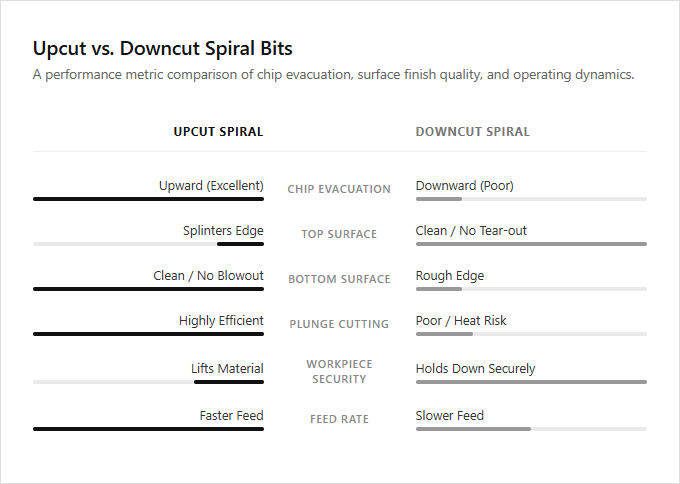
| Factor | Summary |
|---|---|
| Chip Evacuation | Upcut spiral bits pull wood chips upward out of the cut through their helical flutes, whereas downcut bits push debris downward into the kerf. |
| Top Surface Quality | Downcut spiral bits shear wood fibers downward to prevent tear-out on the top veneer of the workpiece, while upcut bits tend to splinter the upper edge. |
| Bottom Surface Quality | Upcut spiral bits pull fibers upward to yield a pristine, blowout-free finish on the bottom face of the material during through-cuts. |
| Plunge Cutting | Upcut spiral bits are highly efficient for plunge routing because their geometry actively clears material from blind holes to prevent thermal degradation. |
| Workpiece Security | Downcut spiral bits exert downward axial force that helps hold thin sheet goods securely against the spoilboard, whereas upcut bits tend to lift the material. |
| Feed Rate | Upcut spiral bits accommodate a much faster feed rate due to superior chip clearance, which significantly reduces friction and tool wear. |
Upcut Bits: Efficient Chip Evacuation in Plunge Cuts
In routing operations, the choice between upcut and downcut spiral bits depends on material behavior and the desired finish. Upcut bits utilize upward helical flute geometry for axial chip evacuation in deep plunge cuts. By pulling waste material upward and out of the cut, these tools prevent heat buildup and clogging during heavy stock removal.
Downcut spiral bits direct the chips downward, pressing the top fibers of the material to prevent fraying and ensure a clean top-edge surface. Upcut bits are ideal for CNC operators and structural woodworkers performing deep pocketing or mortising, whereas downcut bits are best suited for cabinetmakers and laminate fabricators requiring pristine, tear-out-free surface finishes.
Downcut Bit Overheating in Blind Holes
When choosing between spiral router bits, the direction of the flute geometry dictates both the edge quality and heat dissipation. Downcut spiral bits direct wood chips downward, yielding an exceptionally clean top surface. When routing blind holes or deep mortises, this downward force causes severe chip packing at the bottom of the cavity, preventing proper debris evacuation and leading to rapid thermal degradation of the cutter.
Upcut spiral bits pull material upward and away from the workpiece, ensuring cooler operation and longer tool life at the expense of potential top-surface splintering. Upcut bits are ideal for production CNC operators requiring rapid waste removal in deep pockets, while downcut bits are best suited for artisans prioritizing flawless veneer surfaces on shallow cuts.
Upcut Geometry Causes Top-Surface Tear-Out
In CNC and manual routing, the choice between upcut and downcut spiral bits directly impacts workpiece edge quality. Upcut spiral bits pull chips upward toward the shank, which efficiently clears debris from deep mortises. However, this upward pulling action induces tensile stresses at the workpiece surface, resulting in top-surface tear-out. The lifting force tears unsupported wood fibers at the entry point, making it less suitable for delicate laminates.
Downcut spiral bits feature reversed flutes that push chips downward, compressing the surface fibers to deliver a splinter-free top finish. While this requires careful feed rate management to prevent chip clogging in deep cuts, it ensures pristine edge quality on veneers. Upcut bits are best suited for production CNC operators prioritizing rapid waste removal in deep pockets, whereas downcut bits are ideal for precision cabinetmakers demanding flawless top-surface finishes on pre-finished sheet goods.
Downcut Geometry Preserves Top-Face Edge Quality
In CNC routing and handheld woodworking, the choice between spiral bits significantly impacts workpiece finish. The primary distinction lies in how the flutes channel waste and cutting forces. A downcut spiral bit features geometry that directs the cutting force vector downward. This downward pressure holds the wood fibers firmly in place, effectively preventing tear-out and preserving a pristine top-face edge quality on the workpiece.
In contrast, upcut spiral bits pull chips upward, offering excellent chip evacuation but risking splintering on the top surface. Upcut bits are ideal for high-volume production operators requiring fast material removal in deep mortises, while downcut bits are the preferred choice for cabinetmakers and veneer specialists who prioritize flawless surface laminates and finished top edges.
Upcut Routing Demands High-Force Workholding
In routing, choosing between upcut and downcut spiral bits dictates both the finish quality and the necessary workholding. Upcut spiral bits pull chips upward, providing excellent clearance but generating a significant axial lift force. This upward force requires robust, high-holding-force workholding solutions, such as vacuum tables or heavy-duty clamps, to prevent the workpiece from lifting during operation.
Downcut bits direct cutting forces downward, compressing the material against the tool bed. This downward action secures the workpiece naturally, though it can pack debris into deep grooves. Upcut bits are ideal for high-volume CNC machinists prioritizing rapid chip clearance in thick materials, while downcut bits are suited for precision craftspeople seeking clean top surfaces on thin, delicate sheets.
Downcut Plunging: Restricted Airflow and Burning Risks
Selecting the appropriate spiral router bit depends on your project's chip clearance and finish requirements. Upcut spiral bits pull wood chips upward and out of the cut to ensure excellent airflow and cooler operation. Downcut spiral bits push chips downward into the material. During plunging operations, this downward action restricts airflow and traps debris, lowering the allowable chip load and increasing the risk of friction-induced burning.
Managing these thermal dynamics is essential for preserving tool life and workpiece quality. Woodworkers requiring pristine top-surface edges on thin laminates benefit most from the downcut design, whereas craftspeople prioritizing deep mortising and rapid material removal should opt for the upcut variety.
Flute Volume and Helix Angle Govern Plunge Rates
When selecting between upcut and downcut spiral bits, understanding the physics of chip evacuation is critical. Optimal plunge rates are directly governed by the relationship between flute volume and helix angle. Upcut bits feature a steep helix angle and high flute volume designed to pull debris upward out of deep mortises rapidly, preventing heat buildup. In contrast, downcut bits utilize a reversed helix angle that forces chips downward, packing the cut unless plunge rates are carefully calibrated to match the smaller effective clearance volume.
Adjusting feed speeds to accommodate these geometries ensures clean cuts and prolongs tool life. Craftspeople requiring pristine top-surface edges on veneered sheet goods benefit most from downcut bits, while those performing deep mortising, pocketing, or rapid material removal in solid hardwoods are best served by upcut bits.
Leave a comment