
For professionals managing fleet maintenance or onsite pneumatic setups, struggling with underpowered cordless inflators that overheat during critical high-pressure tasks is a costly and frequent frustration. While standard equipment procurement budgets or workshop capital funding sources typically cover heavy, stationary air compressors, selecting a reliable mobile alternative requires a more nuanced decision-making process.
Choosing the right cordless platform grants field technicians the ultimate operational leverage: rapid, untethered inflation without sacrificing tool longevity. However, as a critical technical stipulation, nominal battery voltage alone does not unilaterally dictate overall CFM efficiency or duty cycle duration. For example, consistently inflating commercial utility truck tires up to 110 PSI demands the robust thermal management of an 18V system, whereas smaller pneumatic components are easily serviced by compact 12V tools.
This guide provides an objective, side-by-side comparison of 12V and 18V cordless inflators. We will evaluate pressure capacities, duty cycles, and physical form factors to help you invest in the optimal power-to-weight ratio for your operations.
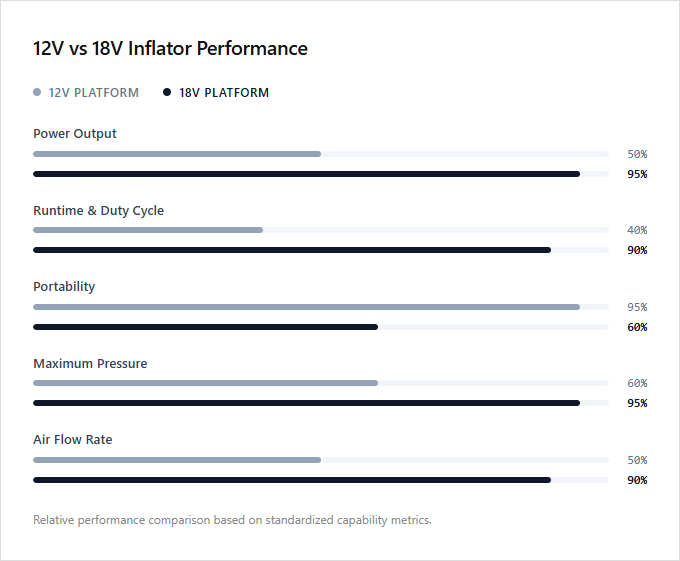
| Factor | Summary |
|---|---|
| Power Output | 18V inflators deliver higher wattage and motor torque, allowing for faster inflation of high-volume tires compared to 12V models. |
| Runtime and Duty Cycle | 18V systems utilize larger Amp-hour battery packs that provide extended duty cycles before experiencing thermal overload. |
| Portability | 12V inflators feature a compact form factor, often drawing energy directly from a vehicle's direct current auxiliary power outlet. |
| Maximum Pressure | 18V inflators typically achieve a higher maximum pounds per square inch threshold, essential for heavy-duty pneumatic tires. |
| Air Flow Rate | The 18V motor configuration yields a superior cubic feet per minute air flow rate for rapid deflation and inflation cycles. |
Maximum PSI output capability
When selecting a cordless inflator, the voltage platform directly influences the tool's maximum pressure capability. Standard 12V inflators typically deliver a maximum output of up to 120 PSI. While this threshold is sufficient for passenger vehicle tires and sports equipment, the lower voltage requires a longer duty cycle to reach peak pressures under load.
Higher voltage 18V inflators leverage increased electrical power to achieve maximum outputs ranging from 150 to 160 PSI. This robust platform delivers faster airflow and handles backpressure more efficiently, allowing the tool to inflate high-pressure commercial tires without overheating.
Compact 12V models are ideal for daily commuters seeking a portable emergency tool for standard cars, while heavy-duty 18V units are best suited for tradespeople, RV owners, and off-road enthusiasts who require rapid, high-volume inflation.
Volumetric flow rate in CFM
When selecting a cordless inflator, voltage directly dictates the volumetric flow rate, measured in Cubic Feet per Minute (CFM). A 12V inflator offers lower CFM, making it highly efficient for low-volume tasks like inflating bicycle tires. In contrast, an 18V platform delivers significantly higher CFM, providing the high airflow necessary to rapidly fill large vehicle tires.
This CFM variance determines how quickly a tool handles air volume under resistance. While 12V models prioritize compact portability and slower inflation, 18V units utilize superior motor power to maximize output and reduce downtime. The 12V tools are best suited for everyday commuters and cyclists seeking light-duty portability, whereas 18V models are ideal for trade professionals and truck owners requiring heavy-duty, rapid performance.
Duty cycle duration under high load
When comparing cordless inflators, voltage directly impacts thermal management and duty cycle duration under high-pressure loads. A 12-volt inflator typically features a smaller motor and less housing volume, which accelerates heat buildup when filling high-volume or high-psi tires. This limitation requires shorter operational windows and frequent cooling periods to prevent internal damage during demanding tasks.
Conversely, an 18-volt platform benefits from superior power reserves and larger internal cooling mechanisms, significantly extending the continuous duty cycle under strain. These tools dissipate heat more efficiently, allowing them to run uninterrupted through demanding inflation cycles without triggering thermal shutdown. Compact 12V inflators are ideal for casual motorists needing occasional roadside top-ups, while robust 18V models are best suited for tradespeople and off-road adventurers requiring heavy-duty, continuous performance.
Battery energy capacity in Watt-hours
When selecting a cordless inflator, comparing battery energy capacity in Watt-hours (Wh) is essential for matching the tool to your operational needs. While voltage indicates power potential, Watt-hours-calculated by multiplying voltage by Amp-hours-represent the total runtime capacity. For instance, a 12V battery at 2.0 Ah delivers 24 Wh of energy, whereas an 18V battery at the same amperage provides 36 Wh, enabling sustained performance under load.
Higher Watt-hour ratings in 18V systems allow the motor to maintain maximum pressure for demanding tasks without depleting the cell charge rapidly. The 12V systems offer a lighter profile with lower Wh capacity, making them highly efficient for quick pressure adjustments. Compact 12V models are ideal for everyday commuters seeking emergency roadside backup, while high-capacity 18V inflators are best suited for tradespeople and recreational adventurers requiring heavy-duty, multi-vehicle performance.
Brushless motor torque and heat dissipation
When selecting a cordless inflator, the battery platform directly dictates overall performance. An 18V brushless motor delivers superior torque compared to a 12V system, allowing the tool to rapidly compress air for high-volume applications without bogging down. While the 12V brushless motor offers lower torque, it provides ample power for standard passenger tires and sports equipment in a significantly lighter frame.
Thermal management also differs between these platforms. The 18V system draws less current to achieve the same power output, generating less internal heat and enabling longer continuous runtimes. The 12V system experiences faster heat buildup under heavy loads, requiring built-in thermal protection and cooling intervals to prevent motor degradation.
The compact 12V inflator is ideal for daily commuters seeking a portable emergency tool, while the robust 18V model best serves tradespeople and off-roaders who require rapid, consecutive inflation of heavy-duty tires.
Amperage draw and resistive thermal loss
When comparing 12V and 18V cordless inflators, the primary operational difference lies in electrical efficiency and thermal management. To achieve equivalent power output, a 12V system must draw higher amperage. Because resistive thermal loss increases with the square of the current, the 12V motor generates more internal heat, which can degrade performance during prolonged operation.
The 18V platform operates at a lower current, minimizing thermal stress and maintaining cooler operating temperatures under heavy loads. This lower heat generation ensures greater tool longevity and sustained efficiency during demanding tasks. The compact 12V unit is suited for light-duty drivers needing occasional roadside tire maintenance, whereas the robust 18V model is designed for trade professionals requiring rapid, high-volume inflation of heavy equipment tires.
Power-to-weight ratio efficiency
When selecting a portable inflator, evaluating the power-to-weight ratio efficiency is crucial for optimizing job site productivity. A 12V inflator maximizes mobility, offering an efficient power output relative to its lightweight, compact frame. In contrast, 18V models deliver significantly higher air volume and faster inflation speeds, though the larger battery increases overall tool weight and physical strain during prolonged use.
Choosing between these platforms requires balancing physical exertion against the required speed of operation. While 12V units excel in light-duty, highly mobile tasks, 18V systems provide the heavy-duty endurance needed for high-pressure demands. The compact 12V model is ideal for roadside emergencies and casual DIYers, whereas the robust 18V system is best suited for commercial contractors and automotive professionals managing heavy-volume workloads.
Leave a comment