
Industrial workshop managers and facility operators frequently battle the costly realities of equipment overheating and sudden pressure drops during continuous pneumatic operations. When systems fail mid-production, the resulting downtime directly threatens profitability. Traditionally, businesses attempt to resolve these capacity bottlenecks by utilizing standard capital expenditure allocations or equipment procurement loans to simply purchase the highest horsepower model available.
However, optimizing the drive mechanism itself grants unprecedented operational longevity and energy efficiency that oversized motors simply cannot match. As a critical stipulation, high duty cycle performance is entirely dependent on aligning the compressor's drive type with your specific load profile. For example, high-demand automotive spray booths and automated assembly lines require distinct mechanical setups to prevent premature thermal shutdown.
This article analyzes the critical engineering differences between belt-driven and direct-drive air compressors. We will examine their thermal efficiency, maintenance demands, and lifecycle costs to guide your next high-duty cycle equipment procurement.
| Factor | Summary |
|---|---|
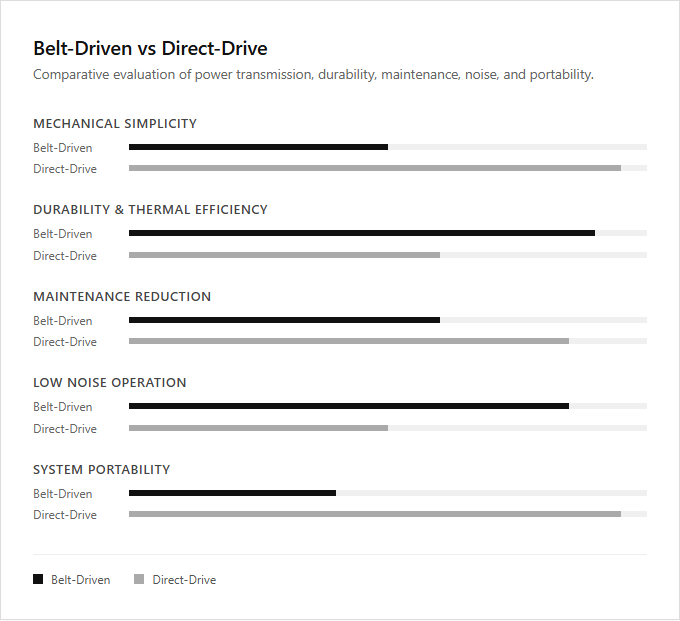
| Power Transmission | Direct-drive utilizes a coaxial coupling directly to the motor shaft, whereas belt-driven models use a pulley system to transfer torque. |
| Durability | Belt-driven units offer superior thermal efficiency and a longer duty cycle because the pump runs at a lower RPM than the motor. |
| Maintenance | Direct-drive compressors eliminate the need for drive belt tension adjustments but still require crankcase oil changes in lubricated models. |
| Noise Level | Belt-driven compressors generate a lower decibel output because the pulleys allow the pump to operate at lower rotational speeds. |
| Portability | Direct-drive systems have a much smaller physical footprint due to their integrated motor-pump design, making them ideal for mobile applications. |
Direct-drive coaxial alignment eliminating transmission power loss
Selecting the right air compressor configuration significantly impacts operational efficiency. Direct-drive air compressors utilize a coaxial alignment where the motor shaft connects directly to the pump. This design eliminates the transmission power loss typically caused by belt slippage and friction in belt-driven systems. By transferring energy without intermediary components, direct-drive models achieve superior mechanical efficiency and require less routine maintenance, though they generally operate at higher speeds.
Conversely, belt-driven compressors employ a pulley system that allows the pump to run at lower, quieter speeds, albeit with minor energy losses through the belt. Direct-drive units are best suited for mobile contractors and DIY enthusiasts seeking compact, low-maintenance efficiency, whereas belt-driven systems are ideal for stationary industrial workshops requiring quiet, continuous-duty performance.
Belt-driven radial load and overhung load on airend bearings
Direct-drive air compressors couple the motor directly to the airend, eliminating lateral forces on the drive shaft. In contrast, belt-driven configurations introduce significant radial and overhung loads on the airend bearings due to the constant tension of the belt. This continuous lateral pull requires highly robust bearing designs to prevent premature wear, shaft misalignment, and potential mechanical failure during high-demand operation.
While direct-drive systems offer superior mechanical efficiency and reduced maintenance, belt-driven models provide valuable shock absorption and flexible speed configurations at the cost of regular bearing inspection. Industrial facilities requiring continuous, high-efficiency air production are ideal candidates for direct-drive units, whereas smaller workshops prioritizing easy serviceability and operational flexibility should select belt-driven compressors.
Maintenance requirements for belt tensioning and pulley sheaves
Direct-drive air compressors feature a motor coupled directly to the pump shaft. This design eliminates belts and pulleys entirely, resulting in virtually zero maintenance regarding tensioning or alignment. Operators of these units avoid the routine inspections required to prevent slippage and premature mechanical wear associated with belt-driven systems.
Conversely, belt-driven compressors require consistent upkeep to ensure mechanical efficiency. Users must periodically adjust the belt tension to prevent power loss and inspect the pulley sheaves for wear or misalignment. Proper alignment of the sheaves is critical to prevent belt degradation and ensure smooth, long-term operation.
Direct-drive models are ideal for DIY hobbyists seeking low-maintenance portability, whereas belt-driven systems suit industrial professionals who require customizable speeds and have the capacity for routine mechanical servicing.
Specific energy consumption efficiency during 100% continuous duty cycles
In continuous 100% duty cycle operations, direct-drive air compressors deliver superior mechanical efficiency. By coupling the motor directly to the pump shaft, these systems eliminate transmission losses, resulting in lower specific energy consumption during sustained operation. This direct transfer of power ensures maximum output per kilowatt consumed, though the configuration runs at higher speeds and generates more concentrated heat.
Belt-driven compressors introduce minor energy losses through belt friction and slippage, slightly increasing initial specific energy consumption. During prolonged continuous use, their ability to run the pump at lower rotational speeds significantly reduces heat buildup, preserving volumetric efficiency and component longevity over time.
Direct-drive units are best suited for mobile contractors requiring compact, high-efficiency power on demand, while belt-driven systems are ideal for industrial workshop operators requiring a quiet, durable, and continuous supply of compressed air.
Frictional heat generation and thermal dissipation in belt drives
When selecting an air compressor, understanding thermodynamic differences is crucial. Direct-drive systems connect the motor directly to the pump, transferring operational heat straight to the compression chamber. In contrast, belt-driven configurations isolate these components. While friction between the belt and pulleys generates some localized heat, the open-air design allows for superior thermal dissipation. The rotating belt and flywheel act as a natural cooling fan, drawing heat away from the pump to ensure lower operating temperatures and prolonged component life.
Direct-drive units lack this dissipation mechanism, resulting in higher running temperatures despite their compact efficiency. Direct-drive compressors are ideal for DIY enthusiasts needing portable, low-maintenance tools for intermittent projects, while belt-driven systems are suited for industrial operators requiring continuous, high-volume duty cycles.
Rotational speed adjustments via drive ratio configurations
In air compressor design, the transmission method dictates operational efficiency and speed. Direct-drive configurations couple the motor directly to the pump shaft, forcing both components to rotate at the same speed, typically a high fixed rate of around 3,450 RPM. In contrast, belt-driven systems offer versatile rotational speed adjustments through customizable drive ratio configurations. By altering the diameters of the motor and pump pulleys, operators can reduce the pump's RPM relative to the motor, lowering operating temperatures and mechanical wear without sacrificing torque.
Modifying these pulley ratios allows for precise tuning of air delivery and noise levels, making belt-driven units highly adaptable to specific workshop demands. Direct-drive models are ideal for DIY hobbyists requiring compact, low-maintenance, and intermittent portable power, whereas belt-driven systems suit industrial professionals who demand customizable, continuous-duty performance in demanding environments.
Elastomeric coupling vibration isolation and drivetrain MTBF
Direct-drive air compressors connect the motor shaft directly to the pump. To mitigate the rigid transfer of harmonic energy, high-performance direct-drive systems utilize elastomeric couplings. These flexible inserts isolate high-frequency vibration, protecting the crankshaft and significantly extending the drivetrain's Mean Time Between Failures (MTBF) by reducing structural metal fatigue.
Conversely, belt-driven compressors inherently isolate vibration through the drive belts, which act as natural dampers. While belt systems require more frequent tension adjustments, they achieve a high drivetrain MTBF in heavy-duty applications by allowing the pump to run at lower, cooler rotational speeds. Direct-drive models with elastomeric couplings suit mobile service technicians requiring compact, low-maintenance equipment, whereas belt-driven configurations are ideal for stationary workshop operators demanding continuous, high-volume industrial air supply.
Leave a comment