
Managing escalating energy costs remains a persistent challenge for plant managers, especially since compressed air systems often account for a significant portion of an industrial facility's total electricity consumption. While operations teams frequently rely on traditional capital expenditure budgets or standard utility rebate programs to mitigate these rising overheads, a more fundamental, long-term solution lies in optimizing the compressor's drive technology itself.
Selecting the appropriate configuration grants facilities immediate, compounding operational savings. For instance, transitioning from a traditional fixed-speed system to a Variable Speed Drive (VSD) rotary screw compressor can reduce energy consumption by up to 35%. However, this efficiency gain carries a vital stipulation: these benefits are highly dependent on fluctuating demand profiles, as steady-state, continuous operations may not yield the same return on investment.
This article will contrast Fixed Speed and VSD technologies, evaluate their performance under varying load conditions, and outline the key selection criteria to help you maximize your facility's energy efficiency.
| Factor | Summary |
|---|---|
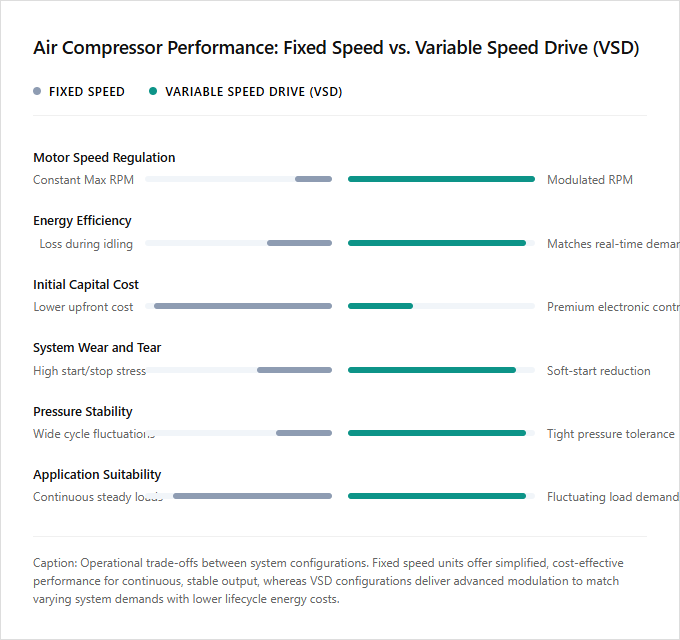
| Motor Speed Regulation | Fixed speed compressors operate at a constant maximum RPM, whereas Variable Speed Drive (VSD) systems utilize an integrated variable frequency inverter to modulate motor speed according to real-time air demand. |
| Energy Efficiency | VSD compressors minimize power consumption by matching output to demand, eliminating the wasteful idling periods and high transient inrush current typical of fixed speed units. |
| Initial Capital Cost | Fixed speed compressors feature a lower upfront acquisition cost, whereas VSD models require a greater initial capital expenditure due to the complexity of their electronic control systems. |
| System Wear and Tear | VSD technology utilizes soft-start capabilities to reduce mechanical stress and thermal loading, unlike fixed speed models which suffer increased component degradation from frequent on-off cycles. |
| Pressure Stability | VSD compressors maintain a tight tolerance of system pressure, preventing the wider pressure fluctuations inherent in the load/unload cycles of fixed speed machines. |
| Application Suitability | Fixed speed units are ideal for continuous, full-load manufacturing processes, while VSD compressors excel in facilities with highly fluctuating air demand profiles. |
Unloaded power consumption losses during fixed speed idle cycles
Fixed speed air compressors operate at a constant velocity. When system demand decreases, these units enter an unloaded state where the motor continues to run at full speed without producing compressed air. This idle cycle still consumes up to 30% of the machine's full-load power, resulting in substantial energy waste during periods of low air activity.
Variable Speed Drive (VSD) technology addresses this inefficiency by adjusting the motor speed to match real-time demand. By slowing down or stopping the motor rather than running it in an idle state, VSD systems eliminate unloaded power losses and optimize energy consumption.
Fixed speed compressors are highly suitable for operators with continuous, steady-state manufacturing demands, while VSD models are best for facilities with fluctuating production schedules and varying daily air requirements.
Dynamic Motor Speed Control via Variable Frequency Inverters
Fixed-speed air compressors operate at a constant maximum speed, delivering a continuous volume of compressed air regardless of actual system demand. Variable Speed Drive (VSD) compressors utilize an integrated variable frequency inverter to continuously adjust the motor's rotational speed. This technology precisely aligns the compressor's output with real-time fluctuations in dynamic system demand, significantly reducing energy consumption during lower-use periods.
By modulating the motor frequency, VSD systems eliminate the wasteful energy spikes associated with frequent start-stop cycles and unloading phases. Maintaining a stable system pressure minimizes mechanical wear and optimizes efficiency across varying workloads. Fixed-speed units are ideal for operations with continuous, constant-demand manufacturing processes, whereas VSD models are best suited for facilities with highly fluctuating production schedules and varying air flow requirements.
Specific energy requirement optimization under part-load conditions
Fixed-speed compressors operate at a constant motor speed, regulating air output through traditional load/unload cycles. Under part-load conditions, this mechanism leads to substantial energy losses during unloaded idling periods. Conversely, Variable Speed Drive (VSD) technology dynamically adjusts the motor speed to match fluctuating air demand in real time. This precise regulation optimizes the specific energy requirement, preventing the waste associated with over-pressurization and frequent blow-down cycles during periods of low demand.
By aligning power consumption directly with actual air usage, VSD compressors significantly lower operational costs in fluctuating environments. Fixed-speed models are best suited for operators with continuous, steady-state production demands, while VSD models are ideal for facilities experiencing variable shift patterns and fluctuating air loads.
Elimination of inrush current spikes through soft-starting mechanisms
Fixed-speed air compressors operate at a constant maximum velocity, drawing a significant inrush current-often up to several times the nominal running current-during startup. This sudden surge can strain local electrical infrastructure and cause localized voltage drops. Conversely, Variable Speed Drive (VSD) compressors employ advanced frequency inverters to manage motor acceleration smoothly from a complete stop.
By utilizing these integrated soft-starting mechanisms, VSD systems gradually ramp up the motor to the required operating speed, completely eliminating harmful inrush current spikes. This controlled power draw protects sensitive facility electronics, reduces mechanical stress on the compressor drive train, and lowers peak demand utility charges. Fixed-speed units are ideal for operators with continuous, unchanging air demands, while VSD models are best suited for facilities with fluctuating workloads seeking to minimize energy consumption.
Reduction of pressure band tolerance to prevent over-pressurization
Fixed-speed air compressors operate within a wide, predetermined pressure band, often over-pressurizing the system to create a buffer before unloading. This operational cycle wastes energy and subjects downstream equipment to unnecessary stress. In contrast, Variable Speed Drive (VSD) compressors continuously adjust motor speed to match real-time air demand. This precise regulation reduces the pressure band tolerance to a narrow margin, preventing over-pressurization and maintaining a highly stable system pressure.
By eliminating the excess pressure cycles common in fixed-speed units, VSD technology optimizes energy consumption and minimizes component wear. Fixed-speed models are suited for facilities with constant, uninterrupted air demands, while VSD systems are ideal for operators managing highly variable workflows who require precise pressure control and maximum energy efficiency.
Minimum turndown ratio limitations on volumetric efficiency at low demand
When comparing fixed speed and variable speed drive (VSD) air compressors, efficiency during low demand is a key differentiator. Fixed speed units run at a constant RPM, relying on load/unload cycles that waste energy when air demand drops. Conversely, VSD compressors modulate motor speed to match real-time demand, though they face performance constraints at their lowest operating limits.
Below the minimum turndown ratio-typically 20% to 30% of maximum capacity-a VSD compressor experiences a sharp decline in volumetric efficiency. At these ultra-low speeds, internal blow-by losses increase and the compressor must resort to cycling, neutralizing its energy-saving benefits. Fixed speed models suit operators with constant, predictable production schedules, while VSD systems are best for users with highly fluctuating daily workloads who can maintain demand above the minimum turndown threshold.
Sump blowdown energy losses associated with load-unload regulation
Fixed-speed air compressors utilize load-unload regulation to manage fluctuating system demand. When air demand decreases, the compressor unloads, and the pressurized air within the internal oil sump is vented to the atmosphere to lower idle power consumption. This sump blowdown represents a significant energy loss, as the work required to compress that vented air is entirely wasted during every cycle transition.
Variable Speed Drive (VSD) compressors mitigate this inefficiency by continuously adjusting motor speed to match real-time demand. This precise control eliminates frequent load-unload cycles and prevents the associated sump blowdown energy losses. Fixed-speed systems remain practical for operations with constant, continuous air demand, whereas VSD models are ideal for facilities experiencing variable shift patterns and fluctuating production schedules.
Leave a comment