
Selecting an industrial air compressor often leads to operational frustration when systems unexpectedly overheat or experience pressure drops during peak production. When addressing these performance bottlenecks, decision-makers typically rely on standard capital equipment budgets and baseline horsepower metrics to guide their procurement.
However, optimizing your machine choice based on actual demand cycles grants your facility significant long-term energy savings and uninterrupted operational uptime. We must stipulate, however, that a compressor's duty cycle-whether designed for intermittent use or 100% continuous run-time-ultimately dictates its operational lifespan and efficiency, far more than initial power ratings. For example, busy automotive collision centers and precision manufacturing plants rely on this precise calculation to avoid catastrophic workflow disruptions.
This article will analyze the critical design differences between reciprocating and rotary screw technologies, examine how duty cycles impact performance, and provide a consultative framework for selecting the ideal compressor for your specific facility needs.
| Factor | Summary |
|---|---|
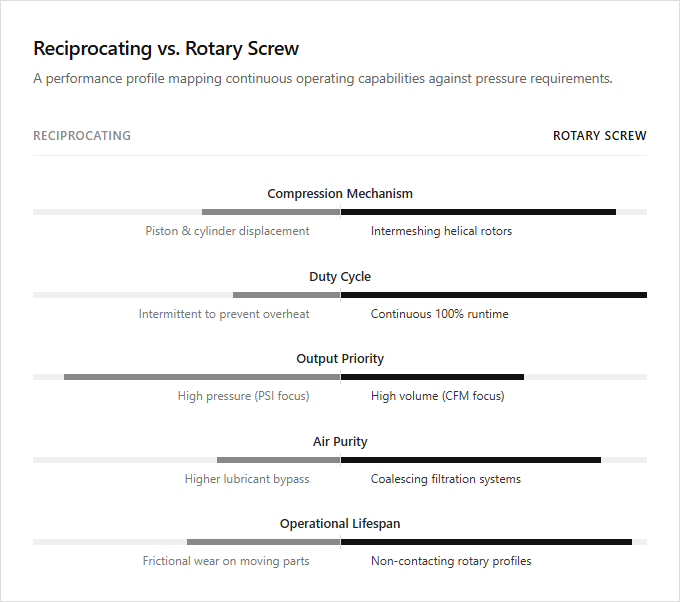
| Compression Mechanism | Reciprocating compressors use a crankshaft-driven piston to compress air within a cylinder, whereas rotary screw compressors utilize two intermeshing helical rotors to displace air continuously. |
| Duty Cycle | Rotary screw compressors are rated for a continuous duty cycle of 100%, while reciprocating compressors operate on an intermittent duty cycle to prevent thermal overload. |
| Output Volume and Pressure | Rotary screw units deliver high volumetric flow rates measured in Cubic Feet per Minute (CFM), whereas reciprocating units are better suited for high-pressure applications measured in Pounds per Square Inch (PSI). |
| Lubrication and Air Quality | Rotary screw compressors utilize coalescing filters and oil separators to minimize lubricant carryover, while reciprocating models tend to release more oil vapor past the piston rings. |
| Lifespan and Wear | Rotary screw compressors experience less frictional wear because of non-contacting rotary screw profiles, yielding a longer operational lifespan than the reciprocating piston assembly. |
Reciprocating Compressors Require 50% Intermittent Duty Cycle
When selecting industrial air compressors, understanding the mechanical distinctions between reciprocating and rotary screw technologies is essential for operational efficiency. Reciprocating compressors are engineered for an intermittent duty cycle, typically limited to fifty percent to prevent thermal overload. These units require periodic rest periods to dissipate heat safely, making them highly efficient for fluctuating workloads rather than constant demand.
Rotary screw compressors utilize a continuous-flow mechanism that allows them to operate at a one hundred percent duty cycle. These systems run constantly without overheating, providing a reliable, steady stream of pressurized air for demanding environments. Reciprocating models are ideal for small workshop owners and automotive hobbyists with sporadic tool usage, while rotary screw systems are best suited for industrial facility managers requiring uninterrupted, heavy-duty power.
How Rotary Screw Compressors Achieve 100% Duty Cycle
Industrial and commercial operations often require a strategic choice between reciprocating and rotary screw air compressors. While reciprocating models rely on pistons to compress air in intermittent cycles, rotary screw compressors utilize intermeshing helical rotors to sweep air continuously through the casing. This advanced mechanism allows rotary screw systems to operate at a one hundred percent duty cycle without overheating, delivering a reliable, pulsation-free airflow for demanding applications.
Reciprocating compressors must cycle off periodically to cool down, making them less efficient for constant, high-demand operations. Reciprocating models serve DIY enthusiasts and small workshops needing intermittent power, whereas rotary screw systems are ideal for manufacturing professionals requiring continuous, heavy-duty utility.
Synthetic Oil Cooling and Lubrication for Rotary Screws
Selecting the ideal industrial air compressor requires understanding the distinct mechanical advantages of reciprocating and rotary screw technologies. Rotary screw units are engineered specifically for continuous, high-demand duty cycles. These systems utilize synthetic oil injection within the compression chamber to facilitate critical thermal dissipation and maintain precise seal lubrication during constant operation, ensuring long-term reliability and consistent pressure.
In contrast, reciprocating compressors rely on piston-driven displacement, making them highly efficient for intermittent workloads that allow the pump to cool down between cycles. Continuous-production manufacturing plants require the relentless output of rotary screw compressors, whereas small automotive repair shops or DIY enthusiasts are best suited for the intermittent performance of reciprocating models.
Reciprocating Models Lose Efficiency Under High Demand
When comparing industrial air compressors, the mechanical differences between reciprocating and rotary screw designs dictate their performance under load. Reciprocating models operate via pistons, which inherently exhibit lower volumetric efficiency. Under sustained high-demand loads, this design suffers from heat buildup and internal clearance losses, leading to a noticeable drop in free air delivery.
Rotary screw compressors utilize continuous helical screws to deliver a constant, pulsation-free airflow. This design maintains high volumetric efficiency and stable free air delivery during continuous operation without requiring cool-down cycles. Reciprocating compressors are best suited for DIY enthusiasts and small workshops with intermittent air needs, while rotary screw models are ideal for industrial facility managers requiring continuous, heavy-duty pneumatic power.
Minimizing Oil Carryover in Rotary Screw Systems
Selecting the appropriate air compressor depends on the operational demand and air quality requirements of your facility. Reciprocating compressors utilize pistons to compress air intermittently, making them ideal for fluctuating workloads. Rotary screw compressors, by comparison, are engineered for continuous duty. To maintain air purity during constant generation, rotary screw systems employ an internal coalescing separator. This component minimizes oil carryover, ensuring a clean, steady stream of compressed air for sensitive applications.
The mechanical differences between these systems dictate their optimal environments. Reciprocating models are best suited for automotive technicians requiring intermittent tool usage, whereas rotary screw units are ideal for industrial operators needing uninterrupted, high-volume airflow.
Exceeding Duty Cycles Accelerates Reciprocating Compressor Wear
When selecting an air compressor, understanding duty cycle limitations is critical for equipment longevity. Reciprocating compressors, while cost-effective for intermittent use, rely on a stop-and-start cycle to dissipate heat. Exceeding these duty cycle limits leads to elevated operating temperatures, causing accelerated wear on vital internal components like reed valves and piston rings. Overheating degrades lubrication, resulting in premature mechanical failure and lost efficiency.
In contrast, rotary screw compressors utilize a continuous-duty design, employing interlocking helical screws that run indefinitely without thermal degradation. This system provides a reliable, constant air supply for demanding applications. Reciprocating models are ideal for DIY hobbyists and small workshops with intermittent air needs, whereas rotary screw compressors best serve industrial manufacturers requiring a constant, high-volume air supply.
Flow Comparison: Rotary Screw vs. Reciprocating Compressors
Industrial operations requiring a reliable compressed air supply must evaluate the distinct operational mechanisms of reciprocating and rotary screw compressors. Rotary screw units utilize twin meshing rotors to deliver a consistent, pulse-free laminar flow. This continuous generation eliminates downstream pressure fluctuations, allowing the system to operate efficiently with minimal storage requirements.
Reciprocating compressors rely on piston motion that creates a pulsating displacement. This intermittent delivery produces inherent pressure surges, which necessitates a larger receiver tank to dampen the pulses and stabilize the airflow. While manufacturing plants requiring non-stop, high-volume air are best served by rotary screw technology, independent mechanics and small workshop owners with intermittent duty cycles are ideal candidates for reciprocating models.
Leave a comment